
In a big announcement, the Reserve Bank of India (RBI) has confirmed that India’s external economic position is showing signs of improvement. The country has posted a current account surplus, a development that offers a positive signal for the nation’s foreign exchange position. Let’s break down what this means and what’s driving it.
What Is a Current Account Surplus?
The current account tracks a country’s international transactions, including trade in goods and services, remittances, and investment income. When money flowing into a country from abroad exceeds money flowing out, it results in a current account surplus. The opposite situation is known as a current account deficit.
What Do the Latest RBI Numbers Show?
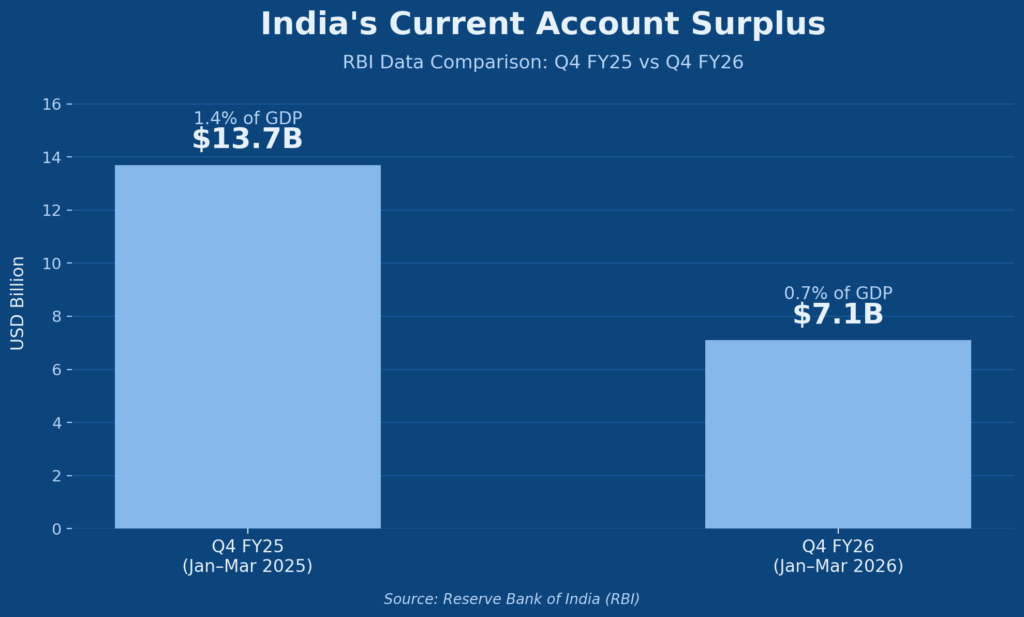
According to RBI data, India recorded a current account surplus of $7.1 billion, or 0.7% of GDP, in Q4 FY26 (January–March 2026). This is a narrowing compared to the same quarter last year, when the surplus stood at $13.7 billion, or 1.4% of GDP.
More recent monthly data shows further improvement India posted a current account surplus of $4.7 billion in April 2026, marking a sharp reversal from the $4.8 billion deficit recorded in April 2025 here is the data .
Key Drivers Behind the Surplus
Strong Growth in Services Exports
India’s IT, computer services, and business services sectors performed exceptionally well. Net services receipts rose to $60.4 billion in Q4 FY26, up from $53.3 billion a year earlier.
2. Surge in Remittances
Money sent home by Indians working abroad also saw significant growth. Net transfers reached $16.0 billion in April 2026, up sharply from $9.4 billion in the same month last year.
3. Robust Foreign Exchange Reserves
India’s forex reserves stand at approximately $682 billion, providing around 11 months of import cover — a strong cushion against external shocks.
The Other Side of the Story: The Full-Year Picture
While the quarterly numbers look encouraging, the picture for the full fiscal year 2025-26 is more mixed. The full-year current account deficit actually widened to $25.2 billion, compared to $22.9 billion the previous year. This was largely driven by a growing merchandise trade deficit, which outweighed the gains from services exports and remittances.
Additionally, foreign portfolio investors (FPIs) pulled out significant capital during the year, putting pressure on the overall Balance of Payments. In April 2026 alone, FPI outflows reached $8.7 billion, contributing to an overall Balance of Payments deficit of $6.6 billion for the month.
What Does This Mean for the Common Citizen?

- A More Stable Rupee: A current account surplus can support rupee stability, potentially making imported goods like fuel and electronics more affordable.
- Inflation Control: Healthier forex reserves help the RBI manage inflation more effectively.
- Investor Confidence: A stronger external account boosts foreign investor confidence in India, though recent FPI outflows remain a point of concern.
What lies ahead
Economists will be watching the next few quarters closely to see whether this surplus holds up. Global crude oil prices, the pace of FPI inflows, and India’s ability to keep expanding services exports will all play a role. If remittances and IT exports continue growing at the current pace, India could see more stable quarters ahead, even as the merchandise trade deficit remains a persistent challenge for policymakers to manage.
Conclusion
India’s current account surplus is a genuinely positive development, driven largely by strength in services exports and remittances. However, the widening trade deficit and persistent FPI outflows serve as a reminder that the economy still needs careful navigation ahead. Upcoming RBI data releases will reveal whether this improvement is a sustained trend or a temporary blip.
Learn more about our site on archive2in.com
Contact us on contactarchive2in.com
Leave a Reply
You must be logged in to post a comment.