
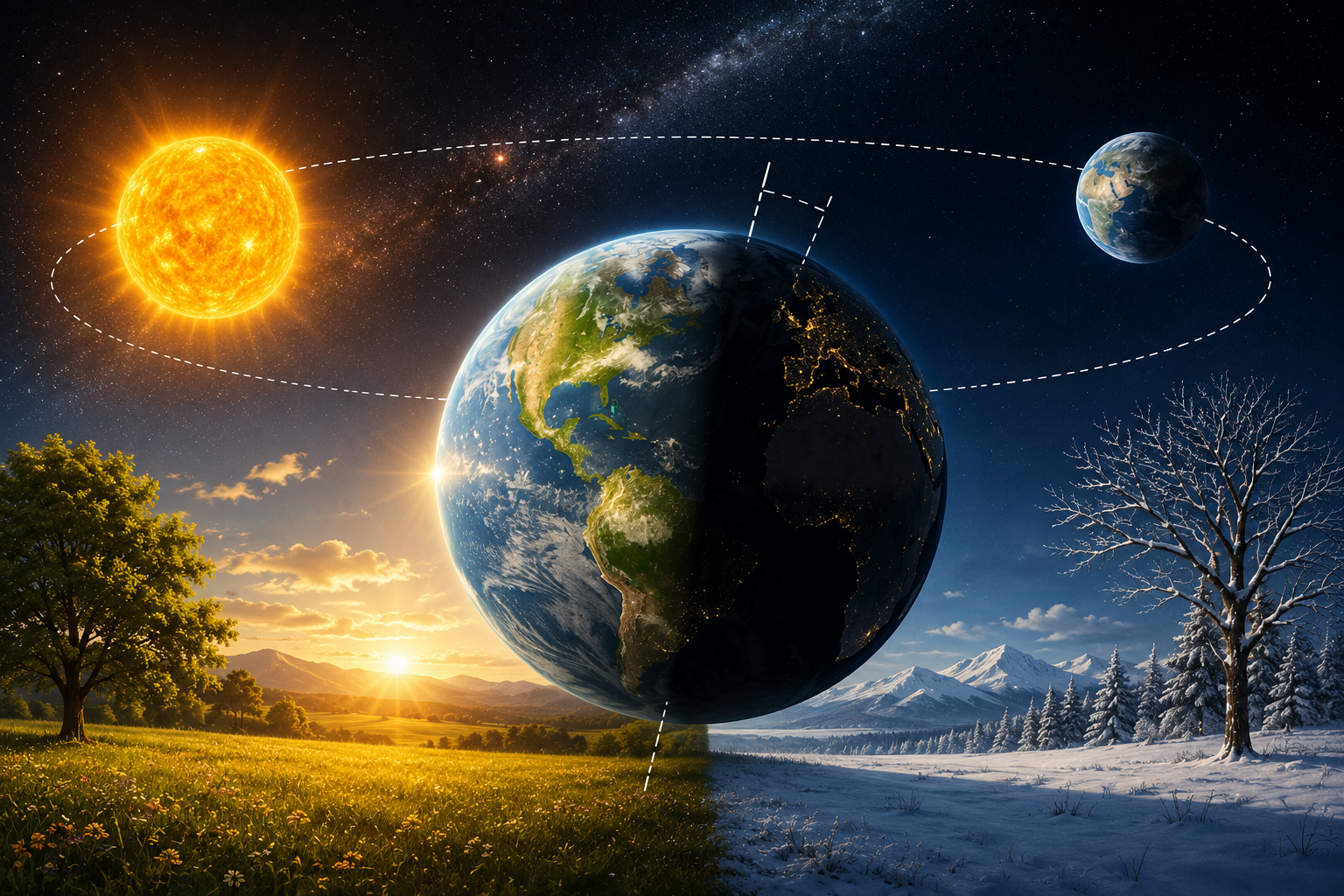
Many people assume that the closer Earth is to the Sun, the hotter the weather becomes. Surprisingly, the opposite is true during the Northern Hemisphere’s summer. Every year in early July, Earth reaches aphelion—the point in its orbit where it is farthest from the Sun. Yet, countries across North America, Europe, and parts of Asia often experience some of the hottest days of the year.
So, if Earth is farther away from the Sun, why is it still so hot? The answer lies not in the distance between Earth and the Sun but in the way our planet is tilted. Understanding this fascinating scientific phenomenon helps explain the changing seasons and the increasing impact of extreme weather.
What Is Aphelion?
Earth follows an elliptical orbit around the Sun rather than a perfect circle. This means the distance between Earth and the Sun changes slightly throughout the year.
Aphelion occurs once every year, usually in early July, when Earth reaches its greatest distance from the Sun—about 152 million kilometers (94.5 million miles) away. Six months later, in early January, Earth reaches perihelion, its closest point to the Sun.
Although this difference in distance may sound enormous, it has only a small effect on Earth’s overall temperature.
The Real Reason Summer Is Hot
Earth is tilted by about 23.5 degrees. During the Northern Hemisphere’s summer, this tilt causes sunlight to strike the surface more directly and for longer hours each day. Longer daylight and stronger sunlight allow the land and oceans to absorb more energy, leading to warmer temperatures.
The Southern Hemisphere experiences winter because it is tilted away from the Sun and receives less direct sunlight.
In simple terms, the angle of sunlight matters far more than the distance from the Sun.
Positive Side of Earth’s Seasonal Tilt
Earth’s tilt is one of the reasons life can thrive across the planet.
The changing seasons support agriculture, replenish ecosystems, and maintain biodiversity. Summer provides longer days for crop growth, increased solar energy production, and more opportunities for outdoor activities and tourism.
Many regions depend on seasonal weather cycles for food production, water resources, and economic activity.
The predictable nature of planets orbit also allows scientists to accurately forecast seasonal changes years in advance.
The Negative Side: Rising Heat and Climate Concerns
While Earth’s tilt explains why summers are naturally warm, climate scientists warn that global warming is making many summers significantly hotter than in the past.
Higher greenhouse gas concentrations are increasing average global temperatures, causing more frequent and intense heatwaves.
Extreme heat can lead to dehydration, heatstroke, droughts, wildfires, and increased pressure on electricity grids as air-conditioning demand rises.
Agriculture may also suffer when prolonged heat damages crops or reduces water availability, affecting food supplies and prices.
Scientists emphasize that although aphelion itself does not cause extreme heat, climate change can amplify seasonal temperatures and weather events.
Common Myth: Distance Controls the Seasons
One of the most widespread misconceptions is that summer occurs because Earth is closer to the Sun.
If this were true, both hemispheres would experience summer at the same time. Instead, when the Northern Hemisphere enjoys summer, countries such as Australia, New Zealand, and South Africa experience winter.
This opposite pattern clearly shows that Earth’s tilt—not its distance from the Sun—is responsible for seasonal changes.
Why This Matters
Understanding Earth’s orbit helps people better interpret weather reports and climate discussions.
It also highlights the difference between weather, seasons, and climate change. While Earth’s orbit and tilt determine the seasons, human-driven climate change influences how intense those seasons become.
As global temperatures continue to rise, scientists are working to improve climate models, weather forecasting, and disaster preparedness to help communities adapt to increasingly extreme conditions.
Conclusion
The fact that Earth is farthest from the Sun during the Northern Hemisphere’s summer may seem surprising, but it perfectly demonstrates how fascinating our planet truly is.
The warmth of summer is driven primarily by 23.5-degree axial tilt, which allows sunlight to reach the Northern Hemisphere more directly and for longer periods each day. The small change in Earth’s distance from the Sun has only a minor influence on seasonal temperatures.
At the same time, today’s record-breaking heat reminds us that climate change is adding another layer of complexity to Earth’s natural climate system. While the changing seasons remain a predictable part of our planet’s orbit, rising global temperatures are increasing the likelihood of more intense heatwaves and weather extremes.
Understanding these scientific principles not only clears up a common misconception but also helps us appreciate the delicate balance that makes life possible.
Disclaimer: This article is intended for educational and informational purposes only. Scientific understanding continues to evolve as new research becomes available, and readers are encouraged to refer to reputable scientific organizations for the latest climate and astronomy updates.
Learn about our site on contactarchive2in.com
Contact via email id contactarchive2in@gmail.com
Leave a Reply
You must be logged in to post a comment.