
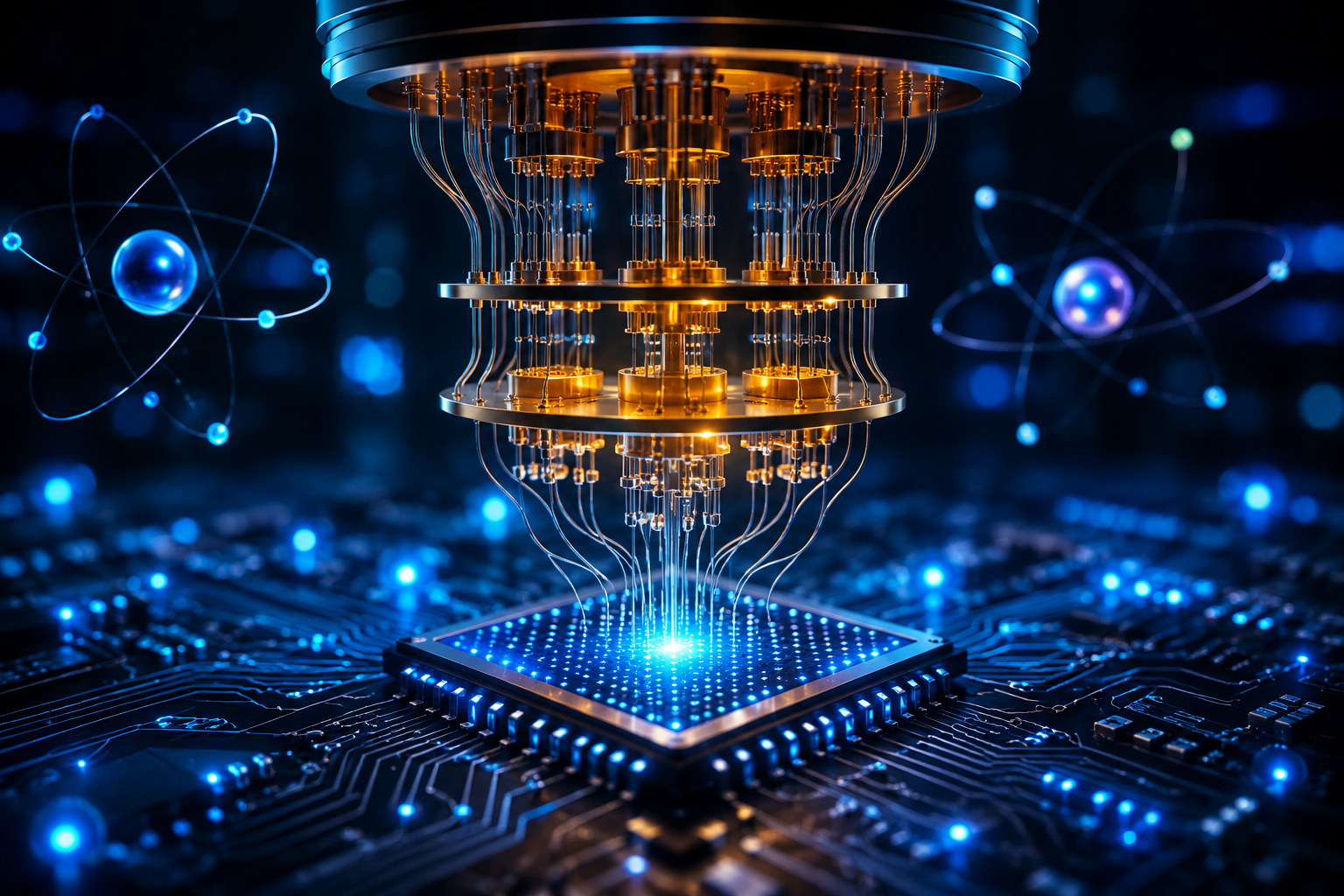
Quantum computing is one of the most exciting technological advancements of the 21st century. While traditional computers have transformed the way we work, communicate, and solve problems, computers promise to tackle challenges that are currently beyond the reach of even the world’s most powerful supercomputers.
Although the concept may sound complex, understanding the basics of computing is easier than you might think. In this beginner-friendly guide, we’ll explore what quantum computing is, how it works, its potential applications, and why experts believe it could revolutionize industries in the coming decades.
What Is Quantum Computing?
Quantum computing is a type of computing that uses the principles of quantum mechanics, the branch of physics that explains how particles behave at extremely small scales, such as atoms and electrons.
Unlike classical computers, which process information using bits that can be either 0 or 1, quantum computers use quantum bits, or qubits. Qubits can exist in multiple states at the same time under certain conditions, allowing computers to explore many possible solutions simultaneously for specific types of problems.
This doesn’t mean quantum computers are simply “faster” versions of today’s laptops. Instead, they are designed for solving particular classes of computational problems more efficiently than classical machines.
Classical Computers vs. Quantum Computers
Understanding the difference between classical and computers is key.
Classical computers:
- Use bits (0 or 1).
- Perform calculations step by step.
- Excel at everyday tasks like web browsing, gaming, and word processing.
Quantum computers:
- Use qubits.
- Leverage phenomena such as superposition and entanglement.
- May offer significant advantages for certain problems in cryptography, chemistry, optimization, and materials science.
For most day-to-day tasks, classical computers remain the best choice.
Key Concepts in Quantum Computing
1. Qubits
A qubit is the basic unit of information. Unlike a classical bit, a qubit can represent combinations of 0 and 1 until it is measured.
2. Superposition
Superposition allows a qubit to exist in multiple possible states before measurement. This property enables algorithms to consider many possibilities during computation.
3. Entanglement
Entanglement is a phenomenon in which two or more qubits become strongly correlated. Changes to one entangled qubit are mathematically linked to the others, even when separated by distance. This property can be used in certain computations.
4. Quantum Interference
Quantum algorithms use interference to increase the probability of correct answers while reducing the likelihood of incorrect ones.
What Can Quantum Computers Be Used For?
Although still in the early stages of development, this computing has promising applications across many industries.
Drug Discovery
Researchers hope computers will help simulate molecular interactions more accurately, potentially speeding up the development of medicines.
Financial Modeling
Banks and financial institutions are exploring these methods for portfolio optimization, fraud detection, and risk analysis.
Artificial Intelligence
This computing may complement AI by improving certain optimization and machine learning tasks, though this is still an active area of research.
Cybersecurity
Quantum computing could eventually challenge some current encryption methods, while also enabling new forms of resistant cryptography.
Logistics and Supply Chains
Optimization problems, such as delivery routes and resource allocation, are potential areas where quantum approaches may provide benefits.
Current Challenges
Despite the excitement, computing faces significant hurdles.
- Qubits are highly sensitive to environmental disturbances.
- These systems require specialized conditions, often operating at extremely low temperatures.
- Building reliable, large-scale computers remains technically difficult.
- Error correction is a major research challenge.
As a result, today’s quantum computers are limited in size and capability.
Who Is Developing Quantum Computers?
Many organizations are investing heavily in research, including:
- IBM
- Microsoft
- Amazon
- Intel
- Rigetti Computing
- IonQ
Governments and universities around the world are also funding research to advance technologies.
Will Quantum Computers Replace Regular Computers?
Probably not.
Quantum computers are expected to complement, not replace, classical computers. Traditional computers will continue to handle everyday activities such as email, office work, streaming, and gaming.
These computers are more likely to be used for specialized scientific, engineering, and industrial applications where their unique capabilities provide an advantage.
The Future of Quantum Computing
Experts believe this computing could transform industries over the coming decades, but widespread practical use will require continued scientific and engineering breakthroughs.
Researchers are working to build more stable qubits, improve error correction, and develop algorithms that solve meaningful real-world problems. As these technologies mature, computing may play an increasingly important role in healthcare, energy, finance, climate science, and advanced manufacturing.
Conclusion
Quantum computing represents a new approach to solving complex computational problems. While it is still an emerging technology, its potential to accelerate scientific discovery and optimize challenging tasks has attracted worldwide attention.
For beginners, the key takeaway is that computers are not designed to replace your laptop or smartphone. Instead, they are specialized tools that may one day help solve problems that are currently too difficult for classical computers.
As research continues, computing is likely to become one of the defining technologies of the future—making now a great time to start learning about it.
Disclaimer
This article is intended for informational and educational purposes only. These computing is a rapidly evolving field, and scientific understanding, technological capabilities, and commercial applications continue to develop. Some future use cases discussed are based on ongoing research and should not be interpreted as guaranteed outcomes. Always refer to reputable scientific publications and official research organizations for the latest developments.
Learn more about our site on contactarchive2in.com
Contact us on our email id contactarchive2in@gmail.com
Leave a Reply
You must be logged in to post a comment.