
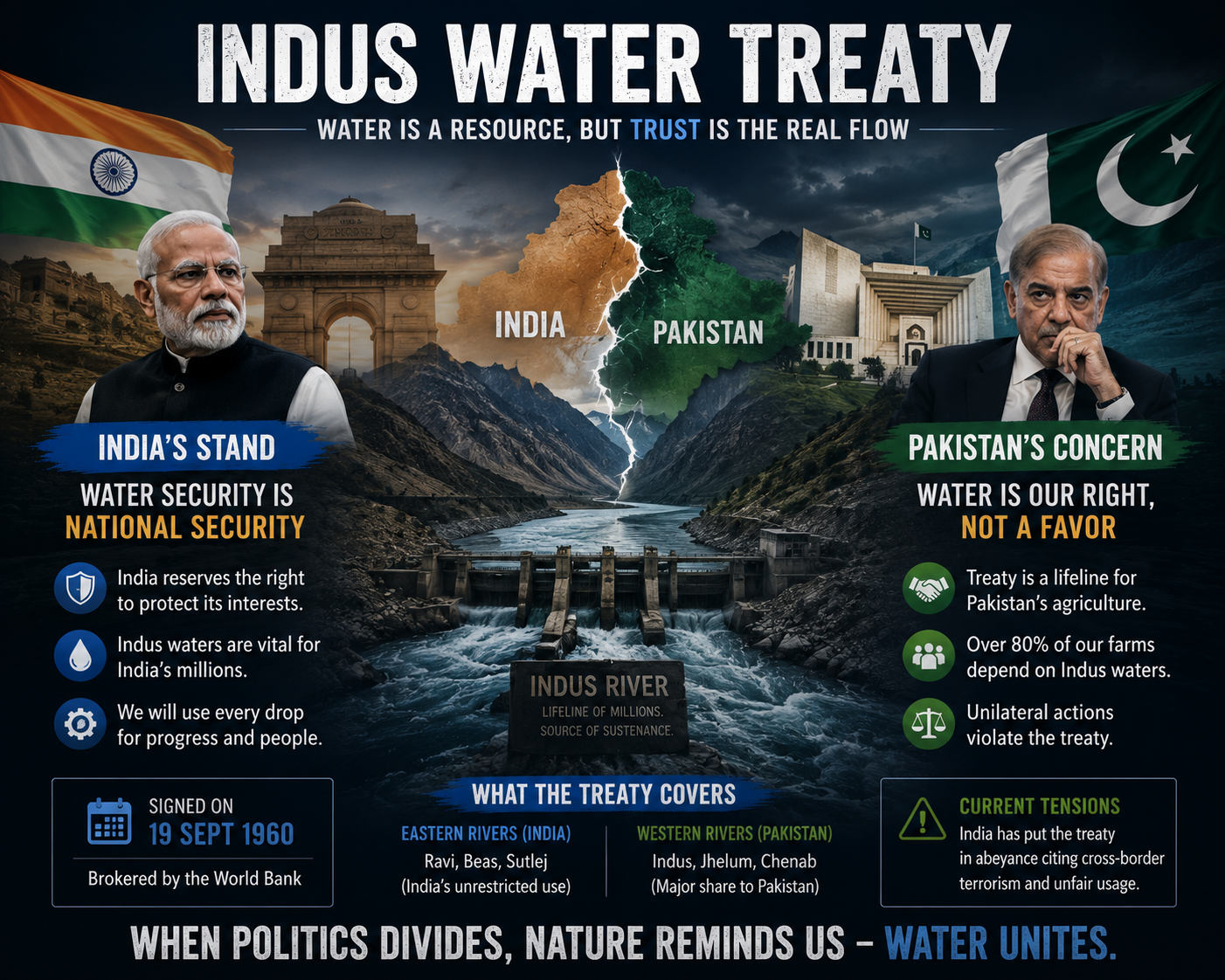
India has once again drawn a hard line on the Indus Waters Treaty (IWT) the six decade old water sharing pact with Pakistan. According to government sources, the treaty will remain in abeyance, and New Delhi retains the option of walking away from it entirely. The message is unambiguous: any revival depends on Pakistan agreeing to renegotiate the deal’s terms and irrevocably ending its support for cross-border terrorism.
How We Got Here: The Pahalgam Trigger
India suspended the IWT after the deadly terror attack in Pahalgam in April 2025, in which 26 civilians were killed. It was the first time in the treaty’s history that India used the pact itself as a lever of response to cross-border terrorism, and it marked a sharp departure from six decades of treating the agreement as untouchable regardless of political tensions between the two countries.
Since then, India has repeatedly reiterated that the suspension isn’t a temporary or symbolic gesture it’s tied directly to Pakistan’s conduct.
What India Is Saying No
Government sources say the treaty, in its current form, has effectively “eroded” and cannot move forward without a full renegotiation of the terms both countries signed in 1960. Two conditions have been laid out for any future engagement:
- Renegotiation of the treaty’s terms India wants a structurally different agreement, not a return to the status quo
- An irrevocable end to Pakistan’s support for cross-border terrorism
India has also signalled it won’t participate in the ongoing Court of Arbitration proceedings that Pakistan has initiated over the matter, arguing that Islamabad bypassed the treaty’s own graded dispute-resolution process which is supposed to move from the Indus Commissioners, to secretary level talks, to a Neutral Expert, and only then to arbitration by going straight to the Court in the last two disputes.
Alongside the diplomatic stand, India is moving ahead on the ground: additional hydroelectric capacity is being built in Jammu and Kashmir, with roughly 3,500 MW of new generation capacity expected to come online this year.
India’s Position at the United Nations
India has taken this stance to international forums as well. Speaking at a UN event, India’s Permanent Representative reiterated that Pakistan must uphold the sanctity of human life before raising concerns about the treaty, and described Pakistan as a global epicentre of terrorism. He added that India had signed the 1960 agreement in good faith, only to see it repeatedly undermined by wars and terror attacks over the decades.
External Affairs Minister S. Jaishankar has also stated plainly that the treaty will stay in abeyance until Pakistan’s cross-border terrorism is stopped credibly and permanently a position India has held even through periods of reduced military tension between the two countries.
Why the Treaty’s Terms Matter So Much to Pakistan
Understanding why Pakistan is pushing so hard to revive the treaty comes down to the numbers. Under the original 1960 agreement, Pakistan was granted rights over the Indus, Jhelum, and Chenab the three western rivers that together make up close to 80% of the entire Indus basin’s water even though the river system largely originates in Indian-controlled territory. That’s an enormous share of Pakistan’s agricultural water supply riding on a treaty India has now paused indefinitely.
India, meanwhile, has also stopped sharing flood season data with Pakistan through the Indus Commissioners information that Pakistan had relied on for monsoon planning for decades.
What Happens Next
For now, the situation is a standoff. Pakistan’s Water Resources Secretary has reportedly written multiple letters requesting India reconsider its position, but India has not responded and has said it won’t engage until its terrorism-related concerns are addressed. With the Court of Arbitration proceedings unresolved and India rejecting the tribunal’s authority outright, there’s no clear diplomatic off-ramp in sight.
The bigger question now is whether Pakistan will meet India’s conditions at all, or whether the Indus Waters Treaty once held up as one of the world’s most durable water-sharing agreements ends up being permanently reshaped, or shelved for good.
FAQs
Is the Indus Waters Treaty officially cancelled? No. India has placed it in abeyance rather than cancelling it outright, but has said it retains the option to exit the treaty completely if Pakistan doesn’t meet its conditions.
Why did India suspend the Indus Waters Treaty? India suspended the treaty after the April 2025 Pahalgam terror attack that killed 26 civilians, citing Pakistan’s continued sponsorship of cross-border terrorism.
What are India’s conditions for reviving the treaty? India wants the treaty’s terms renegotiated and demands that Pakistan irrevocably and verifiably end its support for cross-border terrorism.
Does India recognise the Court of Arbitration’s rulings on this dispute? No. India has called the Court of Arbitration proceedings illegal and says it does not consider itself bound by its rulings.
Learn more about our site archive2in.com
Contact us on contactarchive2in@gmail.com
Read out our latest article on our BLOGS section
Leave a Reply
You must be logged in to post a comment.