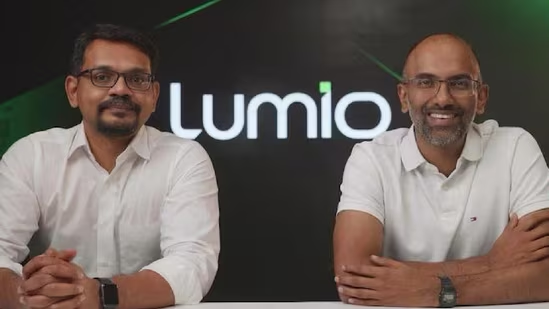
There’s a certain kind of honesty you don’t often get from consumer electronics founders the kind that doesn’t try to spin bad news into a silver lining. When Lumio’s Raghu Reddy and Kailash Sankarnarayanan sat down to talk about where their smart TV brand is headed, they didn’t dodge the uncomfortable part first: yes, your next TV is probably going to cost more. What made the conversation interesting wasn’t that admission — it was what they said comes next.
Two Ex-Corporate Guys Betting on a “Slow TV” Problem
Before Lumio, Reddy was Xiaomi India’s Chief Business Officer and Sankarnarayanan held a senior director role at Flipkart not exactly outsiders to how India’s electronics market works. So when they launched Lumio a little over a year ago under Circuit House Technologies, they weren’t chasing another “cheaper TV” story in a market already crowded with budget brands. Their pitch was narrower and, frankly, more personal: most smart TVs sold in India since 2016 or 2017 start feeling unusable within months, sometimes within a couple of years, regardless of price point. That’s the problem they set out to fix first building what they called India’s fastest smart TV, a hardware promise before anything else.
It worked. In just 13 months, Lumio crossed ₹100 crore in gross merchandise value, landed in more than 30,000 households, and generated over 3 million brand searches — numbers that are hard to dismiss as a fluke in a market this competitive.
Why Price Hikes Are “Inevitable” And It’s Not Really About Lumio
Here’s the part that could sound like an excuse from most companies but comes across more like an industry wide reality check from Lumio’s founders: TV prices are going up, and the reason has almost nothing to do with any single brand’s decisions. It’s a global memory chip shortage, and it’s being driven largely by AI.
The math is simple once you see it laid out. Every smart TV needs RAM and storage chips to run apps, buffer video, and power its operating system. Those same memory chips DRAM in particular are now being bought up at record pace by AI companies building out data centers and training infrastructure. When demand from Nvidia, Microsoft, and Google-scale AI buildouts collides with a limited chip supply, prices rise for everyone downstream, TVs included. Samsung has already said publicly that price hikes on new TVs are something it can’t rule out, and industry analysts have called the increases largely unavoidable, with global TV shipments expected to decline as a result.
For a company like Lumio, competing on India’s tightly contested ₹15,000–₹1,00,000+ TV segment, that’s not a minor supply chain footnote it’s a cost pressure that touches every unit they sell.
The Real Pivot: Betting on AI Discovery Over Specs
What’s more telling is where Lumio is choosing to put its energy instead of fighting the chip shortage head-on. Rather than compete purely on panel size, refresh rate, or price a race that’s getting more expensive for everyone the founders are leaning hard into software, specifically how people find what to watch in the first place.
Their argument is rooted in something almost embarrassingly ordinary about how people actually behave: someone gets a WhatsApp message from their partner about a show, or scrolls past an Instagram post listing “Top 10 movies,” and by the time they sit down in front of the TV, that recommendation is gone. Lumio’s answer to that gap is Project Neo a system that turns WhatsApp and Instagram themselves into a kind of remote control.
Users can message their TV directly, in plain English, Hindi, or Hinglish, describing a mood, a genre, an actor, or even a half-remembered plot, and the show gets queued up on screen. They can even forward a Reel or a screenshot of a poster, and the system will surface it directly.
It’s a quiet but deliberate strategic shift from “we made the fastest hardware” to “we made discovery frictionless” and it says something about where the founders think the real battleground in smart TVs is moving.
Reading Between the Lines
There’s a broader lesson in how Reddy and Sankarnarayanan are framing this moment. Rather than pretending the chip shortage isn’t going to touch their pricing, they’re being upfront about a cost pressure that’s genuinely out of their control — and using that honesty to point attention toward what they believe they can control: the experience layer sitting on top of the hardware. It’s a bet that, as commodity components get squeezed and expensive across the entire industry, the brands that win the next few years won’t necessarily be the ones with the cheapest chips, but the ones that make the living room itself feel less broken.
Whether that bet pays off will depend on how quickly Project Neo actually changes daily habits, and how much patience Indian consumers have for near term price increases across the board not just from Lumio, but from every TV brand riding the same memory chip wave.
FAQs
Who founded Lumio? Lumio was founded by Raghu Reddy (CEO), formerly Xiaomi India’s Chief Business Officer, and Kailash Sankarnarayanan (COO), formerly a Senior Director at Flipkart, under their parent company Circuit House Technologies.
Why are TV prices expected to rise? A global shortage of memory chips (DRAM), driven largely by AI companies buying up supply for data centers and infrastructure, is pushing up component costs across TVs, smartphones, and other consumer electronics.
What is Lumio’s Project Neo? Project Neo is an AI-driven content discovery feature that lets users find and play shows on their Lumio TV by messaging in plain language through WhatsApp or Instagram, supporting English, Hindi, and Hinglish.
How big is Lumio’s business so far? Within about 13 months of launch, Lumio reported crossing ₹100 crore in gross merchandise value, reaching over 30,000 households, and generating more than 3 million brand searches
Learn more about our site https://archive2in.com
Contact us on contactarchive2in@gmail.com
Read out our latest articles on BLOGS section
Leave a Reply
You must be logged in to post a comment.