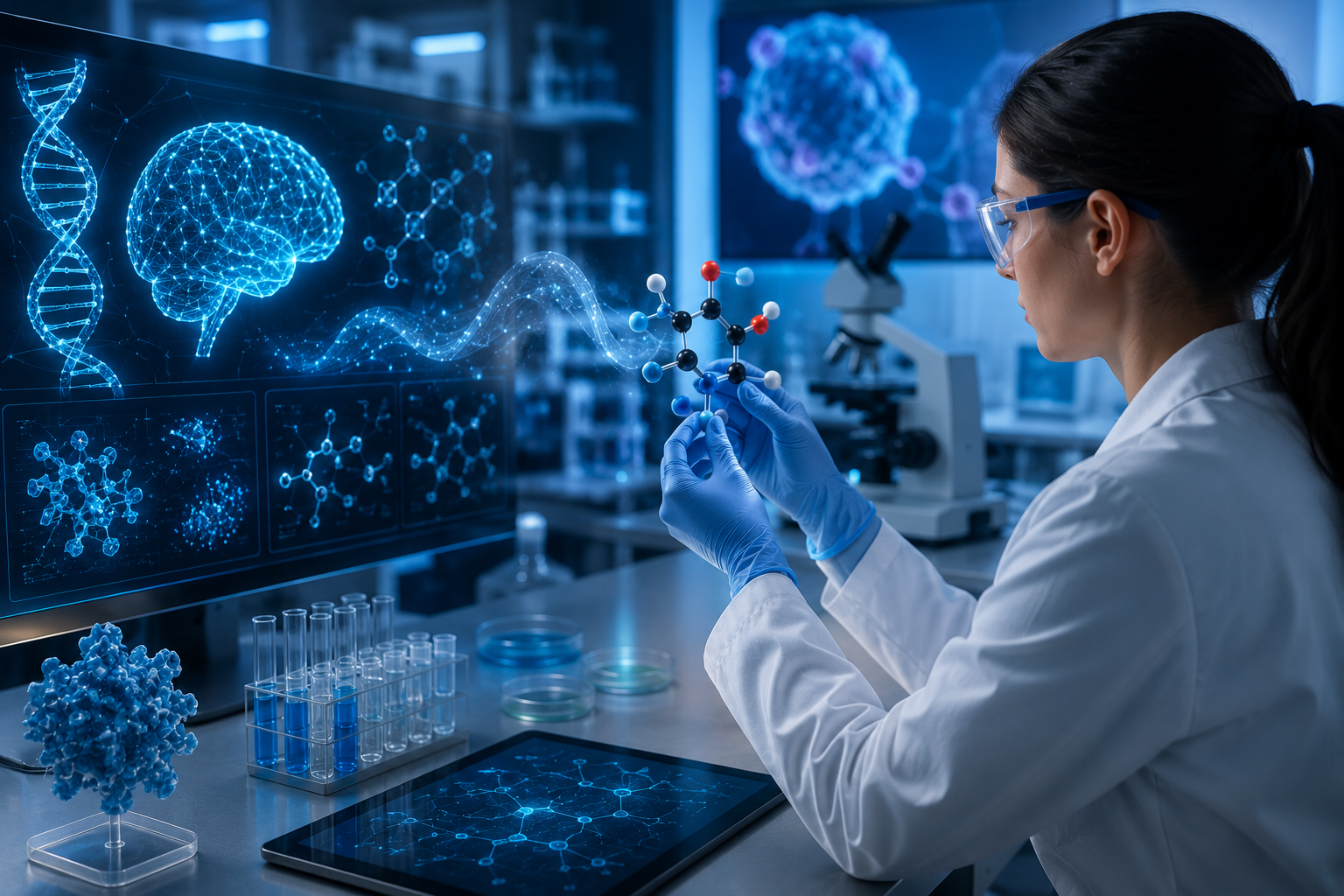
Artificial Intelligence is transforming industries worldwide, and healthcare is among the biggest beneficiaries. One of the most exciting breakthroughs is AI’s growing role in discovering new medicines. Traditionally, developing a new drug could take over a decade and cost billions of dollars. Today,it is helping researchers analyze massive amounts of biological data, identify promising drug candidates, and significantly accelerate the discovery process.
Although it cannot replace scientists, it has become a powerful tool that allows researchers to work faster, reduce costs, and explore treatments for diseases that were once considered too complex to tackle.
Why Drug Discovery Takes So Long
Creating a new medicine is one of the most challenging scientific processes.
Researchers typically spend years:
- Understanding diseases
- Identifying biological targets
- Screening millions of chemical compounds
- Testing promising molecules
- Conducting laboratory experiments
- Running multiple phases of clinical trials
- Obtaining regulatory approval
Out of thousands of potential compounds, only a tiny fraction eventually becomes an approved medicine.
This lengthy process makes drug development expensive and time-consuming.
How AI Changes the Process
Artificial intelligence excels at recognizing patterns in enormous datasets.
Instead of manually analyzing millions of molecules, models can rapidly examine chemical structures, biological interactions, genetic information, and previous research to identify compounds with the highest probability of success.
This allows scientists to focus laboratory testing on the most promising candidates rather than relying solely on traditional trial-and-error methods.
Identifying Drug Targets
Before creating a medicine, researchers must identify the biological mechanism responsible for a disease.
It helps by analyzing:
- DNA sequences
- Protein structures
- Medical research databases
- Patient health records
- Scientific publications
Machine learning algorithms can uncover hidden relationships between genes, proteins, and diseases that may not be obvious through conventional analysis.
This helps researchers identify entirely new drug targets.
Designing New Molecules
One of AI’s most impressive capabilities is generating completely new molecular structures.
Instead of searching only existing chemical libraries, advanced models can design molecules predicted to interact effectively with specific disease targets.
Researchers then evaluate these generated compounds through laboratory experiments to determine whether they perform as expected.
This dramatically expands the number of potential medicines scientists can investigate.
Predicting Success Earlier
Drug development often fails during laboratory testing because compounds prove ineffective or unsafe.
It helps reduce this risk by predicting important characteristics before physical testing begins, including:
- Toxicity
- Stability
- Solubility
- Biological activity
- Potential side effects
While predictions are not perfect, they allow researchers to eliminate weaker candidates much earlier in the development process.
AI and Rare Diseases
Rare diseases have historically received less research attention because developing treatments can be financially challenging.
It is helping scientists analyze limited datasets more effectively, making it easier to identify potential therapies for conditions affecting smaller patient populations.
This creates new opportunities for developing treatments that may previously have been overlooked.
Accelerating Personalized Medicine
Every patient responds differently to medication.
It is supporting personalized medicine by analyzing genetic information, medical history, lifestyle factors, and disease characteristics to help researchers understand which treatments may work best for specific groups of patients.
In the future, they could help physicians recommend more individualized treatment strategies based on a person’s unique biological profile.
Challenges of AI in Drug Discovery
Despite its enormous potential, It is not a magic solution.
Several challenges remain:
- High-quality training data is essential.
- Biological systems remain extremely complex.
- Laboratory validation is still required.
- Clinical trials cannot be replaced.
- Regulatory approval remains a lengthy process.
AI speeds up the early stages of research but does not eliminate the need for rigorous scientific testing.
The Future of AI in Medicine
Experts believe It will become increasingly integrated into pharmaceutical research over the next decade.
Future applications may include:
- Faster vaccine development
- Improved cancer therapies
- Drug repurposing for existing medicines
- Earlier disease detection
- More efficient clinical trial design
- Discovery of treatments for previously untreatable diseases
As computing power and biological datasets continue to grow, AI’s role in medical innovation is expected to expand significantly.
Conclusion
Artificial intelligence is reshaping how scientists discover new medicines by reducing the time and cost required to identify promising drug candidates. From analyzing genetic data and predicting molecular behavior to designing entirely new compounds, has become an invaluable partner in pharmaceutical research.
While human expertise, laboratory experiments, and clinical trials remain essential, it is enabling researchers to make faster, more informed decisions than ever before. As technology continues to evolve, the collaboration between artificial intelligence and medical science could lead to safer treatments, faster breakthroughs, and improved healthcare outcomes for millions of people around the world.
Disclaimer
This article is for informational and educational purposes only. It discusses the role of artificial intelligence in drug discovery based on publicly available scientific research and industry developments. assisted discoveries still require extensive laboratory testing, clinical trials, and regulatory approvals before medicines become available to patients.
Learn more about our site on contactarchive2in.com
Contact us on our email id contactarchive2in@gmail.com
Leave a Reply
You must be logged in to post a comment.