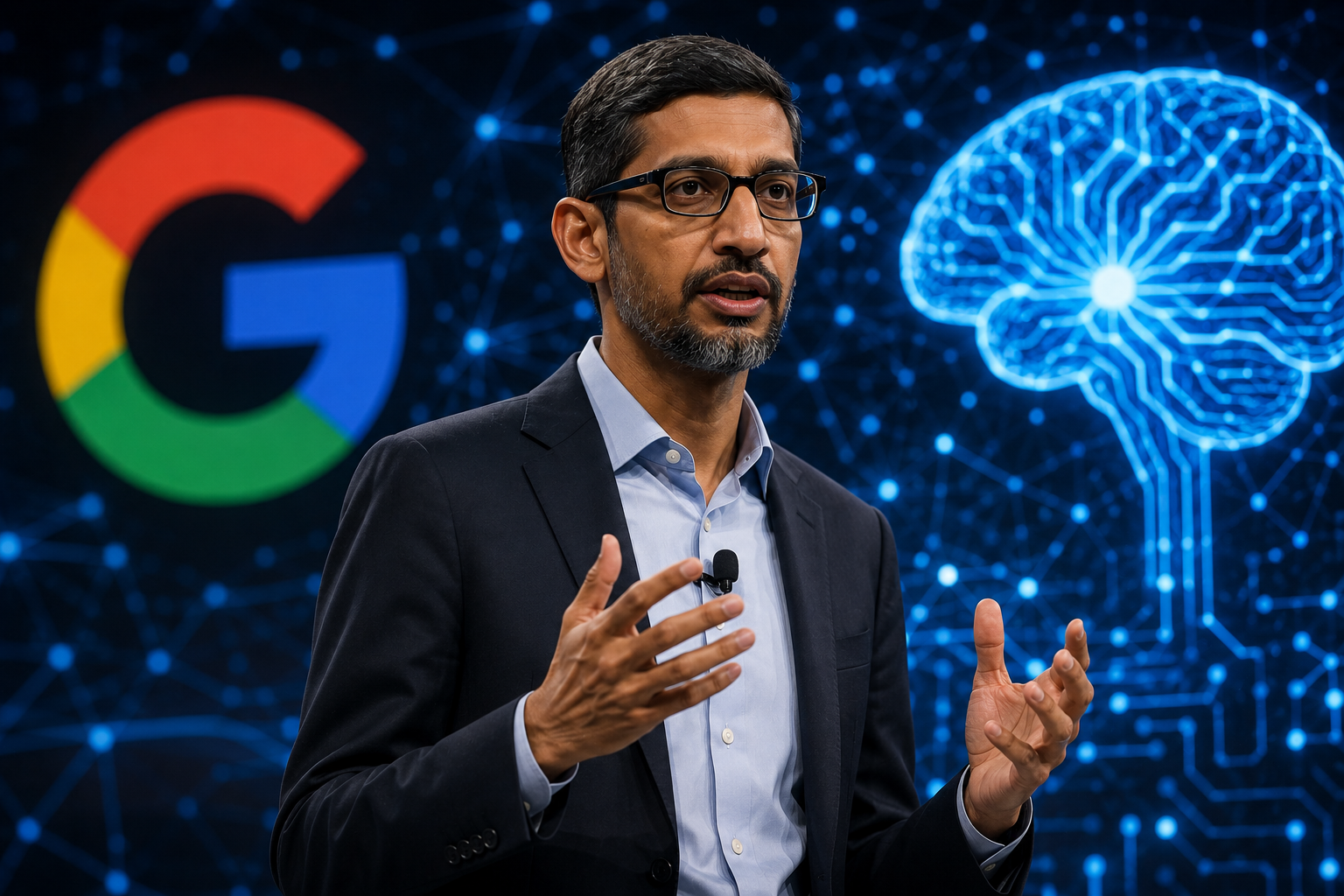
The artificial intelligence race has become one of the most closely watched technology battles in history. As companies such as google, OpenAI, Microsoft, Anthropic, Meta, and xAI continue releasing increasingly powerful AI models, questions have emerged about whether Google has lost its long-held leadership position in AI.
Responding to these claims, Google CEO Sundar Pichai has pushed back, arguing that remains one of the world’s strongest AI innovators and that the company’s long-term investments continue to shape the future of artificial intelligence.
His comments come as competition intensifies across generative AI, AI-powered search, enterprise solutions, and multimodal models.
Why People Think Google Is Falling Behind
For years,It was considered the undisputed leader in AI research.
The company developed groundbreaking technologies including:
- Transformer neural networks
- Tensor Processing Units (TPUs)
- DeepMind’s AI research
- TensorFlow
- Large language model research
However, the public launch of ChatGPT in late 2022 dramatically changed perceptions of the AI industry.
Competitors rapidly introduced consumer-facing AI products while many observers questioned whether it had become too cautious in commercializing its own innovations.
Sundar Pichai’s Response
Pichai has rejected the idea that Google is losing the AI race.
According to him, AI leadership should not be measured only by who launches products first, but also by:
- Quality of AI models
- Long-term research
- Responsible AI development
- Infrastructure investment
- Product integration
- Scientific innovation
It continues investing billions of dollars into AI research while deploying AI features across nearly every major product it offers.
Google’s AI Ecosystem Continues to Expand
Rather than focusing on a single chatbot, It has integrated AI throughout its ecosystem.
Examples include:
- AI-powered Google Search
- Gemini AI assistant
- Workspace AI features
- Android AI capabilities
- Cloud AI services
- YouTube AI tools
- AI-powered coding assistance
This broad strategy allows Google to reach billions of users across multiple platforms instead of relying on a single AI application.
Gemini Takes Center Stage
One of Google’s biggest AI initiatives is Gemini, its family of multimodal AI models.
Gemini is designed to understand and generate:
- Text
- Images
- Audio
- Video
- Computer code
Google positions Gemini as a foundation model capable of supporting everything from consumer search experiences to enterprise applications and scientific research.
The company continues releasing improved versions aimed at increasing reasoning ability, speed, and efficiency.
Why AI Competition Benefits Everyone
The AI race is no longer about one company dominating the market.
Instead, competition is driving:
- Faster innovation
- Better AI models
- Lower costs
- Improved safety research
- More business applications
- Greater consumer choice
Every major technology company is investing heavily in AI infrastructure, making this one of the fastest-moving industries in history.
Google’s Biggest Strengths
Despite increasing competition, Google retains several major advantages.
Massive Computing Infrastructure
Training advanced AI models requires enormous computing power.
It operates one of the world’s largest cloud infrastructures and develops its own specialized AI hardware through TPUs.
Decades of AI Research
Many foundational AI technologies originated from Google’s research teams.
The influential Transformer architecture introduced by researchers became the basis for many modern large language models used across the industry.
Billions of Daily Users
Google’s products—including Search, Gmail, Android, Maps, YouTube, and Workspace—provide enormous opportunities to integrate AI into everyday experiences.
Few companies have comparable global reach.
Challenges Ahead
Although it remains a leader, significant challenges remain.
The company faces pressure to:
- Continue improving Gemini
- Protect search advertising revenue
- Balance innovation with AI safety
- Respond to rapidly evolving competitors
- Manage increasing infrastructure costs
- Navigate global AI regulations
Success will depend on Google’s ability to innovate while maintaining user trust.
The Future of Google’s AI Strategy
Industry experts expect Google to deepen AI integration across its entire ecosystem.
Future developments may include:
- Smarter AI-powered search
- More capable personal AI assistants
- Advanced multimodal reasoning
- Improved enterprise AI tools
- AI-powered scientific research
- Enhanced productivity applications
Rather than viewing AI as a separate product, Google increasingly sees artificial intelligence as the foundation of nearly every digital service it offers.
Conclusion
Sundar Pichai’s response reflects Google’s confidence that its long-term investments in artificial intelligence continue to position the company among the industry’s leaders. While competitors have accelerated innovation and intensified the AI race, Google remains a major force through its research expertise, global infrastructure, and expanding Gemini ecosystem.
The coming years will likely determine not who “wins” the AI race, but how multiple companies shape the future of intelligent computing. As AI becomes embedded into search, productivity, healthcare, education, and business, competition between technology giants is expected to deliver faster innovation and greater value for users worldwide.
Disclaimer
This article is for informational and educational purposes only. It is based on publicly available interviews, company announcements, and industry reports available at the time of writing. The AI industry evolves rapidly, and company strategies, products, and market positions may change over time.
Learn more about our site on contactarchive2n.com
Contact us on our email id contactarchive2in@gmail.com
Leave a Reply
You must be logged in to post a comment.