
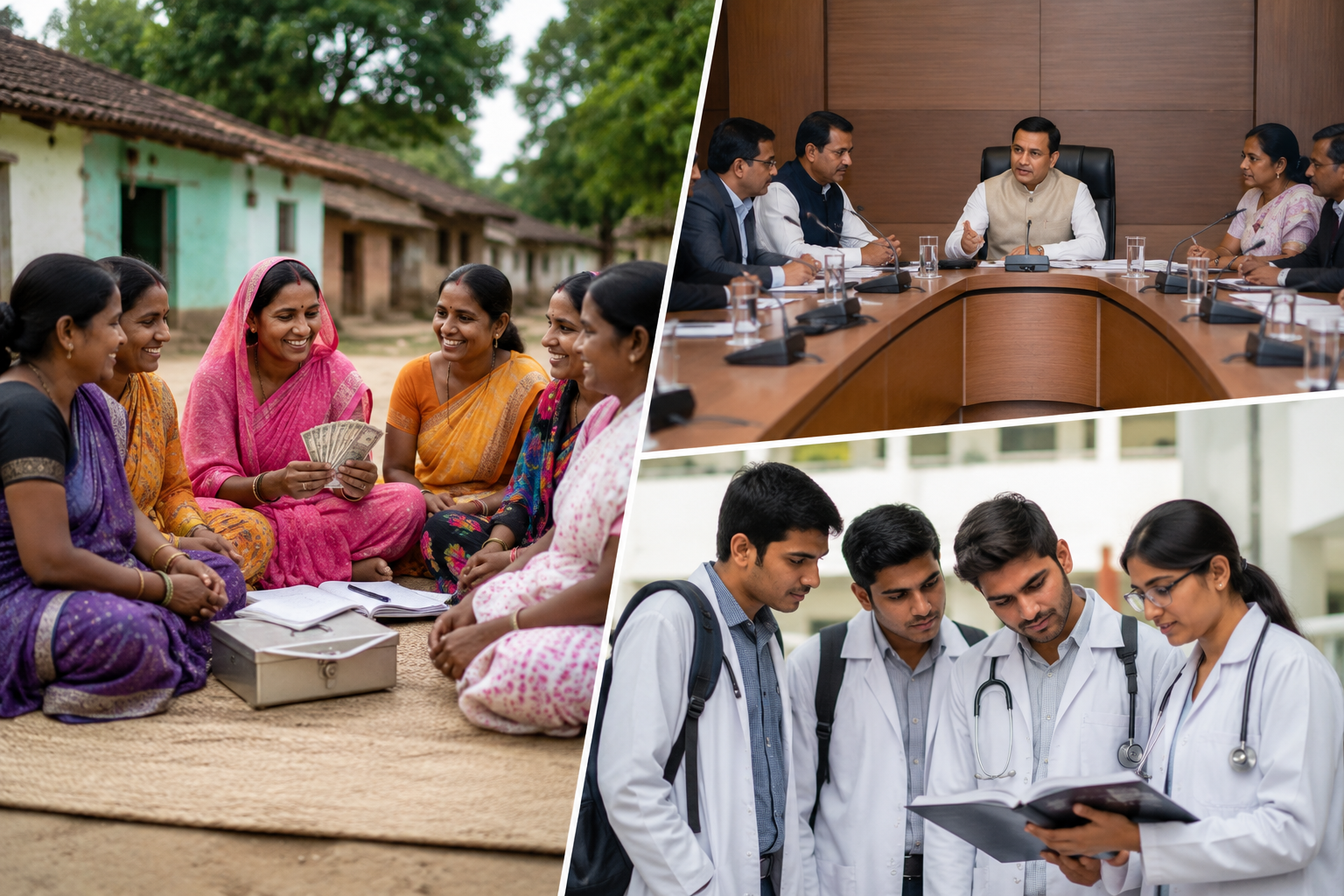
The Assam Cabinet has approved two significant policy decisions aimed at strengthening financial inclusion and improving the state’s medical education system. The first provides a stamp duty waiver on loans up to ₹10 lakh for Self-Help Groups (SHGs), while the second introduces changes to MBBS admission rules to streamline the admission process and align it with current educational requirements.
These decisions are expected to benefit thousands of women associated with Self-Help Groups, aspiring medical students, and the broader healthcare and economic landscape of Assam.
Stamp Duty Waiver for SHG Loans
One of the Cabinet’s most notable decisions is the approval of a 100% stamp duty waiver on loans of up to ₹10 lakh taken by registered Self-Help Groups (SHGs).
The move is intended to make institutional credit more affordable by reducing the additional costs associated with borrowing.
Why This Matters
Self-Help Groups play a vital role in Assam’s rural economy by promoting:
- Women’s financial independence
- Small-scale entrepreneurship
- Livelihood generation
- Community development
- Rural employment
Lower borrowing costs mean SHGs can access formal loans more easily, allowing members to invest in agriculture, handicrafts, food processing, tailoring, retail businesses, and other income-generating activities.
Boosting Women’s Empowerment
Across Assam, thousands of women are members of Self-Help Groups that support savings, credit access, and entrepreneurship.
The stamp duty waiver is expected to:
- Encourage more women to seek formal financing.
- Reduce the financial burden of taking loans.
- Promote small business expansion.
- Improve household incomes.
- Strengthen rural economic development.
By making credit more affordable, the government hopes to increase financial participation among women entrepreneurs.
Supporting Rural Economic Growth
Small loans often serve as the foundation for local businesses in rural communities.
With lower transaction costs, SHGs may find it easier to:
- Purchase equipment
- Expand production
- Hire workers
- Improve productivity
- Diversify income sources
These activities can contribute to stronger local economies and increased employment opportunities.
Changes to MBBS Admission Rules
The Cabinet also approved amendments related to MBBS admissions in Assam.
The revised rules aim to improve transparency, streamline the admission process, and ensure that seat allocation aligns with updated educational policies and regulatory requirements.
Medical education remains a priority as Assam continues expanding healthcare infrastructure and increasing the availability of trained doctors.
Why Admission Rule Changes Matter
Medical admissions involve thousands of students every year.
Clear and updated admission policies help:
- Reduce administrative confusion.
- Improve transparency.
- Ensure fair allocation of seats.
- Align state rules with national medical education standards.
- Simplify the admission process for eligible candidates.
Students should carefully review the latest official notifications before applying.
Strengthening Healthcare Capacity
Increasing access to quality medical education is essential for addressing future healthcare needs.
Updated admission policies may help:
- Improve medical workforce planning.
- Increase the availability of qualified doctors.
- Support healthcare services in rural areas.
- Strengthen public health infrastructure.
Combined with investments in hospitals and medical colleges, these reforms can contribute to better healthcare outcomes across the state.
Broader Impact on Assam
The Cabinet’s latest decisions reflect efforts to promote both economic development and social welfare.
On one hand, the stamp duty waiver encourages financial inclusion by supporting women-led Self-Help Groups.
On the other, revised MBBS admission guidelines seek to improve the efficiency and transparency of medical education.
Together, these initiatives support long-term goals related to entrepreneurship, healthcare, education, and inclusive growth.
What Citizens Should Know
Members of eligible Self-Help Groups should consult their lending institutions and relevant government departments for detailed information regarding the stamp duty waiver and eligibility criteria.
Similarly, MBBS aspirants are advised to monitor official admission notifications, counselling schedules, and eligibility requirements released by the appropriate authorities.
Staying informed through official channels will help applicants take full advantage of these policy changes.
Final Thoughts
The Assam Cabinet’s approval of a stamp duty waiver for SHG loans up to ₹10 lakh represents an important step toward empowering women entrepreneurs and strengthening rural livelihoods. At the same time, the revised MBBS admission rules demonstrate the government’s focus on improving transparency and efficiency in medical education.
Together, these decisions have the potential to create long-term benefits for Assam’s economy, healthcare system, and educational landscape. As implementation progresses, both Self-Help Groups and aspiring medical students are expected to gain from these reforms.
Disclaimer
This article is for informational purposes only and is based on publicly available government announcements and reports at the time of writing. Policy implementation details, eligibility criteria, and MBBS admission guidelines may be updated by the Government of Assam or the relevant authorities. Readers should refer to official government notifications for the most accurate and up-to-date information.
Learn more about our site on contactarchive2in.com
Contact us on our email id contactarchive2in@gmail.com
Leave a Reply
You must be logged in to post a comment.