
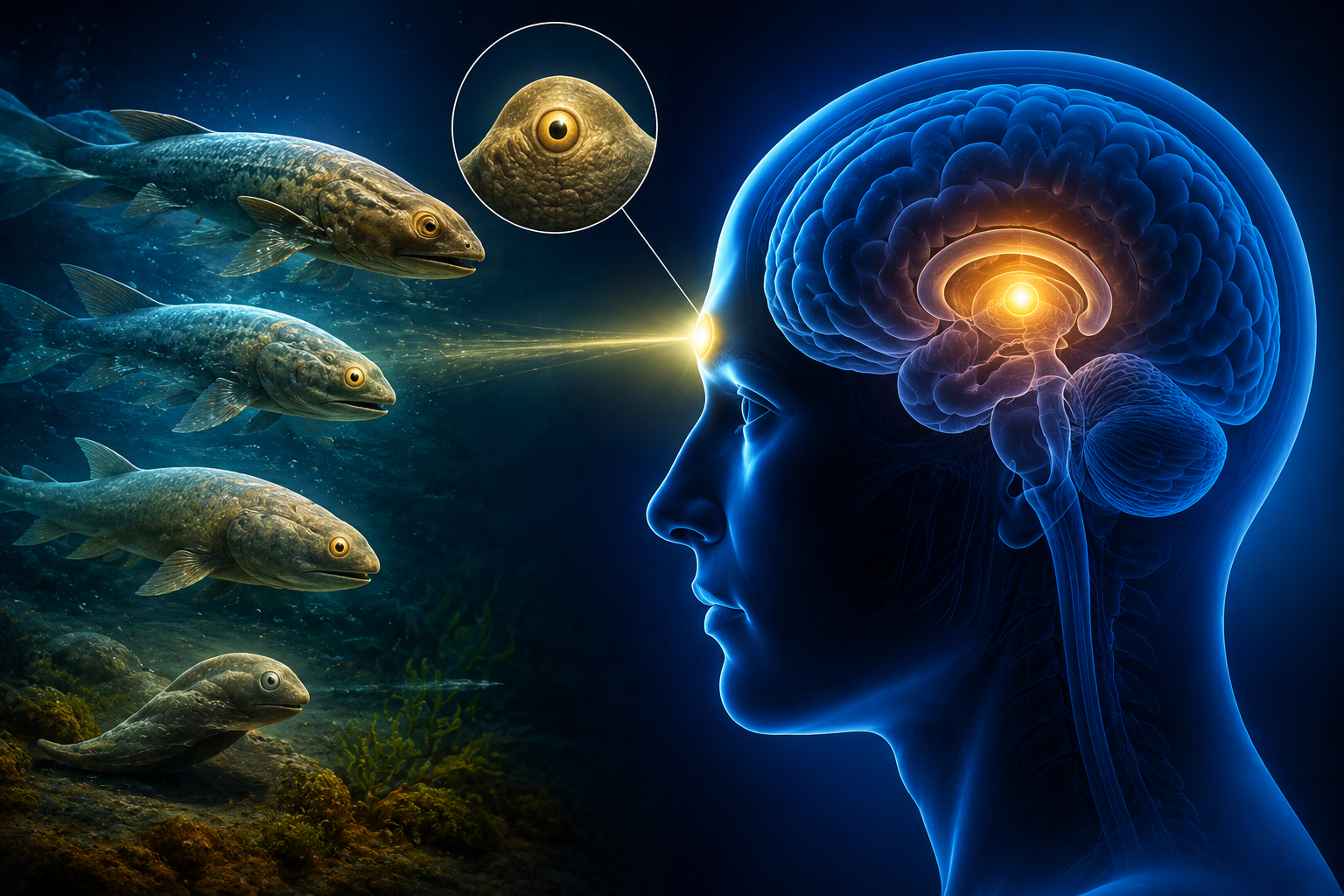
The phrase Human “third eye“ has long been associated with spirituality, meditation, and ancient traditions. However, a recent scientific study has brought the term into the spotlight for an entirely different reason. Researchers suggest that humans possess a tiny structure deep within the brain that may be linked to a light-sensitive organ found in an ancient ancestor that lived approximately 600 million years ago.
While humans do not have a literal third eye capable of seeing the world, the study sheds new light on the evolutionary history of the pineal gland—a small endocrine organ that plays a vital role in regulating sleep, biological rhythms, and hormone production.
The findings offer fascinating insights into how evolution has shaped the human brain over hundreds of millions of years.
What Is the ‘Third Eye’ in Humans?
The so-called “third eye” referred to in the study is the pineal gland, a pea-sized structure located near the center of the brain.
Although it does not detect images like our eyes, the pineal gland responds indirectly to changes in light through signals received from the eyes.
Its primary functions include:
- Producing the hormone melatonin
- Regulating the body’s sleep-wake cycle
- Supporting circadian rhythms
- Influencing seasonal biological processes
Because of its location and light-related functions, the pineal gland has often been referred to as the brain’s “third eye.”
The Ancient Evolutionary Connection
According to the research, the evolutionary origins of the pineal gland may stretch back around 600 million years to early vertebrate ancestors.
Some primitive animals possessed a parietal eye—often called a “third eye”—located on the top of the head.
Unlike modern eyes, this organ could detect light intensity and help regulate daily and seasonal behaviors.
Scientists believe that over millions of years of evolution, this light-sensitive organ gradually changed, eventually giving rise to structures like the pineal gland found in mammals today.
What About the “Cyclops Ancestor”?
The study also discusses an ancient evolutionary ancestor that possessed a single central light-sensitive organ, leading some media reports to describe it as a “Cyclops ancestor.”
The term is metaphorical rather than literal.
Researchers are not suggesting that humans descended from mythical one-eyed creatures. Instead, the comparison refers to early organisms that had one centrally positioned light-detecting structure rather than two fully developed eyes.
This feature helped organisms sense environmental light, an important ability for survival long before complex vision evolved.
Why the Pineal Gland Is Still Important Today
Although the pineal gland no longer functions as a visual organ, it remains essential for human health.
It helps regulate:
- Sleep patterns
- Biological clock
- Hormone secretion
- Seasonal rhythms
- Circadian timing
The gland produces melatonin, often called the “sleep hormone,” primarily during darkness.
Exposure to bright light at night can suppress melatonin production, which is one reason experts recommend limiting screen use before bedtime.
Evidence from Other Animals
Some reptiles, amphibians, and fish still possess a functional parietal eye or closely related light-sensitive organ.
These structures help animals:
- Detect sunlight
- Regulate body temperature
- Navigate seasonal changes
- Monitor day length
- Support reproductive cycles
Studying these species provides researchers with valuable clues about the evolutionary history of vertebrate brains.
Why This Discovery Matters
Understanding the origins of the pineal gland helps scientists answer broader questions about evolution.
The study contributes to knowledge about:
- Brain evolution
- Development of sensory organs
- Hormonal regulation
- Vertebrate ancestry
- Evolution of circadian rhythms
It also demonstrates how organs can change function dramatically over hundreds of millions of years while remaining important for survival.
Separating Science from Myth
Because the phrase “third eye” has spiritual and philosophical meanings in many cultures, headlines can sometimes be misleading.
The scientific study does not suggest that humans possess hidden psychic abilities or an undiscovered visual organ.
Instead, it explores the evolutionary origins of an existing brain structure that plays a well-established biological role.
Looking Ahead
Advances in genetics, neuroscience, and evolutionary biology continue to reveal surprising connections between modern humans and ancient life forms.
Future research may further explain how early sensory organs evolved into the complex systems that regulate sleep, hormones, and biological rhythms today.
These discoveries remind us that many structures inside the human body have remarkable evolutionary histories stretching back hundreds of millions of years.
Conclusion
The latest research linking the human pineal gland to an ancient light-sensitive organ offers another fascinating glimpse into our evolutionary past. While humans do not possess a literal third eye, the pineal gland serves as an important reminder that evolution often repurposes existing structures rather than creating entirely new ones.
Far from being a mystical organ, the pineal gland is a crucial part of the body’s internal clock, helping regulate sleep and biological rhythms every day. Its ancient origins highlight the extraordinary journey of life on Earth and the deep evolutionary connections shared by all vertebrates.
Disclaimer
This article is for informational and educational purposes only. The term “third eye” in this context refers to the pineal gland’s evolutionary history and should not be interpreted as evidence of supernatural or psychic abilities. The findings discussed are based on scientific research into vertebrate evolution and may evolve as further studies become available.
Learn more about our site on contactarchive2in.com
Contact us on our email id contactarchive2in@gmail.com
Leave a Reply
You must be logged in to post a comment.