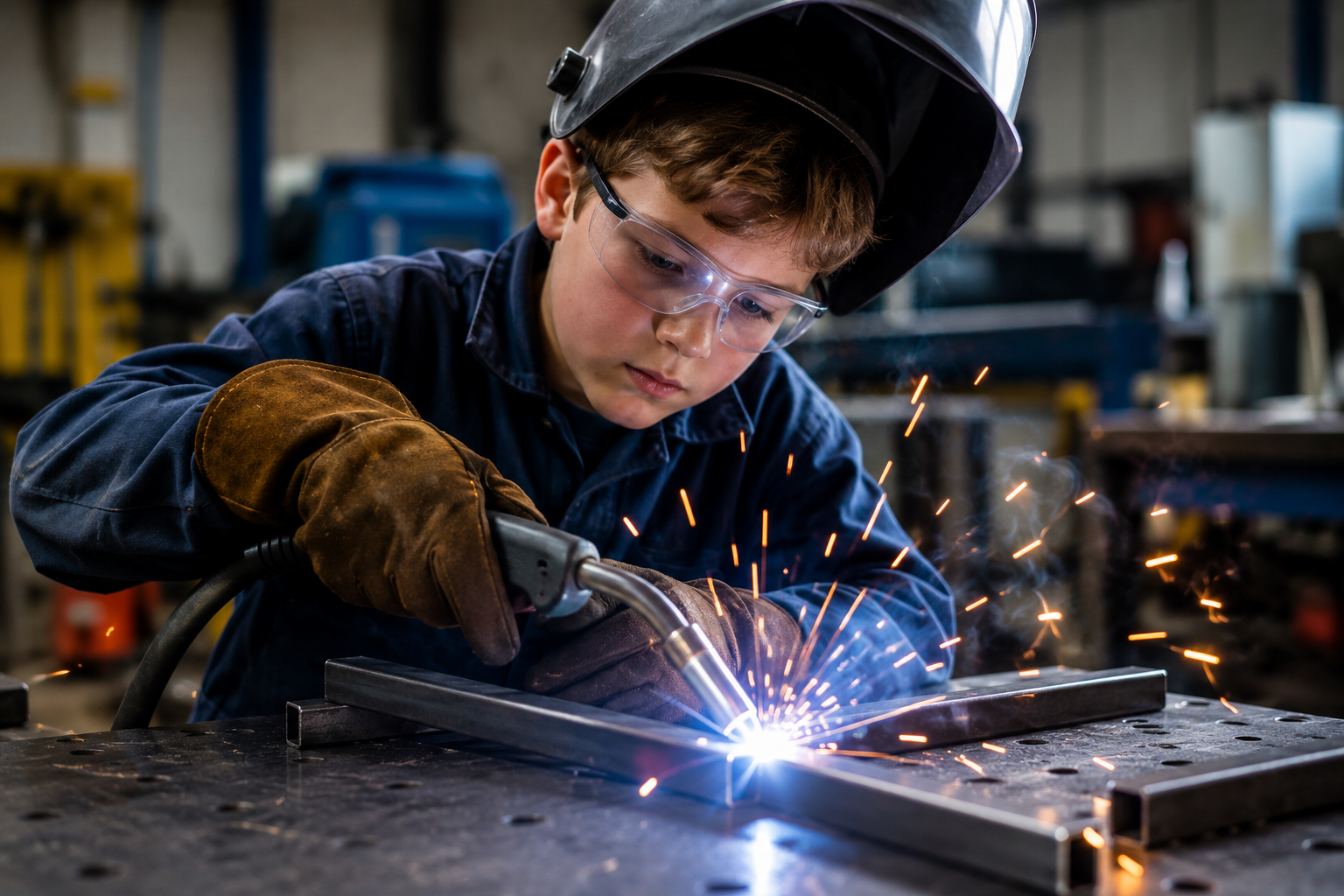
At a time when many children are introduced to career ambitions through technology, medicine or other traditional professions, 11-year-old Tayden Franklin from West Virginia is taking a very different route.
The homeschooled youngster is working toward a welding certification through a programme connected with Marshall Advanced Technology and the Marshall Advanced Manufacturing Center in Huntington. If he completes the programme as expected later this summer, he could become one of the youngest certified welders in the United States.
His story has attracted attention not simply because of his age, but because it highlights the growing importance of skilled trades and hands-on education in the US.
Who is Tayden Franklin?
Tayden is a homeschooled student whose education includes practical, hands-on learning. His father, Brandon Franklin, has encouraged him to explore different interests rather than pushing him toward one particular career.
Welding became one of those interests.
According to reports, Tayden receives guidance from his father as well as welding instructor Brad Lowe, who said Tayden is the youngest student he has trained. Despite his age, Lowe reportedly described the young learner as performing similarly to his adult students.
Tayden’s interests also extend well beyond welding. He has explored subjects and activities including scuba diving, aviation, animation and 3D printing, suggesting that his family is focused on giving him exposure to different practical and creative skills.
How did an 11-year-old get into welding?
For Tayden’s family, the answer appears to be a combination of curiosity and a homeschooling approach that allows him to learn outside the conventional classroom structure.
His father has explained that Tayden has a creative personality and enjoys making and building things. Welding, therefore, became a way for him to combine creativity with practical skills.
The programme at Marshall has given him the opportunity to develop those skills under professional supervision.
Marshall University itself describes its welding programmes as hands-on training designed to prepare learners for a high-demand trade. Its welding micro-pathway includes industry-focused skills and certifications, with pathways that can lead to further education in welding technology.
Tayden’s situation is unusual, but his experience also demonstrates that technical education does not necessarily have to begin only after high school.
How much can a welder earn in America?
This is where Tayden’s story becomes particularly interesting.
It is important to distinguish between what certified welders can earn in the US generally and what Tayden himself could earn. At 11, he is still a student and his certification does not automatically mean he can enter the workforce as a full-time welder.
According to the US Bureau of Labor Statistics (BLS), welders, cutters, solderers and brazers had a median annual wage of $51,000 in May 2024, equivalent to about $24.52 an hour. The lowest 10% earned below $38,130, while the highest 10% earned more than $75,850.
Pay can also vary significantly by industry. In May 2024, the median wage was about $57,310 for workers in specialty trade contractors, compared with $53,300 in repair and maintenance and $49,740 in manufacturing.
More recent BLS industry data also show that wages can differ depending on where a welder works. For example, 2025 wage data for welders in machinery manufacturing show a median annual wage of $53,660.
So, while headlines may suggest that Tayden could eventually earn tens of thousands of dollars annually, his actual future income would depend on his experience, certifications, location, industry and type of welding work.
Why skilled trades are attracting attention
Tayden’s story arrives at a time when the US continues to need skilled workers across manufacturing, construction, repair and other industries.
The BLS estimates that welders, cutters, solderers and brazers held approximately 457,300 jobs in 2024. Employment is projected to grow 2% between 2024 and 2034, with around 45,600 openings expected each year, largely because workers leave the occupation or retire.
That means the opportunity in welding isn’t necessarily about rapid job growth alone. A significant part of future demand is expected to come from replacing experienced workers.
Tayden isn’t choosing his entire future yet
Perhaps the most important part of Tayden’s story is that he isn’t treating welding certification as a final career decision.
The young student reportedly told local media that he doesn’t yet know what he will do when he grows up and wants to keep his options open.
That makes his achievement less about deciding on a profession at 11 and more about learning a useful skill early.
Whether Tayden ultimately becomes a professional welder, works in another technical field or follows a completely different path remains to be seen. For now, his experience offers an unusual example of how hands-on education can help young people discover their abilities — and perhaps discover careers they might never have encountered through a traditional classroom alone.
Disclaimer
This article is intended for informational purposes only no negative sentiment. Tayden Franklin is currently pursuing welding certification and should not be assumed to be eligible for employment as a professional welder solely because of certification. Child-labor laws, workplace safety requirements, certification rules and minimum-age requirements may affect whether and when a minor can legally work in welding or other hazardous occupations. Earnings figures are general US occupational statistics from the US Bureau of Labor Statistics and are not a prediction of Tayden Franklin’s future income. Information was checked against publicly available sources as of July 28, 2026.
Learn more about our site on contactarchive2in.com
Contact us on our email id contactarchive2in@gmail.com
Leave a Reply
You must be logged in to post a comment.