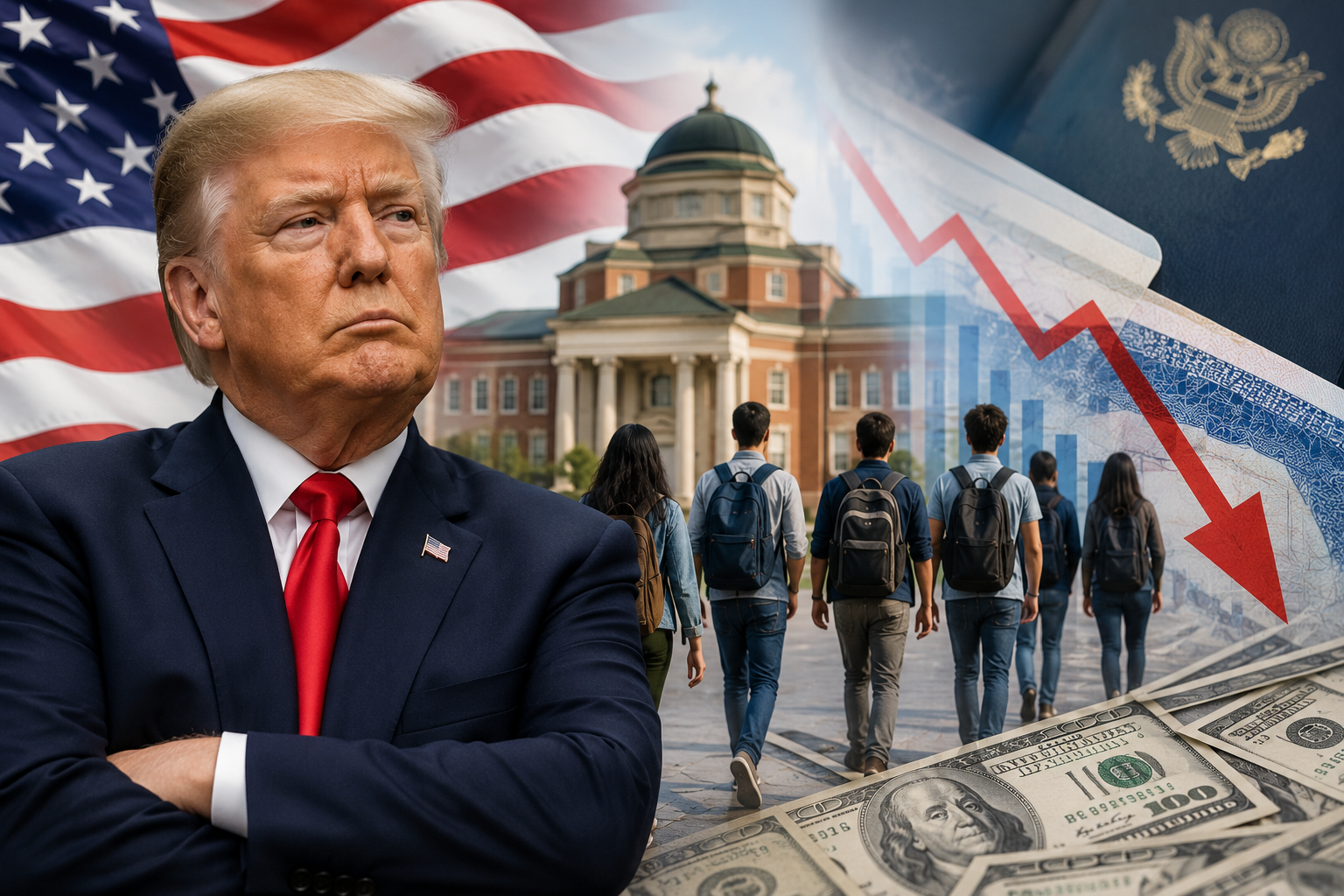
The Trump administration’s latest changes to US student visa rules are creating concern far beyond university campuses. A new federal rule that changes how long international students can remain in the United States could discourage overseas students from choosing American universities and potentially weaken the country’s highly skilled talent pipeline.
A new analysis from the Peterson Institute for International Economics (PIIE) estimates that if the policy leads to a sustained one-third reduction in the annual inflow of international students, the US economy could lose between $200 billion and $400 billion every year. The researchers estimate that this would represent roughly 0.7% to 1.3% of US GDP. Trump
However, it is important to note that this is an economic projection, not a guaranteed loss.
What has changed under Trump’s new visa rule?
The Trump administration issued a final rule in July that changes the long-standing “duration of status” system used for many international students.
Under the previous approach, students generally remained in valid status while making normal academic progress. The new policy instead establishes a fixed period of admission for foreign students, with the maximum generally limited to four years, or less if the academic programme is shorter. Trump
Students who need additional time can petition for an extension. The rule is scheduled to take effect in September 2026.
The administration says the policy is intended to address concerns about visa abuse and ensure that international students remain focused on completing their studies.
Critics, however, argue that the new system could create additional uncertainty for students whose academic programmes take longer than expected.
Why are universities and economists concerned?
The biggest concern is the potential impact on America’s ability to attract international talent.
International students are particularly important to US universities in fields such as science, technology, engineering and mathematics, commonly known as STEM.
Many international students who graduate from US universities later gain practical work experience through Optional Practical Training (OPT). For STEM graduates, the existing framework can allow extended practical training under certain conditions.
The PIIE analysis argues that reducing access to this pathway could weaken the supply of highly skilled workers and affect US innovation and productivity. Trump
The institute says US-trained foreign STEM workers who remain in the country after graduation have historically made an outsized contribution to innovation. Its analysis says these workers patent new inventions at significantly higher rates than typical US college graduates and are also disproportionately represented among founders of high-growth startups. Trump
How could the economic loss reach $400 billion?
The headline figure needs some context.
PIIE researchers estimate that if the new environment causes the US to lose roughly one-third of the annual inflow of international students, the resulting long-term economic impact could amount to $200 billion–$400 billion per year. Trump
The projected loss does not simply represent tuition revenue disappearing from American universities.
Instead, the researchers consider the broader economic consequences of fewer international students entering the US workforce. These include potentially fewer startups, inventions, patents, scientific breakthroughs, skilled workers and new businesses. Trump
In other words, the estimated economic cost is primarily about lost future economic output and innovation, rather than a direct annual bill to the US government.
Why international students matter to the US economy
International education is itself an important US export.
PIIE notes that providing higher education to foreign students represents around 5% of US services exports. International students also spend money on housing, food, transportation and other services while living in America. Trump
Their economic importance can extend well beyond graduation.
Some international graduates eventually become researchers, entrepreneurs, engineers and technology professionals in the United States. Others move into industries where specialised skills are in high demand.
That makes student migration an important part of America’s broader talent and innovation ecosystem.
What does the rule mean for Indian students?
The change is particularly relevant for Indian students, who form one of the largest international student communities in the United States.
Students planning to pursue master’s, doctoral or STEM programmes may need to pay closer attention to the duration of their programmes and the requirements for extending their status.
The potential effect is not limited to students currently preparing to travel. Universities could also face challenges in attracting future applicants if students begin to view the US as a less predictable destination compared with competing education markets.
For Indian students, this means checking the latest requirements carefully before making major decisions about applications, finances and long-term career plans.
What happens next?
The rule is final, but the debate is far from over.
PIIE says Congress or the courts could potentially intervene before or after the policy takes effect. The institute has also argued that the rule’s potential economic consequences could become an important issue in any legal or legislative review.
For now, international students and universities are likely to watch implementation closely.
The central question is whether tighter visa rules can achieve the administration’s stated goals without making the United States less attractive to the international students and skilled workers who have long contributed to its universities, research institutions and economy.
The potential $400 billion annual figure is therefore best understood as a warning about what could happen under a significant decline in international student numbers — not as a prediction that the US economy will definitely lose that amount.
Disclaimer
This article is for informational purposes only and does not constitute immigration, legal, educational or financial advice. The $200 billion–$400 billion annual economic-loss estimate comes from analysis by researchers associated with the Peterson Institute for International Economics and is based on a scenario involving a sustained one-third reduction in international student inflows. It is not a guaranteed or independently established loss. US immigration and student-visa rules can change, and students should consult official US government sources or qualified immigration professionals for current requirements.
Learn more about our site on contactarchive2in.com
Contact us on our email id contactarchive2in@gmail.com
Leave a Reply
You must be logged in to post a comment.