
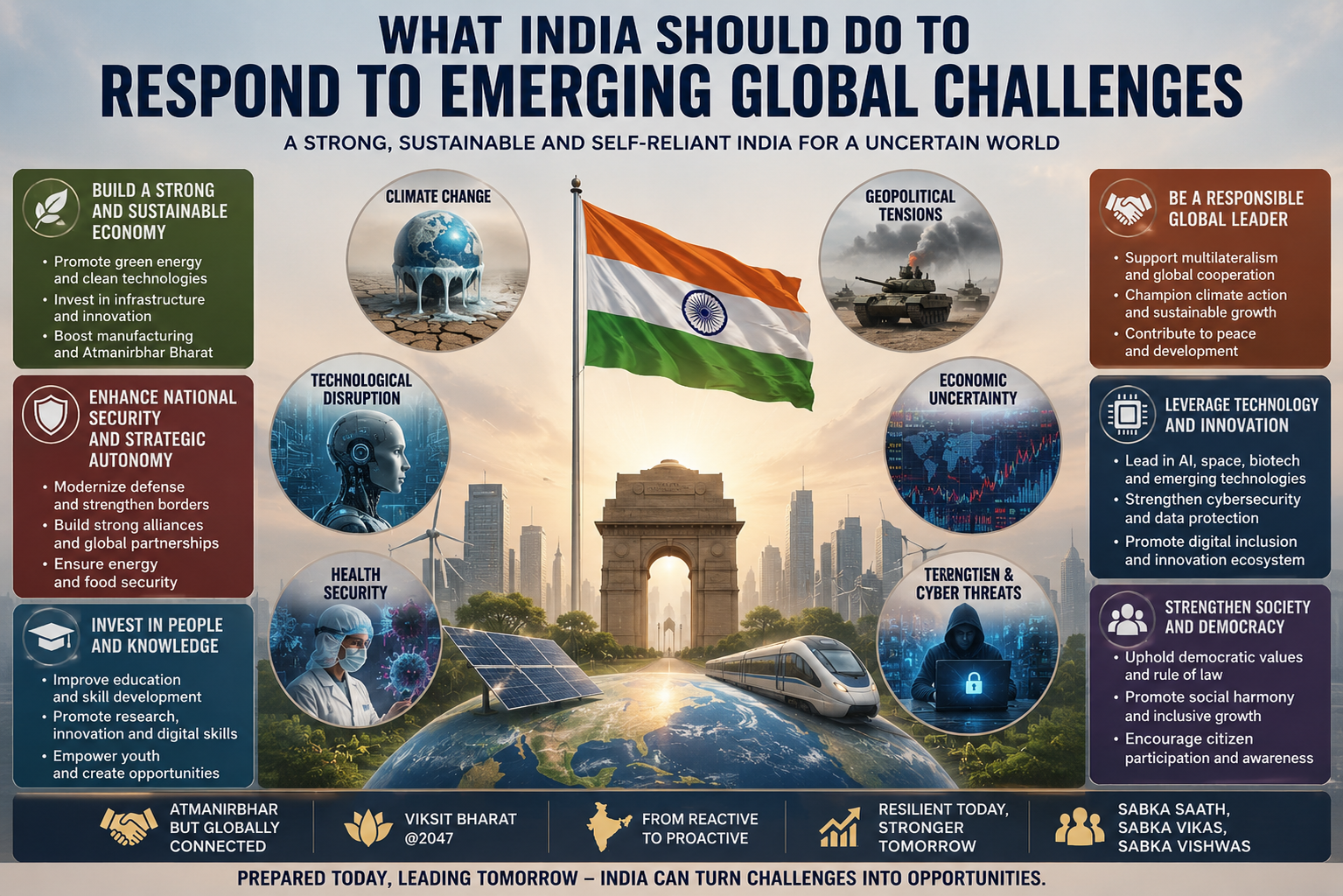
Introduction: A 1991-Style Crisis, Only Deeper
In 2026, India stands at an economic and geopolitical crossroads that many are comparing to the 1991 balance-of-payments crisis. But this time, the stakes are far more complex. It isn’t just about foreign exchange reserves anymore it’s about manufacturing, critical minerals, semiconductor chips, and artificial intelligence, the very sectors that will define economic power in the coming decades. Here’s a look at the challenges India faces and the concrete steps it can take to counter them.
The “Four Cs” Structural Vulnerability
Experts point to four critical pillars where India lags significantly behind:
- Commerce (Manufacturing): Despite three decades of state encouragement, India’s manufacturing sector remains largely stagnant.
- Critical Minerals & Rare Earths: Inadequate mapping, mining, and processing capacity leaves India 50% to nearly 100% dependent on China across various critical minerals and metals.
- Computer Chips: NITI Aayog estimates that 90–95% of India’s chip demand will rely on imports until 2035.
- AI Infrastructure & Software: While strong in talent and technology adoption, our nation has almost no presence in the foundational AI value chain (chips, models, compute infrastructure).
Capital Flight and Currency Pressure
Shifts in global monetary policy and rising geopolitical tension routinely trigger sudden capital flight from emerging markets like us. In just the first four months of 2026, foreign investors pulled over $20 billion out of Indian equities already surpassing 2025’s full-year total of $18.9 billion with $19 billion of that selling triggered by the onset of the Iran war. Under this pressure, the Indian rupee touched an all-time intraday low of 96.96 against the US dollar in May 2026.
The Middle East and India’s Energy Vulnerability
India imports nearly 88% of its crude oil requirements, making it highly exposed to any disruption in Middle East shipping routes. Every sustained $10-per-barrel rise in crude prices adds $13–14 billion to our nation import bill, widening the current account deficit by roughly 0.3% of GDP and fueling domestic inflation.
Trade Friction With the United States
The US is Bharat largest pharmaceutical export market of the nation $25.8 billion in global pharma exports in 2025, about 37.7% ($9.7 billion) went to the US. Indian companies also supply 47% of all generic prescriptions dispensed in America. But tariff relief on generics is temporary, and steep tariffs are set to kick in over the next few years unless manufacturers relocate production to the US putting this crucial export sector at real risk.
The Paradox of India’s Relationship With China
The nation ‘BHARAT’ runs a trade deficit of roughly $100 billion with China. Even as our country pushes domestic manufacturing through PLI schemes and the “China Plus One” strategy, it remains heavily dependent on Chinese active pharmaceutical ingredients (APIs), telecom hardware, and electronic components. In 1991, China’s economy ($380 billion) was only slightly larger than bharat ($270 billion). By 2026, China’s economy has grown to $20 trillion versus India’s $4 trillion a gap projected to widen from $16 trillion today to $24 trillion by 2050.
What Can India Do? Six Practical Steps Forward
- Sovereign “Geopolitical Risk Insurance” Facility: Using a portion of its massive foreign exchange reserves, India can create a state-backed reinsurance vehicle to protect shipping lines and energy importers against war-risk premiums and supply disruptions in high-risk zones.
- Digital Rupee Bilateral Currency Swaps: To reduce dependence on the US dollar and shield against sanctions or liquidity crunches, India can scale its Central Bank Digital Currency (e-Rupee) into a platform for direct trade settlement with resource-rich partners for oil and critical minerals.
- Dynamic Carbon-Adjusted Tariff Buffers: As the EU’s Carbon Border Adjustment Mechanism (CBAM) takes effect, India can introduce its own domestic carbon-pricing mechanism, keeping compliance revenue at home and reinvesting it into green-tech R&D for export industries.
- Decentralised Micro-Grid Industrial Clusters: To protect manufacturing hubs from climate-driven grid failures, India can fast-track autonomous, renewable-powered micro-grids for export-oriented industrial zones.
- Balancing Fiscal Deficit and Subsidies: Monetising non strategic public assets through Infrastructure Investment Trusts (InvITs) and converting untargeted fuel/fertiliser subsidies into direct, Aadhaar linked cash transfers can protect capital expenditure during global commodity shocks.
- Correcting the Trade Asymmetry With China: Enforcing strict, time-bound Phased Manufacturing Programs (PMPs) with mandatory domestic value addition, and pushing critical sectors toward certified non-Chinese tier-1 supply chains, can gradually reduce structural dependence.
Conclusion
Our country 2026 crisis may resemble 1991 on the surface, but it runs far deeper cutting across manufacturing, critical minerals, chips, and AI. Old playbooks won’t be enough this time. Sovereign risk insurance, digital rupee swaps, and carbon tariffs represent the kind of innovative instruments India will need, alongside fiscal discipline, technological self-reliance , and sharper strategic diplomacy, to turn this challenge into an opportunity.
Learn more about our site archive2in.com
Contact us on contactarchive2in@gmail.com
Read out our latest article on our BLOG section
Leave a Reply
You must be logged in to post a comment.