
Introduction
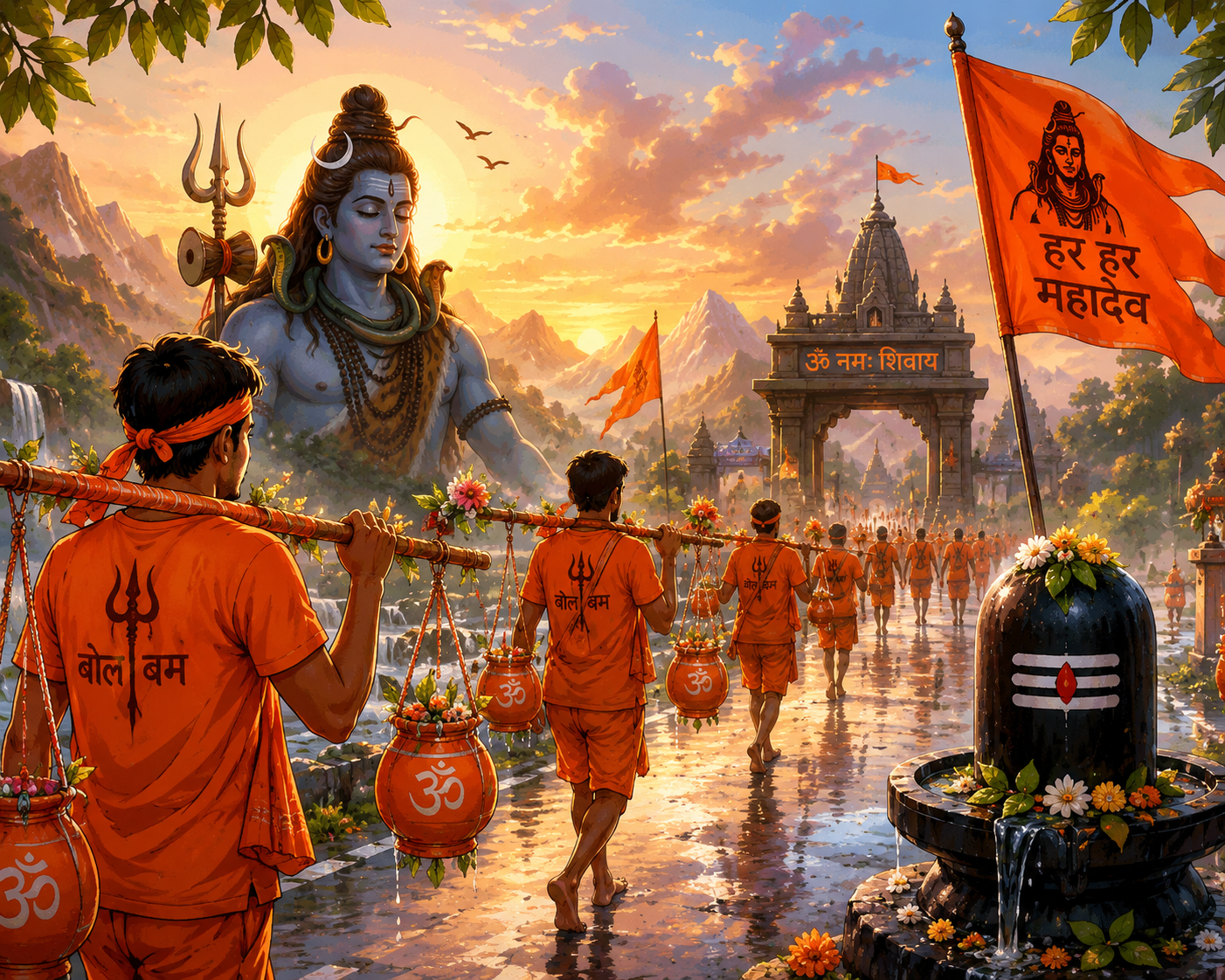
Every year, as the holy Hindu month of Shravan begins, highways across northern and central India turn saffron. Millions of devotees known as Kanwariyas set out on foot, shoulders bearing decorated bamboo poles loaded with sacred water from the Ganga, walking hundreds of kilometres to offer it at Shiva temples. This is the Kanwar Yatra, one of the largest annual religious gatherings on Earth. But behind the chants of “Bol Bam” and “Har Har Mahadev” lies a pilgrimage that is as much a modern logistical and cultural flashpoint as it is an ancient act of devotion.
What Exactly Is a “Kanwar”?
The word “Kanwar” refers to a simple but symbolic bamboo pole with water containers suspended from each end, carried across the shoulders so the sacred Ganga water never touches the ground. “Yatra” simply means journey. Together, the Kanwar Yatra represents a pilgrim’s commitment to carrying something pure and sacred, undisturbed, across great distances a physical test that mirrors spiritual discipline.
Roots in Mythology: The Story of Samudra Manthan
The spiritual foundation of the Kanwar Yatra traces back to the legend of Samudra Manthan, the churning of the cosmic ocean, described in the Bhagavata Purana and Shiva Purana. As gods and demons churned the ocean in search of the nectar of immortality, a deadly poison called Halahala emerged, threatening to destroy the universe. Lord Shiva, in an act of ultimate sacrifice, drank the poison and held it in his throat, turning it blue earning him the name Neelkanth. Devotees carry Gangajal to Shiva temples as a gesture of gratitude, believing the offering symbolically cools Shiva’s throat and honors his protection of the universe.
Many devotees also connect the tradition to the story of Shravan Kumar, who is said to have carried his elderly parents on a bamboo structure resembling the modern Kanwar yatra during their own pilgrimage reinforcing themes of devotion, duty, and sacrifice that run through the ritual.
Older Than You’d Think: Evidence from the 7th Century
While the Kanwar Yatra feels distinctly modern in its scale today, its origins are genuinely ancient. Historians point to a sculpture at Kalinjar Fort in Uttar Pradesh, dated to the 7th–8th century CE, depicting a fort commandant carrying a Kanwar on his shoulders considered the earliest known physical evidence of the tradition in India. Unlike today’s brightly decorated plastic and bamboo structures, the earliest Kanwars were far simpler: two bucket-shaped baskets tied to a sturdy wooden pole, built for function rather than display.
From Ancient Ritual to Massive Modern Movement
Today, the Kanwar Yatra has evolved into one of the world’s biggest crowd-management events. Pilgrims travel from states including Uttarakhand, Uttar Pradesh, Delhi, Haryana, Rajasthan, Bihar, Jharkhand, Madhya Pradesh, and Punjab, converging on collection points like Haridwar’s Har Ki Pauri Ghat, considered the most significant site for gathering Gangajal. Other major routes connect pilgrims to revered destinations such as the Baba Baidyanath Jyotirlinga in Jharkhand and demanding Himalayan paths favored by more dedicated devotees.
The numbers involved are staggering past editions of the Kanwar Yatra have drawn well over five crore (50 million) pilgrims, with authorities regularly expecting the crowd size to exceed previous years’ records.
Where Faith Meets Friction: Modern-Day Challenges
As the scale of the Yatra has grown, so has its footprint on daily life and with it, a set of tensions that didn’t exist in its earlier, quieter form.
Traffic disruption: With crore-level crowds walking along highways for weeks, authorities are forced to implement large-scale traffic diversions and designate dedicated “Kanwar lanes,” often disrupting regular commuters and local businesses along the route for extended periods.
Noise complaints: Modern Kanwar processions are frequently accompanied by loudspeakers, DJ trucks, and boomboxes blasting devotional and popular music, which has become a recurring source of friction with residents living along Yatra routes, particularly in dense urban stretches.
Security and crowd management: Given the sheer volume of participants, thousands of police personnel are deployed each year purely to manage movement, prevent stampedes, and maintain order across hundreds of kilometres of route.
Balancing tradition and regulation: Local governments increasingly find themselves negotiating between protecting religious freedom and addressing legitimate civic concerns from noise ordinances to road safety sparking recurring public debate each Shravan season.
Why the Pilgrimage Still Resonates
Despite these modern-day tensions, the Kanwar Yatra’s core appeal hasn’t diminished. For many Kanwariyas, the journey is described as building mental discipline, patience, and a deep sense of spiritual connection values that have persisted even as the surrounding infrastructure, technology, and controversy around the pilgrimage have transformed dramatically.
Conclusion
The Kanwar Yatra sits at a fascinating intersection a tradition with roots stretching back over a thousand years, now expressed through a modern lens of loudspeakers, traffic apps, and crowd-control barricades. Understanding its mythological origins helps explain why millions continue to walk barefoot for hundreds of kilometres each year, even as the same scale that makes the pilgrimage remarkable also makes it one of India’s most complex annual logistical and cultural challenges.
Learn more about our site on contactarchive2in.com
Contact us on our email id contactarchive2in@gmail.com
Read out our latest articles on our Blog section
Leave a Reply
You must be logged in to post a comment.