
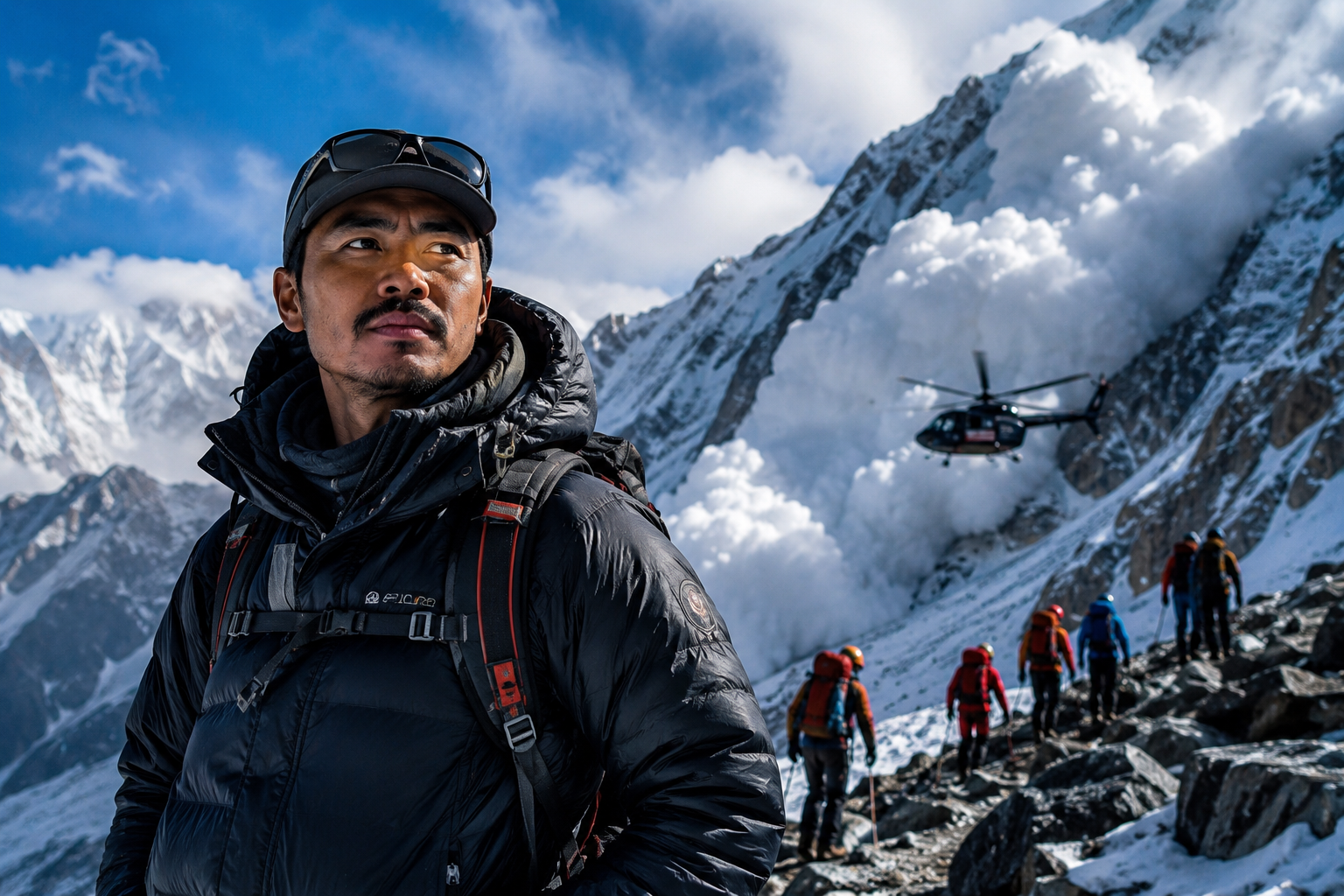
Nepal-born mountaineer Nirmal Purja, widely known as “Nims” or “Nims Dai”, is among the climbers reported missing after an avalanche struck Broad Peak in Pakistan’s Gilgit-Baltistan region.
The incident has drawn international attention because Purja is one of the most recognizable figures in modern high-altitude mountaineering. He became globally known after completing the ascent of all 14 mountains above 8,000 meters in just six months and six days in 2019, a feat documented in the Netflix film 14 Peaks: Nothing Is Impossible.
As of July 31, 2026, rescue teams were searching for seven climbers still unaccounted for, including Purja, after three bodies had been recovered. Poor weather and difficult conditions in the remote mountain region have complicated the operation.
Who is Nirmal Purja?
Nirmal Purja is a Nepalese mountaineer who built his reputation through a series of extraordinary high-altitude expeditions.
Before becoming a professional mountaineer, Purja served in the British Army’s Brigade of Gurkhas and later in the Special Boat Service (SBS), the Royal Navy’s special forces unit. His military career helped develop the discipline, endurance and mental resilience that would later become central to his climbing career.
Purja eventually left the military and turned his attention to mountaineering, taking on some of the world’s most difficult peaks.
His biggest achievement came through Project Possible, an ambitious attempt to climb all 14 of the world’s 8,000-metre mountains in less than seven months.
How did Purja climb all 14 eight-thousands’?
The world’s 14 eight-thousanders are mountains rising above 8,000 metres, including Mount Everest, K2, Kangchenjunga, Lhotse and Broad Peak.
Purja began Project Possible in April 2019. His original goal was to complete all 14 climbs within seven months.
Instead, he finished the challenge in just six months and six days, completing the final summit, Shishapangma, on October 29, 2019. His official project account describes the achievement as a record-breaking ascent of all 14 of the world’s highest peaks.
The project required an extraordinary schedule. Purja and his team moved between some of the world’s most dangerous mountain environments, often operating under extremely tight weather windows.
He also used supplementary oxygen during Project Possible, an aspect that is important when comparing his achievement with earlier climbers who completed the 14 peaks without supplemental oxygen.
What is Netflix’s 14 Peaks about?
Purja’s remarkable 2019 expedition became the subject of the Netflix documentary 14 Peaks: Nothing Is Impossible.
Released in November 2021, the film follows Purja and his team as they attempt to complete the seemingly impossible challenge of climbing all 14 eight-thousanders within seven months.
Netflix describes the documentary as following “fearless Nepali mountaineer Nimsdai Purja” on his quest to summit the world’s 14 highest peaks.
The film brought Purja’s story to a much wider global audience, introducing viewers to the physical risks, logistical difficulties and personal sacrifices involved in high-altitude mountaineering.
It also helped establish his nickname, Nims Dai, among international audiences.
Purja’s connection to Broad Peak
Broad Peak is not an unfamiliar mountain to Purja.
During Project Possible in July 2019, he climbed Broad Peak after completing a series of other major Pakistani peaks, including Nanga Parbat, Gasherbrum I, Gasherbrum II and K2. He summited Broad Peak on July 26, 2019.
Broad Peak rises to approximately 8,051 metres and is the world’s 12th-highest mountain. Located in the Karakoram range, it is known for its demanding high-altitude environment and serious avalanche and weather risks.
That makes the current incident particularly striking: the mountain is one Purja had successfully climbed during his historic 14-peak project.
What happened in the latest avalanche?
An avalanche struck an international group of climbers on Broad Peak on July 30, 2026.
Purja was among those reported missing after the incident. Reuters reported on July 31 that Pakistani authorities had recovered three bodies, while seven climbers, including Purja, remained missing. Search efforts involved ground teams and Pakistan Army Aviation helicopters, although poor weather was hampering the operation.
Other reports have described the group as an international expedition involving climbers from several countries.
The situation remains fluid, and information can change as rescue teams gain access to the affected area.
Why the climbing world is watching
Purja’s disappearance has resonated strongly because of the scale of his mountaineering achievements.
His 2019 Project Possible expedition transformed him into one of the most prominent names in modern Himalayan and Karakoram climbing. His ability to complete all 14 eight-thousanders in just over six months dramatically compressed a challenge that had historically taken climbers years to accomplish.
He later remained active in extreme mountaineering, including leading the team that achieved the first winter ascent of K2 in 2021.
For now, however, attention is focused not on records but on the ongoing rescue effort.
A record-holder facing one of mountaineering’s greatest dangers
Nirmal Purja’s story has been defined by extraordinary ambition, endurance and a willingness to take on some of the world’s most dangerous mountains.
From the British Gurkhas and Special Boat Service to his record-setting Project Possible expedition and global recognition through Netflix’s 14 Peaks, his journey has made him a celebrated figure in mountaineering.
But the Broad Peak avalanche is a stark reminder that even the most experienced climbers remain vulnerable to the unpredictable forces of high-altitude mountains.
As rescue teams continue their search, the climbing community and Purja’s supporters are awaiting further updates on the fate of the celebrated mountaineer and the other climbers caught in the avalanche.
Disclaimer
This article is intended for informational purposes only. The situation on Broad Peak is an ongoing rescue operation, and casualty numbers, missing-person status and other details may change as authorities receive new information. The article reflects reports available on July 31, 2026, and readers should consult official authorities and reputable news organisations for the latest updates. It does not speculate on the outcome of the rescue operation.
Learn more about our site on contactarchive2in.com
Contact us on our email id contactarchive2in@gmail.com
Leave a Reply
You must be logged in to post a comment.