
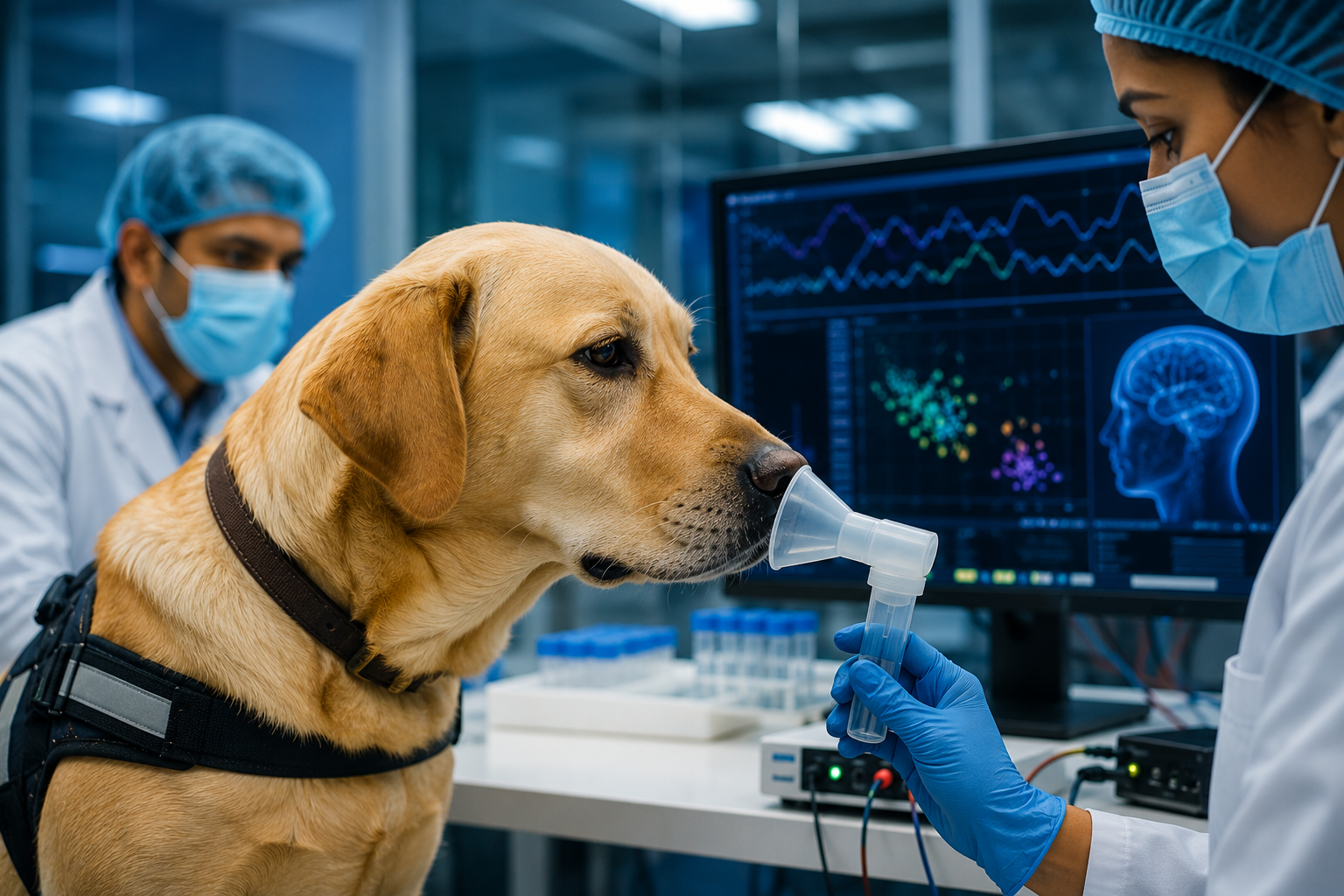
A breath test for cancer might sound like something from a science-fiction movie. But a Bengaluru-based startup Dognosis is exploring an unusual idea: using trained dogs as biological detectors and artificial intelligence to turn what they smell into measurable medical data.
The company, Dognosis, is developing a technology called BreathEasy, which uses breath samples to look for chemical patterns associated with disease. Rather than asking patients to undergo an invasive procedure, the concept involves collecting a breath sample and analysing it with trained detection dogs in a controlled laboratory environment.
The technology is particularly interesting because it brings together three very different fields—canine biology, neuroscience and artificial intelligence.
Why would dogs be able to detect cancer?
Dogs have an extraordinary sense of smell. Their noses can distinguish extremely subtle chemical differences that humans cannot perceive.
Scientists have been studying whether this ability can be used in medicine. One area of interest is volatile organic compounds, or VOCs.
These are chemical compounds released by the body that can be found in breath. Changes in the body’s metabolism can alter the combination of VOCs present, potentially creating a chemical pattern associated with certain diseases.
Dognosis is attempting to use trained dogs to recognise these patterns.
The company says its dogs are trained to identify disease-associated scent signatures rather than directly “smelling cancer” in the way the phrase might suggest.
The unusual role of artificial intelligence
The most fascinating part of the project is what happens after the dog detects a scent.
Dognosis is developing technology that records information from the dogs while they analyse samples. Its DogSense system is described by the company as a brain-computer interface designed to capture EEG data from a dog’s brain during scent detection.
Machine-learning systems can then analyse these biological signals.
The broader objective is to convert an animal’s extremely sensitive sense of smell into a digital signature that computers can study.
In simple terms, the dog provides the biological sensing ability, while AI helps translate that ability into data.
Patients don’t have to meet the dogs
Despite the unusual concept, the proposed test doesn’t involve bringing a group of dogs into a hospital and asking them to sniff patients.
Instead, Dognosis says a person provides a breath sample using a mask. The sample is sealed and transported to a laboratory, where trained dogs analyse it under controlled conditions.
According to the company, a breath collection session takes about 10 minutes.
This approach could potentially make the system easier to operate at scale because samples can be collected away from the laboratory and analysed later.
What have the studies found?
The technology has moved beyond the purely experimental stage.
A Phase II study involving researchers from Dognosis and several Indian medical institutions was published in the Journal of Clinical Oncology in 2026. The study investigated canine olfaction combined with Bayesian modelling for detecting multiple cancers from breath samples.
Dognosis reports that its study involved 1,502 participants across six hospitals and found approximately 91% accuracy across seven cancer groups.
The company’s own media information lists a larger figure of 3,222 study participants and 15 trained detection dogs, reflecting its broader research programme.
These results are encouraging, but they should not be interpreted as meaning that the technology can currently diagnose cancer with certainty.
Clinical screening technologies need extensive validation across different populations and settings before they can become routine medical tools.
Why breath-based screening could be important
One of the biggest attractions of the approach is its simplicity.
Traditional cancer investigations can involve blood tests, imaging, tissue sampling or other procedures, depending on the suspected disease.
A breath sample, by comparison, is non-invasive.
That could make it particularly interesting for large-scale screening, where affordability, convenience and accessibility are important.
Dognosis says its longer-term goal is to develop a multi-cancer early-detection system that can complement existing medical screening rather than immediately replace established diagnostic methods.
Bengaluru’s deep-tech experiment
Dognosis was founded in 2024 and is headquartered in Bengaluru. Its founders include Akash Kulgod and Itamar Bitan, and the company has built a research programme around canine cognition and medical detection.
Its work also involves collaborations with medical institutions, including St. John’s Medical College, Narayana Health, Aster CMI Hospital and other research organisations.
The startup’s approach illustrates an increasingly interesting direction in healthcare technology: instead of replacing biology with machines, researchers are trying to combine biological intelligence with computing power.
What happens next?
Dognosis has indicated that it is working toward a potential commercial launch in India in early 2027, subject to ongoing clinical work and the necessary requirements.
The next stage will be crucial.
Researchers will need to establish how consistently the system performs across different groups of patients, how it compares with existing screening techniques and how effectively it can operate outside controlled research environments.
There is also the question of regulation and clinical adoption.
The bigger picture
The idea of dogs helping detect cancer may sound unusual, but the science behind the concept is rooted in a simple observation: disease can change the chemistry of the human body, and dogs are exceptionally good at detecting chemical differences.
Dognosis is trying to add a technological layer to that biological ability.
If researchers can reliably capture what dogs detect and translate it into useful digital information, the result could be a new kind of medical screening—one based not on an image or blood sample, but on the chemistry of a person’s breath.
For now, the technology remains an emerging area of research. But if further clinical evidence supports the early findings, Bengaluru’s experiment with dogs and AI could offer a remarkably different approach to one of medicine’s biggest challenges: finding cancer earlier, when treatment can have a better chance of succeeding.
Disclaimer
This article is independently written for informational and educational purposes and is not copied from any source. Medical research and clinical results can change as additional studies are published. Dognosis’ technology is still being evaluated and should not be considered a replacement for established cancer screening or diagnostic tests. Anyone concerned about cancer should consult a qualified healthcare professional and follow recommended screening guidelines.
Learn more about our site on contactarchive2in.com
Contact us on our email id contactarchive2in@gmail.com
Leave a Reply
You must be logged in to post a comment.