
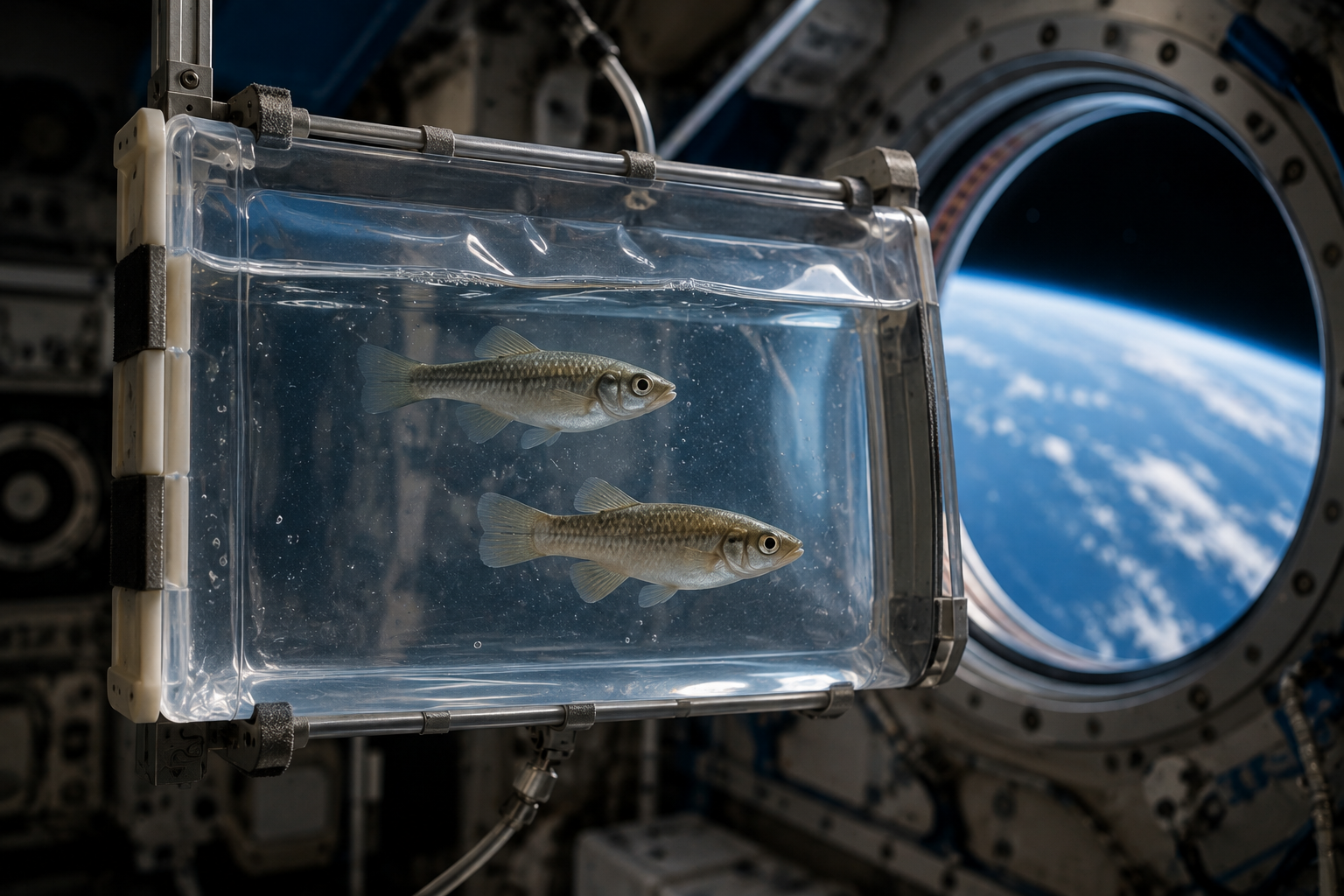
In 1973, NASA carried out a small but remarkable experiment aboard the Skylab 3 mission: two young mummichog fish and 50 embryonated eggs were sent into orbit to see how life adapted when gravity—the constant that helps define “up” and “down” on Earth—was suddenly removed.
What happened next was strange. When scientists first observed the fish after several days in weightlessness, both spent much of their time swimming in tight loops and circles. But over the following weeks, the behavior gradually faded. By about the 21st day, the fish had largely adapted and were swimming normally, using light as an important substitute for the directional cue that gravity normally provides.
A Tiny Experiment on a Historic Mission
The fish experiment took place during Skylab 3, the second crewed mission to America’s first space station. Launched on July 28, 1973, astronauts Alan L. Bean, Owen K. Garriott and Jack R. Lousma spent a then-record 59.5 days in space.
They were not alone. Skylab 3 also carried a variety of living organisms for scientific studies, including the two minnows, 50 fish eggs, spiders, mice and fruit fly pupae. The goal was to understand how living systems responded to the unfamiliar environment of orbital weightlessness.
The fish, scientifically identified as Fundulus heteroclitus, were kept in a small plastic bag aquarium. On Earth, fish have several cues that help them maintain orientation. Gravity influences sensory structures involved in balance, while visual information—including the direction of light—also helps them determine how to position their bodies.
The Fish Started Swimming in Strange Loops
When the NASA astronauts first observed the fish after three days in orbital weightlessness, their behavior was far from normal.
Both fish repeatedly swam in tight circles and looping patterns. NASA’s later technical analysis described the behavior as “looping,” with the frequency of these episodes gradually decreasing as the mission continued. Scientists had seen related behavior in earlier short-duration experiments involving fish in reduced-gravity conditions, but Skylab offered an opportunity to observe adaptation over a much longer period.
The looping was not random in the ordinary sense. Researchers proposed that the fish were responding to the sudden loss of gravitational information affecting their balance and orientation systems.
One hypothesis suggested that tiny sensory hairs associated with structures in the fish’s inner ear were no longer being bent by gravity as they were on Earth. The fish may have responded by changing their body position in an attempt to generate or interpret a familiar directional signal—except, in weightlessness, the movement continued into a loop.
Another possibility was that the looping itself could have created an inertial stimulus for the fish’s balance organs.
Scientists could not reduce the entire mystery to a single explanation, but the unusual swimming demonstrated just how deeply living creatures can depend on environmental cues they rarely notice on Earth.
After Three Weeks, They Began to Adapt
The most fascinating part of the experiment was what happened next.
The looping behavior slowly became less frequent. By the 21st day of the experiment—reported in observations around flight day 22—the fish were predominantly swimming in a more normal pattern.
But “normal” in space did not necessarily mean that their bodies had somehow recreated Earth’s gravitational environment.
Instead, the fish appeared to rely heavily on visual orientation. They positioned themselves with their backs toward the light source, effectively using light as a substitute reference for the missing gravitational cue.
NASA’s NASA Skylab life-sciences records describe this adaptation as the fish using visual orientation to compensate for the absence of gravity. Earlier experiments on Earth had already shown that both light direction and gravity could influence how fish orient themselves. In orbit, where gravity no longer provided a reliable “down,” light became an especially important reference.
In other words, the fish did not simply stop being confused. They appeared to develop a new strategy for navigating their environment.
The Experiment Had Another Surprise
The two adult fish were only part of the story.
NASA Skylab 3 also carried 50 embryonated fish eggs. According to the published research, 96% of the eggs hatched during the mission. The hatchlings displayed generally normal swimming behavior and immediately showed visual orientation, keeping their backs toward the light.
However, the young fish could also display abnormal circular swimming when their aquarium was shaken.
The timing of hatching was also noteworthy. NASA’s Skylab records reported that many of the space-borne eggs hatched later than the control eggs on Earth, providing researchers with additional information about how development might be affected in a microgravity environment.
Why Two Small Fish Mattered
At first glance, an experiment involving two minnows may sound like a minor footnote in the history of space exploration. Skylab 3 is more often remembered for its record-setting mission, solar research and the work of its three astronauts.
But the fish offered an important lesson.
Gravity is not just something that keeps people and objects on the ground. Over millions of years of evolution, life on Earth has developed countless ways of sensing and responding to it. Take that constant away, and animals may initially struggle to interpret their surroundings.
Yet the Skylab fish also demonstrated something equally important: adaptation.
Within weeks, their behavior changed. The looping diminished, and visual information helped them establish a new sense of orientation. The experiment became an early example of how living organisms can adjust to an environment radically different from the one in which they evolved.
A Lesson That Still Matters
More than five decades later, humans are spending increasingly long periods in space, while scientists continue to study how microgravity affects the body, balance, development and behavior.
The story of Skylab’s tiny fish remains a vivid reminder that space exploration is not only about rockets and astronauts. Sometimes, major questions about biology can emerge from watching two small creatures trying to answer a simple question that becomes surprisingly difficult in orbit:
Disclaimer: This article is intended for educational and informational purposes. It is based on NASA archival records and published scientific research on the Skylab 3 fish experiment. Scientific interpretations of the fish’s looping behavior include proposed mechanisms related to sensory and balance systems, and the exact explanation should not be presented as conclusively established beyond the evidence reported by the researchers.
Learn more about our site on contactarchive2in.com
Contact us on our email id contactarchive2in@gmail.com
Leave a Reply
You must be logged in to post a comment.