
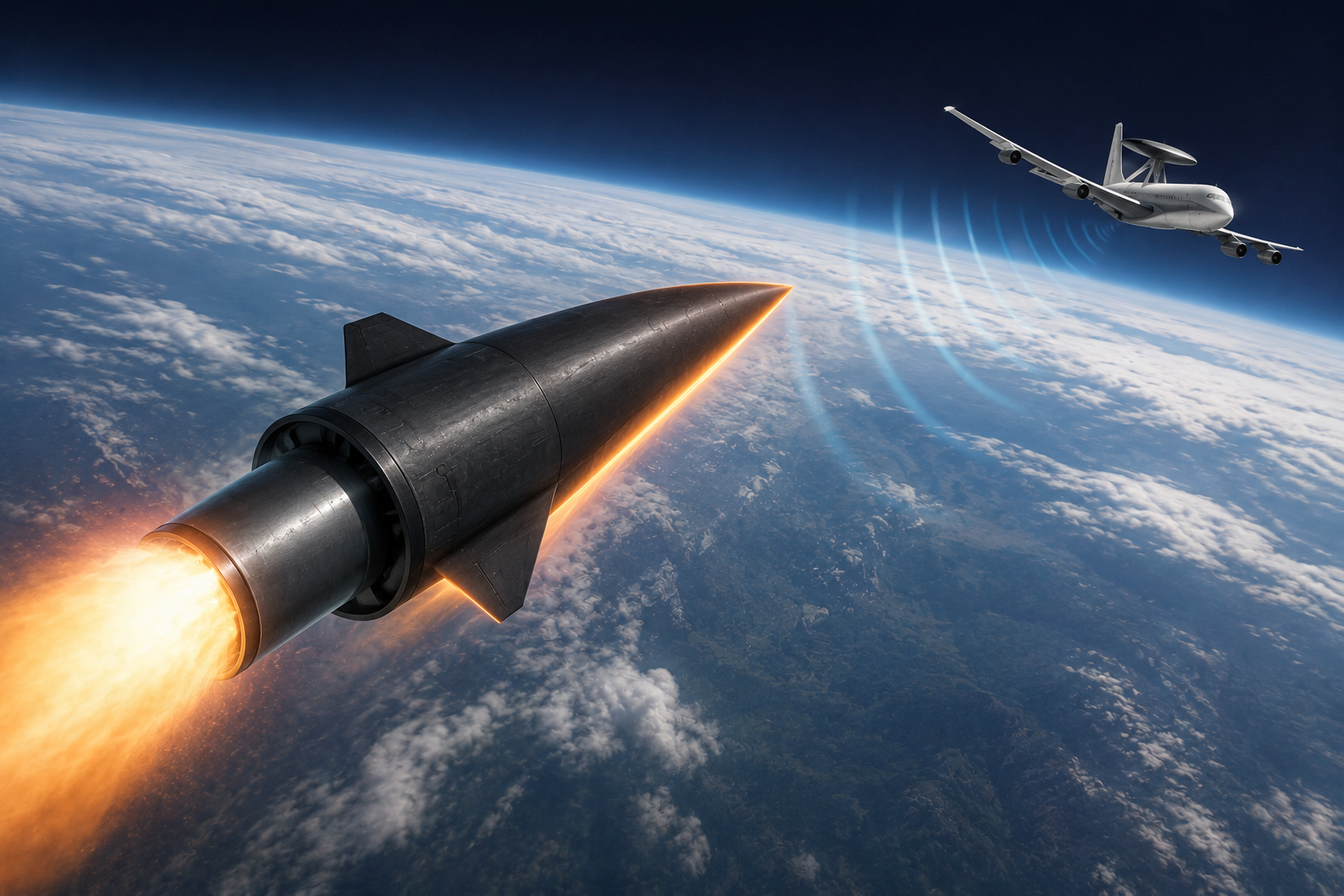
China has reportedly developed a new class of hypersonic weapon capability that could dramatically change the way long-range air warfare is understood.
According to recent reporting, the Chinese military has developed hypersonic glide vehicles capable of launching air-to-air weapons missile, potentially allowing it to threaten high-value aircraft operating thousands of miles—or thousands of kilometres—away from the battlefield. The reported development is significant because it could place aircraft traditionally considered relatively safe at extreme distances within the reach of China’s expanding missile arsenal.
The concept is still surrounded by important unanswered questions, including exactly how the system operates, how mature it is and whether it has entered operational service. But if the reported capability performs as described, it could represent a major shift in the challenge facing air forces operating in the Indo-Pacific.
What exactly has China reportedly developed?
The key development is not simply a new conventional air-to-air missile.
Reports indicate that China has developed hypersonic glide vehicles, or HGVs, that can carry and launch air-to-air weapons. A hypersonic glide vehicle is generally launched at high speed before gliding and maneuvering through the atmosphere toward its target.
The reported concept could combine the enormous reach of a ballistic or hypersonic delivery system with a weapon designed to engage aircraft. That could theoretically allow China to attack high-value airborne assets from distances far beyond those associated with traditional fighter-launched air-to-air missiles.
According to the reporting, China has also explored adding air-to-air capabilities to certain hypersonic cruise missiles, as part of a broader effort to adapt its missile forces for multiple types of missions.
Which aircraft could be at risk?
The potential targets are not necessarily fighter jets engaged in close-range combat.
The greater concern involves the large, high-value aircraft that support military operations from far behind the front line. These can include:
- Airborne early-warning and control aircraft
- Aerial refueling tankers
- Intelligence and surveillance platforms
- Airborne command-and-control aircraft
- Strategic command aircraft
These aircraft act as critical enablers for modern air operations. Tankers allow fighters to remain airborne longer, while airborne warning aircraft can provide radar coverage and coordinate operations across large areas.
A weapon capable of threatening such aircraft at extreme range could force them to operate farther away from contested airspace, potentially reducing their effectiveness. That is why the reported Chinese capability has attracted particular attention in discussions about a possible future conflict in the Indo-Pacific.
The DF-17 and DF-27 could provide enormous reach
The reported system is associated with China’s broader hypersonic and ballistic missile infrastructure.
A hypersonic glide vehicle launched by a DF-17 could reportedly travel about 1,500 miles, or roughly 2,414 kilometres. That is close to the distance between parts of mainland China and the U.S. territory of Guam, one of Washington’s most strategically important military hubs in the Pacific.
The DF-27, meanwhile, has been reported as having a substantially longer maximum range—around 5,000 miles, or approximately 8,000 kilometres—potentially placing locations as distant as Hawaii within its reach.
That does not mean a missile can simply launch and automatically hit an aircraft thousands of miles away. The technical challenge is considerably more complicated.
Hitting a moving aircraft is the real challenge
A fixed target is difficult enough. An aircraft moving hundreds of kilometres per hour at a distance of thousands of kilometres presents a much harder problem.
The weapon would need highly accurate and continuously updated information about the target’s location. During a long flight, the aircraft could change direction, altitude or speed.
This creates what military analysts often call a kill chain—the process of detecting a target, tracking it, communicating updated information, launching a weapon and guiding that weapon to the correct location.
Reports note that a ballistic missile travelling at maximum range could take 20 minutes or more to reach its destination. During that period, the target may have moved a considerable distance. Any disruption in surveillance, communications or targeting data could make an engagement far more difficult.
There is another risk: the launch of a long-range ballistic missile could potentially be misinterpreted during a major conflict, particularly if an adversary cannot immediately determine whether the weapon carries a conventional or nuclear payload.
Why hypersonic weapons are so difficult to counter
Hypersonic systems generally travel at speeds of at least Mach 5. Their high speed, combined with the ability of some systems to maneuver during flight, can make detection, tracking and interception more difficult than with certain traditional ballistic trajectories.
China has already invested heavily in hypersonic weapons, and recent reporting has pointed to the broader deployment and development of systems including the YJ-20 anti-ship missile.
The newly reported air-to-air concept would extend this broader strategy into a different area: using extreme-range missile technology against airborne targets.
If successful, the approach could challenge the assumption that support aircraft can remain safely outside the reach of an opponent’s air-defense network.
A new challenge for the United States and its allies?
The development comes as long-range air-to-air warfare becomes an increasingly important area of military competition.
The United States is also developing and testing longer-range weapons. The U.S. Navy recently disclosed the AIM-424 Long Range Air-to-Air Missile, also known as Malice, which is designed to engage aircraft at ranges exceeding 300 miles, according to recent reporting.
But the Chinese concept described in the latest reports operates on a potentially different scale. Rather than extending the range of a fighter’s air-to-air missile by hundreds of miles, the idea is reportedly to use a long-range hypersonic delivery system to bring an air-to-air weapon into the vicinity of a distant airborne target.
That could potentially transform how militaries think about protecting tankers, surveillance aircraft and airborne command centres.
A breakthrough—but with major questions remaining
Despite the dramatic headlines, it is important to separate reported capability from a fully verified and demonstrated operational weapon.
Much of the latest information is based on reporting citing a person with direct knowledge of the matter, rather than a detailed public technical disclosure by China’s military. Important details—including the system’s guidance method, testing history, operational status and actual effectiveness against moving targets—remain unclear.
The idea itself also comes with substantial technical and strategic risks. Long-range targeting against a maneuvering aircraft is extraordinarily demanding, while the use of ballistic or hypersonic weapons against airborne targets could introduce escalation concerns during a conflict.
Still, the reported development highlights the direction of modern military competition: longer range, faster weapons and a growing effort to target the networks that allow air forces to operate at great distances.
For decades, the safest place for a command aircraft or aerial tanker was believed to be far behind the front line. China’s reported new missile concept suggests that, in a future high-intensity conflict, “far away” may no longer mean what it once did.
Disclaimer: This article is intended for informational and news-analysis purposes only. The reported Chinese capability is based on recent media reporting and information that has not been fully detailed in public by the Chinese military. Technical specifications, operational status, range and effectiveness may change or remain unverified. Claims about the weapon’s performance should therefore be treated with appropriate caution.
Learn more about our site on contactarchive2in.com
Contact us on our email id contactarchive2in@gmail.com
Leave a Reply
You must be logged in to post a comment.