
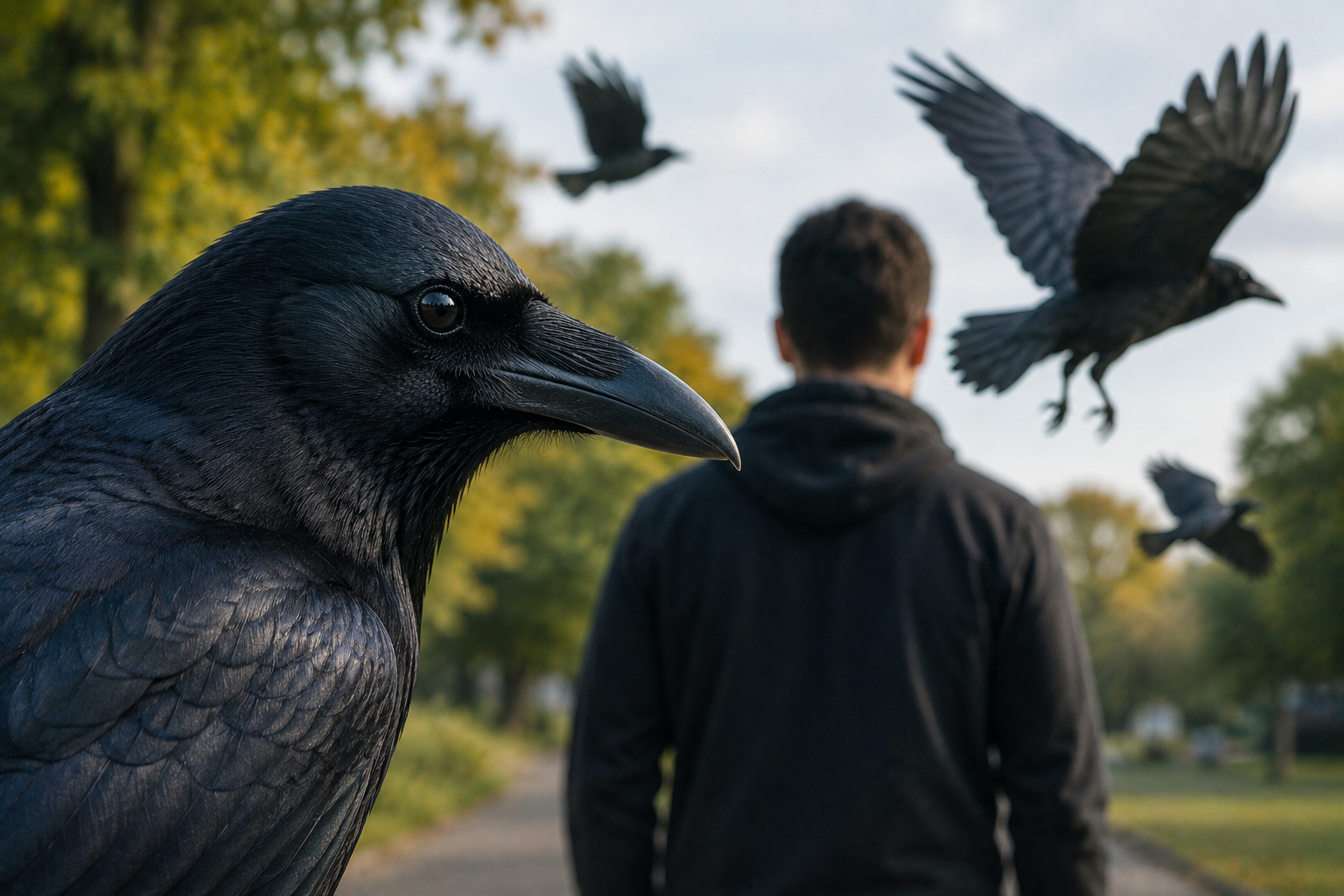
If you have ever annoyed a crow, it may remember you.
That sounds like something from a wildlife thriller, but scientific research suggests there is a fascinating truth behind the idea. American crows can recognize individual human faces, remember people associated with threatening experiences and change their behaviour when they encounter those people again.
Scientists have even used brain imaging to investigate what happens inside a crow’s brain when it sees a familiar human face. The results offer an extraordinary glimpse into the cognitive abilities of birds—and challenge the old assumption that sophisticated intelligence requires a mammalian brain.
Crows don’t just see a face—they can associate it with an experience
One of the most striking findings comes from research published in 2012.
Scientists worked with American crows that had previously encountered particular humans. Some people had been associated with capture or threatening experiences, while others had provided care.
When the birds later saw those familiar faces, their brains responded differently depending on the person’s history with them.
The researchers found activity in several regions involved in visual processing, learning, motivation and emotional responses. Faces associated with threats activated circuitry involving the avian equivalent of the amygdala-related fear system, along with areas involved in attention and behavioural responses. Faces associated with caring experiences produced a different pattern of activity.
In simple terms, the crows appeared to have learned:
“This person is dangerous.”
or
“This person is associated with something positive.”
That is much more sophisticated than simply recognizing that a human is standing nearby.
How long can a crow remember a face?
Researchers have reported that crows can remember specific human faces for years after a single encounter.
That ability can be extremely useful in the wild.
Humans can represent different levels of danger. A person who feeds birds may be harmless or beneficial, while someone who captures or threatens them may represent a serious risk.
Remembering individual people allows a crow to respond differently instead of treating every human as identical.
It is an example of social learning and long-term memory—abilities that are extremely valuable for animals living in complex environments.
The famous “angry crow” effect
This research helps explain why some people report being repeatedly mobbed or scolded by crows after disturbing them.
Crows are highly social animals. When one bird detects a potential threat, other crows can become involved, calling loudly, gathering nearby and sometimes diving toward the perceived danger.
Research has shown that crows respond differently to different threats, including a person who previously captured a crow, a person holding a dead crow and a taxidermy hawk. Brain-imaging experiments found that these different dangers activated partly different neural circuits.
That distinction is important.
The birds were not simply reacting to everything frightening in exactly the same way. Their brains appeared to process different threats according to what they had learned about them.
What happens inside a crow’s brain?
Crows do not have a human-like neocortex.
That makes their intelligence particularly interesting.
One brain region that has received significant attention is the nidopallium caudolaterale (NCL). It is an association area in the avian brain involved in higher-level cognitive processes.
Research on crows has found neurons in the NCL that can maintain information in working memory, including visual information and spatial locations. Other research has found activity related to flexible, rule-based decision-making.
Scientists therefore increasingly view the crow brain not as a simpler version of a mammalian brain, but as a different biological solution to complex information processing.
The architecture is different, yet some of the functions can be surprisingly comparable.
Intelligence does not require a human-style brain
For a long time, intelligence was often discussed as though it depended on having a large mammalian brain or a structure resembling the human neocortex.
Crows challenge that assumption.
Their brains evolved along a different path, but they demonstrate abilities involving memory, problem-solving, decision-making, social learning and flexible behaviour.
Research into crow cognition has even found neural activity associated with remembering quantities and visual information. Some aspects of their neuronal coding show surprising similarities to mechanisms observed in primates, despite the evolutionary differences between birds and mammals.
This is an example of convergent evolution: very different animals can independently evolve sophisticated solutions to similar cognitive problems.
Crows may also learn from danger
The intelligence story becomes even more interesting when scientists examine how crows respond to dead members of their own species.
Research using brain imaging found that seeing a dead crow activated the nidopallium caudolaterale, a region associated with higher-order decision-making. The researchers suggested that these responses could help birds process potentially dangerous situations and learn from negative experiences.
This does not mean that crows understand death in exactly the same way humans do. Scientists are careful about attributing human emotions or concepts to animals.
But it does show that their reactions to potentially dangerous situations involve more than simple reflexes.
So, do crows actually “hold grudges”?
That depends on what we mean by a grudge.
Saying that a crow remembers a person associated with a negative experience is supported by research.
Saying that the bird experiences a human-like desire for revenge is much harder to establish scientifically.
The safest interpretation is that crows can form lasting associations between individual people and positive or negative experiences. When they later encounter a familiar face, those memories can influence attention, physiological responses and behaviour.
Calling that a “grudge” makes for a catchy headline—but the science is even more interesting without the human analogy.
What this tells us about animal intelligence
The crow’s ability to remember people offers a bigger lesson about intelligence.
There may not be one universal blueprint for being intelligent.
Humans evolved extraordinary cognitive abilities using a mammalian brain. Crows and other corvids developed impressive abilities using an entirely different neural architecture.
Their brains demonstrate that sophisticated memory, learning and decision-making can emerge through different evolutionary routes.
So the next time you see a crow watching you from a rooftop, it may be doing more than simply looking.
It could be identifying you, comparing you with a previous experience and deciding whether you are worth watching—or worth avoiding.
And if you have ever treated a crow badly, perhaps it is wise to remember one thing:
You may have forgotten the encounter. The crow may not have.
Disclaimer
This article is intended for educational and informational purposes. Scientific studies show that crows can recognize familiar human faces and associate individuals with positive or threatening experiences, but this does not establish that crows experience human-like emotions such as resentment or revenge. Interpretations of animal cognition should therefore avoid assuming that birds think exactly like humans.
Learn more about our site on contactarchive2in.com
Contact us on our email id contactarchive2in@gmail.com
Leave a Reply
You must be logged in to post a comment.