
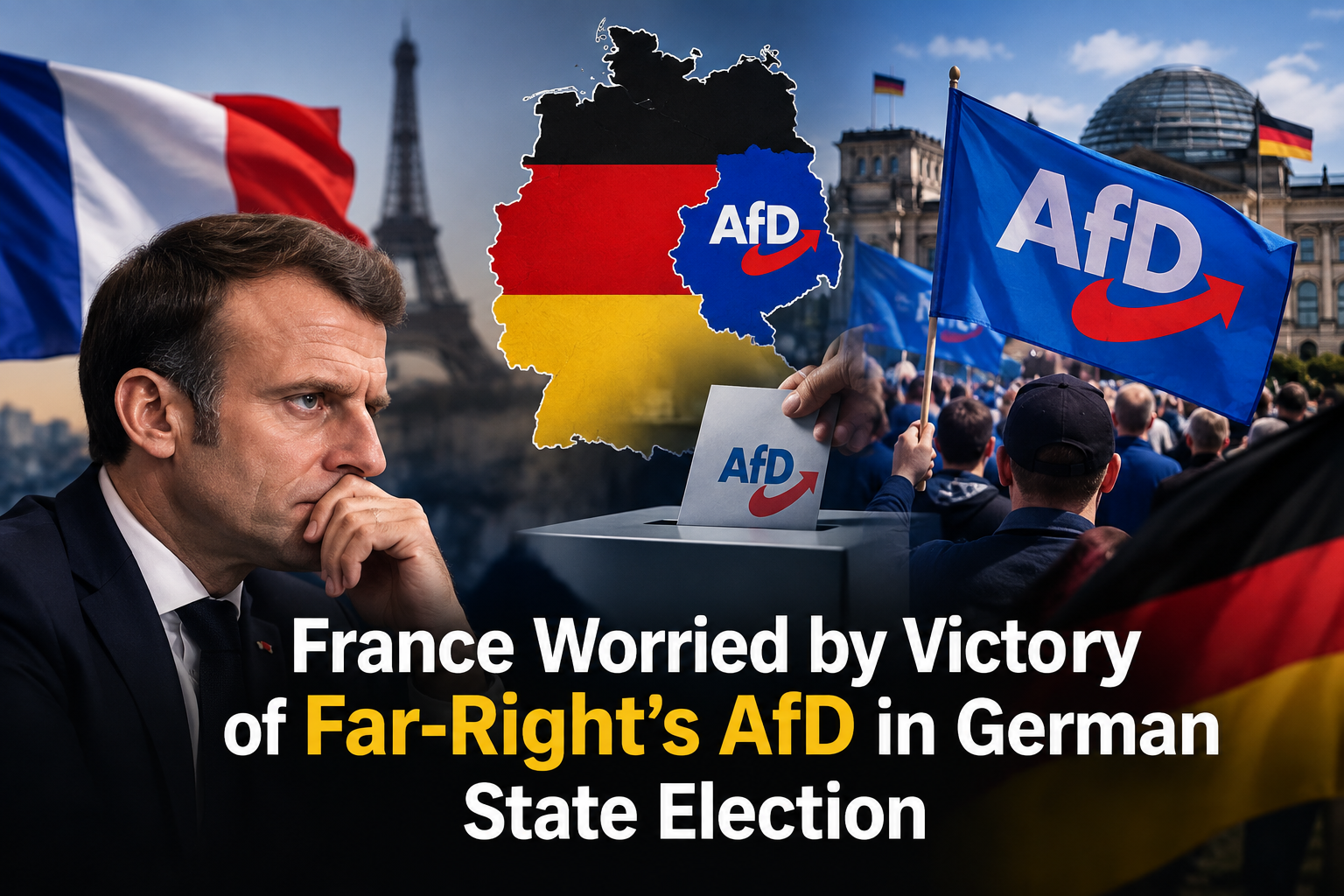
PARIS, September 7 — French government ministers on Monday expressed deep concern over the far-right Alternative for Germany (AfD) party’s decisive win in Sunday’s Saxony-Anhalt state election, a result that has sent ripples of anxiety across European capitals.
AfD Scores Its Biggest-Ever Win
Final results from Sunday’s vote show the AfD taking 43.9 percent of the ballot in Saxony-Anhalt more than double its 20.8 percent showing in the 2021 election, and its strongest state-level result to date. That translates into 39 of the 83 seats in the state parliament, a gain of 16 seats, putting the party just three seats shy of the 42 needed for an outright majority.
The CDU, meanwhile, collapsed to a distant second place with just 17.2 percent of the vote and 15 seats a loss of 25 seats compared to 2021 ending the party’s 24-year hold on the state. The Social Democrats took 9.3 percent, the Greens 8.9 percent, and the Left party 8.6 percent, each securing 8 seats, while the newly formed Sahra Wagenknecht Alliance (BSW) cleared the threshold for the first time with 5.3 percent and 5 seats.
Germany’s domestic intelligence service has classified the Saxony-Anhalt branch of the AfD as a confirmed right-wing extremist organization, a label the party disputes as politically motivated. AfD candidate Ulrich Siegmund hailed the outcome as historic and said it gave his party a clear mandate.
On the other side, CDU state premier Sven Schulze congratulated the AfD and admitted the party would simply have to live with the result, though he said he did not intend to govern alongside them even as he initially hesitated when asked whether the CDU’s long-standing “firewall” against cooperating with the AfD would hold. With the projected seat arithmetic making it exceptionally difficult for any rival bloc to assemble a majority, it remains unclear who will ultimately govern Saxony-Anhalt.
The result is also a fresh blow to Chancellor Friedrich Merz, whose approval ratings have slipped as his federal coalition struggles to reignite growth in Europe’s largest economy. Nationwide, the AfD has been polling in the 25–27 percent range, closing in on the CDU, and Sunday’s landslide arrives just two weeks before further state elections in Berlin and Mecklenburg-Vorpommern both seen as fresh tests of whether Germany’s mainstream parties can keep containing the far right’s rise.
France Sounds the Alarm
The result quickly drew reaction from across the German border. French Finance Minister Roland Lescure told RTL radio that the outcome sent out a deeply worrying signal, framing it as part of a broader populist wave sweeping across the globe that needs to be pushed back against.
His comments echoed those of France’s European Affairs Minister, Benjamin Haddad, who had already reacted on Sunday night. Haddad described the far right’s success in the German regional vote as marking a grave moment for Europe, and cautioned against turning to nationalism and xenophobia as a response.
A Wider European Reaction
France wasn’t alone in voicing concern. Poland’s foreign minister also weighed in on Monday, calling the AfD’s win a very worrying sign following the party’s surge to first place in Saxony-Anhalt. The reaction underscores growing unease among Germany’s neighbors about the political trajectory of Europe’s largest economy, particularly given the AfD’s skepticism toward the European Union and its comparatively friendly posture toward Moscow.
Part of a Broader Populist Trend
Sunday’s result adds to a string of gains for the AfD in recent years, following strong showings in earlier eastern German state elections and February’s federal parliamentary election, where the party finished second nationally with more than 20 percent of the vote becoming Germany’s largest opposition force. Formed in 2013, the AfD has steadily built support in the formerly communist east, where analysts point to persistent frustration over immigration, economic stagnation, and dissatisfaction with establishment parties as key drivers.
Merz himself has repeatedly vowed that the CDU won’t be “destroyed” by the AfD’s rise, describing the party as his conservatives’ “main opponent” and insisting there can be no common ground with it. Yet despite that rhetoric, the isolation strategy pursued by Germany’s mainstream parties refusing any coalition with the AfD at state or federal level has so far failed to slow the party’s momentum. Unlike several of its European neighbors, Germany has yet to see a right-wing populist party lead a national government, a state, or a major city a distinction Sunday’s result has brought closer to an end than ever before.
Whether the AfD can ultimately translate its Saxony-Anhalt breakthrough into actual governing power will hinge on whether other parties in the state parliament are willing to break with that firewall policy something none have so far indicated any willingness to do.
For now, the vote stands as a symbolic watershed: the first time since the Nazi era that a far-right party has come out on top in a German state election, and a result that officials in Paris, Warsaw, and beyond are watching with evident concern.
Learn more about our site on contactarchive2in.com
Contact us on our email id contactarchive2in@gmail.com
Leave a Reply
You must be logged in to post a comment.