
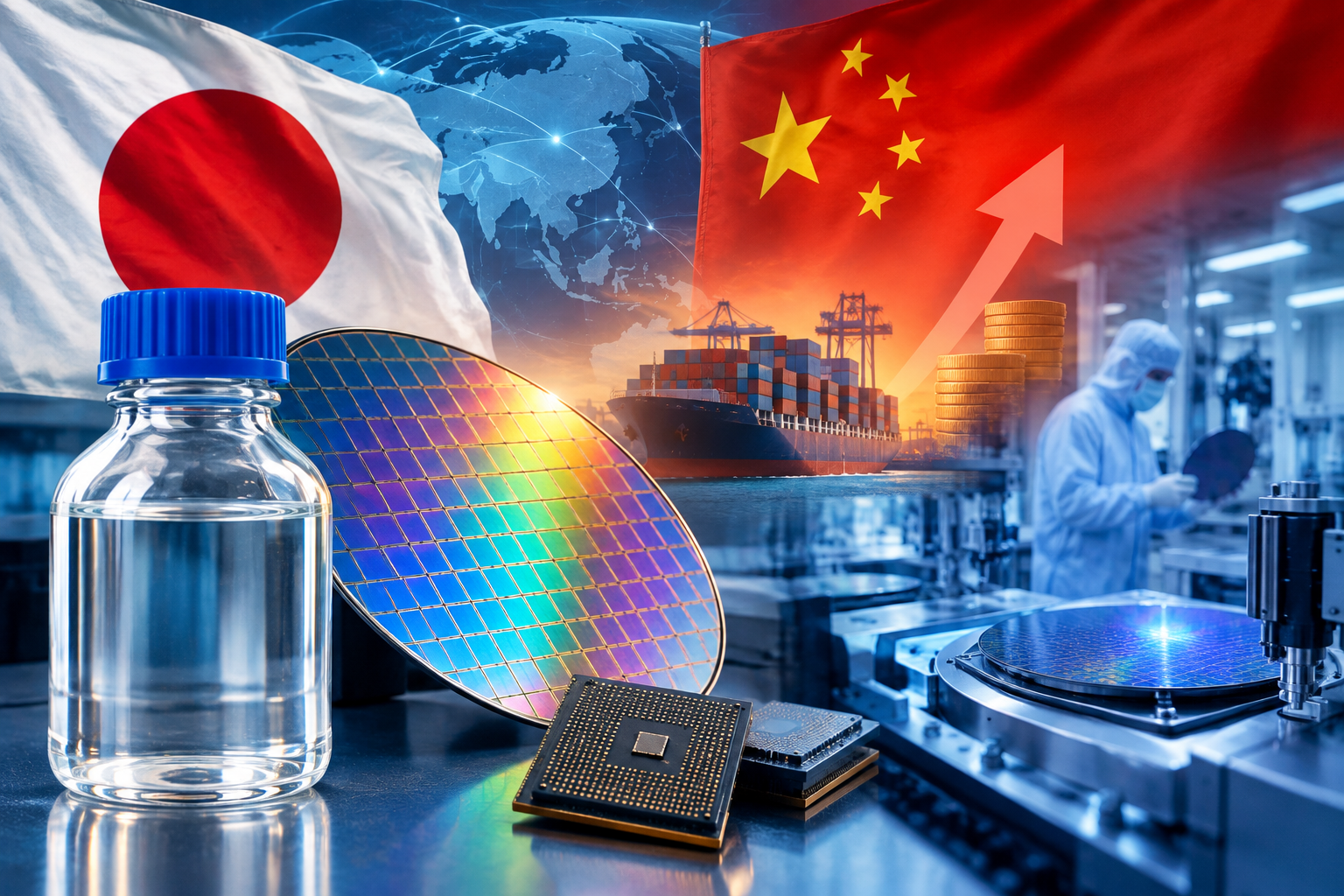
China has taken a fresh step in its increasingly complicated trade relationship with Japan, imposing provisional anti-dumping measures on a key Japanese chemical used in semiconductor manufacturing.
Starting September 8, 2026, Chinese importers of dichlorosilane, a specialised chemical used in the production of semiconductor wafers, must pay a security deposit when bringing the material into China from Japan. The deposit rate has been set as high as 99.2% for several Japanese manufacturers.
The move could have consequences beyond the chemical industry because dichlorosilane is an important material in the manufacturing process for both logic and memory chips.
What is China charging Japanese companies?
China’s Ministry of Commerce announced the provisional measures after an anti-dumping investigation launched in January.
Chinese authorities said preliminary evidence indicated that Japanese imports of dichlorosilane were being sold at unfairly low prices and that the domestic Chinese industry had suffered substantial damage as a result.
Under the new system, importers must provide a cash deposit to Chinese customs.
For most Japanese producers, including major semiconductor-material supplier Shin-Etsu Chemical, the deposit rate is 99.2%. Denal Silane has been assigned a lower rate of 80.8%.
Technically, these are described as provisional anti-dumping security deposits rather than a final determination of duties.
That distinction matters because China’s investigation is still continuing.
Why is dichlorosilane important?
Dichlorosilane, commonly known as DCS, is not a consumer-facing product. It is an industrial chemical used during semiconductor manufacturing, particularly in processes that create thin films on silicon wafers.
Those thin layers are essential components in the fabrication of modern chips.
The chemical is used across different categories of semiconductors, including logic and memory products.
That makes the latest Chinese measure strategically important.
Semiconductor manufacturing depends on a long chain of highly specialised materials and equipment. Even when a particular material represents only a small portion of the total cost of manufacturing a chip, difficulty obtaining it can create delays or force manufacturers to find alternative suppliers.
A new pressure point in China-Japan relations
The timing of the decision is also significant.
China began its investigation in January, following a period of worsening diplomatic relations with Japan.
The dispute has included disagreements over Taiwan and China’s restrictions on certain exports of dual-use goods to Japan. Japanese Prime Minister Sanae Takaichi’s comments concerning a possible Taiwan contingency have further intensified tensions between Beijing and Tokyo.
Against that backdrop, the semiconductor supply chain has increasingly become part of broader geopolitical competition.
China has been working to reduce its dependence on foreign technology and materials, while Japan remains a major supplier of specialised semiconductor equipment and chemicals.
Japan’s semiconductor-material advantage
Japan occupies a powerful position in the global semiconductor supply chain.
Its companies are major suppliers of materials required to manufacture advanced chips, including photoresists, silicon wafers and specialised electronic chemicals.
Companies such as Shin-Etsu Chemical have significant positions in the global semiconductor-materials industry. Reuters reported earlier this year that Japan’s JSR, another major photoresist producer, had attracted interest from other Japanese chemical companies as demand for semiconductor materials increased amid the AI boom.
This creates an interesting strategic situation.
China is attempting to build a more self-sufficient semiconductor industry, but advanced chip manufacturing still depends on specialised foreign technologies and materials.
Could Chinese chipmakers simply switch suppliers?
That may be possible over time—but not necessarily overnight.
Semiconductor manufacturing is an extremely sensitive process. Materials used inside a fabrication plant have to meet stringent purity and consistency requirements.
Changing suppliers is therefore not as simple as replacing one commodity with another.
A new chemical supplier may need to go through extensive qualification and testing before its material can be used reliably in high-volume semiconductor production.
This means Chinese manufacturers could face higher costs or logistical challenges if Japanese supplies become significantly more expensive.
At the same time, the pressure could accelerate China’s efforts to develop domestic alternatives.
The bigger story: semiconductor self-sufficiency
China has been investing heavily in building a domestic semiconductor ecosystem, from chip-design companies and fabrication plants to lithography equipment and electronic chemicals.
Recent developments show that effort accelerating.
Huawei, for example, is supporting Chinese companies developing domestic semiconductor manufacturing equipment, including advanced deep-ultraviolet lithography technology. Chinese chipmakers are testing some of these systems as Beijing seeks to reduce dependence on foreign suppliers.
The same logic applies to chemicals.
If access to Japanese semiconductor materials becomes more expensive or uncertain, Chinese companies have an additional incentive to develop domestic production capabilities.
In the short term, that could create disruption.
In the long term, it could make China’s semiconductor supply chain more self-reliant.
What does this mean for the global chip industry?
The immediate impact will depend on how long the anti-dumping measures remain in place and whether China eventually converts the provisional deposits into definitive duties.
But the broader implication is already clear.
The global semiconductor industry is becoming increasingly fragmented along geopolitical lines.
The United States has imposed restrictions affecting China’s access to advanced semiconductor technologies. Japan has become an important participant in technology controls and remains a major supplier of chipmaking materials. China, meanwhile, is using its own trade and export-control tools while investing heavily in domestic alternatives.
The result is a semiconductor industry where supply-chain security is becoming almost as important as cost and efficiency.
A warning for investors and manufacturers
China’s latest move is unlikely to be viewed simply as another trade dispute over a specialised chemical.
For semiconductor manufacturers, it highlights the risk of depending too heavily on a single country or group of suppliers for critical materials.
For investors, it offers another reminder that semiconductor companies are increasingly exposed not only to chip demand and technological competition, but also to geopolitics.
Artificial intelligence may be driving unprecedented demand for chips, but producing those chips requires an enormous network of chemicals, equipment and materials.
And as the latest China-Japan dispute shows, even a relatively obscure chemical such as dichlorosilane can become strategically important when the world’s biggest technology powers are competing for semiconductor independence.
Disclaimer: This article is for informational purposes only and does not constitute investment, financial, trade or geopolitical advice. The anti-dumping measures discussed are provisional and may change following the completion of China’s investigation.
Learn more about our site on contactarchive2in.com
Contact us on our email id contactarchive2in@gmail.com
Leave a Reply
You must be logged in to post a comment.