
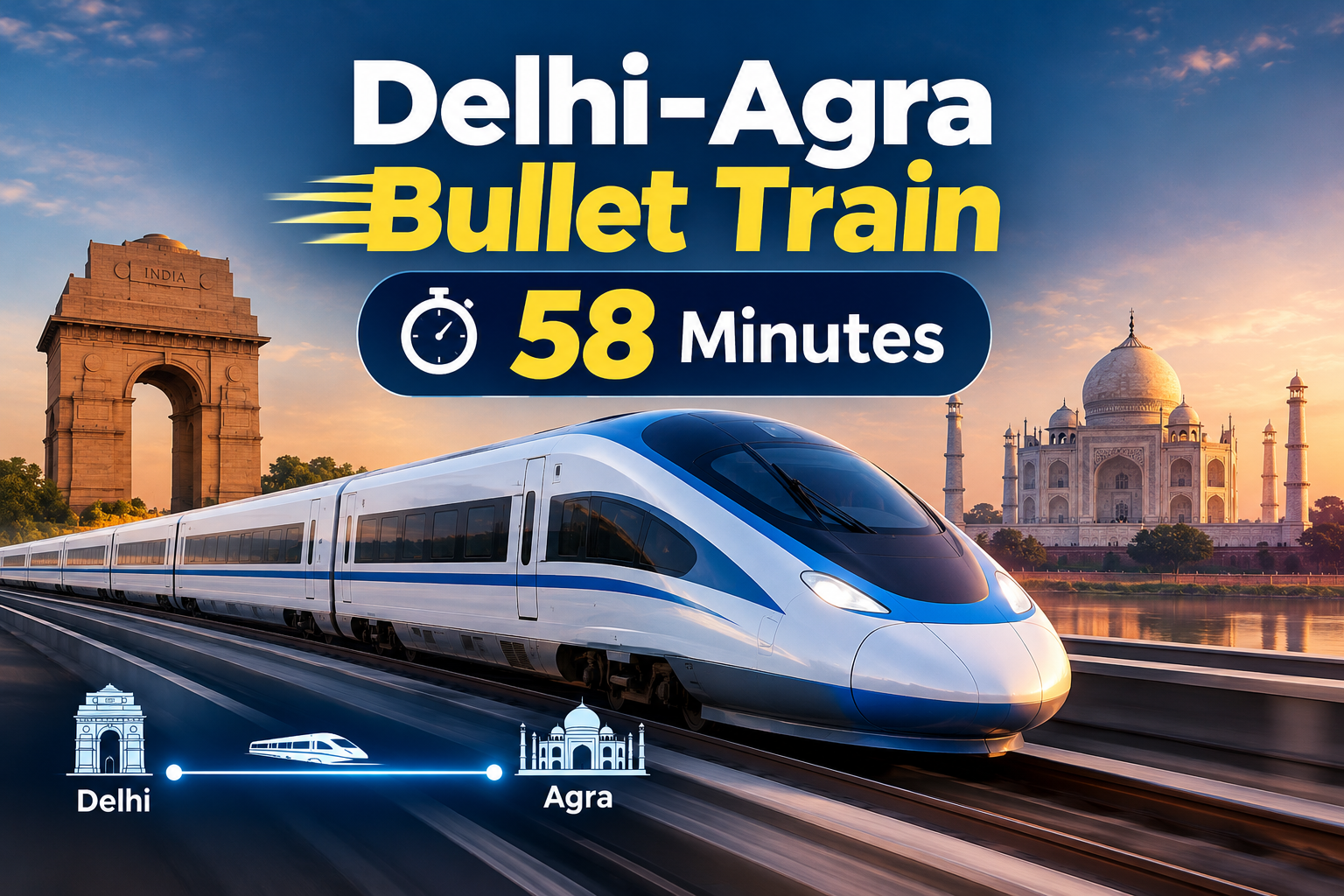
Delhi to Agra, Almost as Fast as a Flight Check-In
Imagine covering the 200 km between Delhi and Agra home of the Taj Mahal in just 58 minutes. That’s the headline number from Railway Minister Ashwini Vaishnaw’s announcement of India’s next major bullet train project: the Delhi-Varanasi High-Speed Rail Corridor, which will also extend onward to Patna.
For context, this would be significantly faster than even the semi-high-speed Vande Bharat trains currently running on Indian tracks, and roughly a third of the time a car or a regular train currently takes to cover the same stretch.
The Full Route: City-by-City Travel Times
According to the route map revealed by the Railway Ministry, the corridor spanning roughly 1,170 km from Delhi to Patna will connect several major cities in Uttar Pradesh and Bihar with dramatically reduced travel times:
| Route | Distance | Travel Time |
|---|---|---|
| Delhi → Agra | ~200 km | 58 minutes |
| Delhi → Kanpur | ~455 km | 1 hour 45–50 minutes |
| Delhi → Lucknow | — | 2 hours 12 minutes |
| Delhi → Prayagraj | ~750 km | ~3 hours |
| Delhi → Varanasi | — | ~3 hours 30 minutes |
| Delhi → Patna | ~1,170 km | ~4 hours 30 minutes |
To put that Delhi-Patna figure in perspective: the same journey currently takes 12 hours or more by conventional train. The bullet train would cut that travel time by more than half.
Who’s Building It, and With What Technology?
The project is being overseen by the National High-Speed Rail Corporation Limited (NHSRCL), under the Ministry of Railways, and will use Japan’s Shinkansen bullet train technology — the same system powering India’s first bullet train project, the Mumbai-Ahmedabad High-Speed Rail (MAHSR) corridor.
This makes Delhi-Varanasi-Patna India’s second major bullet train corridor, following Mumbai-Ahmedabad. It was among seven new high-speed rail corridors announced in the Union Budget 2026-27, signaling a broader national push to expand high-speed rail beyond the Mumbai-Ahmedabad line.
Other corridors announced alongside it include:
- Varanasi–Siliguri: cutting travel time to roughly 2 hours 55 minutes, aimed at improving connectivity to India’s northeast.
- Pune–Hyderabad: targeting around 1 hour 55 minutes.
- Chennai–Bengaluru: targeting roughly 1 hour 13 minutes.
- Chennai–Hyderabad: targeting around 2 hours 55 minutes.
Why This Corridor Matters Economically
Beyond convenience, a high-speed rail link of this scale is expected to have ripple effects across the region:
- Tourism boost for Agra: Cutting the Delhi-Agra journey to under an hour could turn a Taj Mahal visit into a genuine same-day round trip for Delhi-based travelers, potentially increasing footfall and reducing the need for overnight stays.
- Business connectivity across UP and Bihar: Faster access to Kanpur, Lucknow, Prayagraj, Varanasi and Patna could make it far easier for companies to run operations, meetings, and supply chains across cities that are currently 6–12 hours apart by road or rail.
- Real estate and urban development: High-speed rail corridors have historically triggered land-value appreciation and new commercial development near stations, as seen in Japan and China. Cities along this corridor could see similar effects over the medium term.
- Religious and cultural tourism: Varanasi and Prayagraj, both major pilgrimage destinations, stand to benefit significantly from faster, more comfortable connectivity — particularly during large events like the Kumbh Mela.
How Does This Compare to the Mumbai-Ahmedabad Bullet Train?
India’s first bullet train project, the 508 km Mumbai-Ahmedabad corridor, is designed to cover its full route in under two hours, with a partial stretch between Surat and Bilimora expected to become operational by August 2027 and full completion targeted by the end of 2029.
The Delhi Varanasi Patna corridor is at an earlier, announcement-and-planning stage by comparison meaning construction timelines, land acquisition, and final costs are yet to be firmed up. Given that the Mumbai Ahmedabad project has already seen delays due to land acquisition and environmental clearance challenges, similar hurdles could shape the pace of this new corridor as well.
The Bottom Line
A Delhi to Agra bullet train ride in under an hour would have sounded like science fiction a decade ago. With the Delhi Varanasi Patna corridor now officially on the map backed by proven Shinkansen technology and a clear route plan India is signaling serious intent to expand high-speed rail well beyond its first Mumbai-Ahmedabad line. The real test now shifts from announcement to execution: land acquisition, funding, and construction pace will determine how soon “58 minutes to Agra” becomes a reality rather than a headline.
This article is based on route and timeline details announced by Railway Minister Ashwini Vaishnaw and the Ministry of Railways as of September 2026. Timelines are projections and subject to change during project execution.
Learn more about our site archive2in.com
Contact us on our email id contactarchive2in@gmail.com
Read out our latest artice on our blog section
Leave a Reply
You must be logged in to post a comment.