
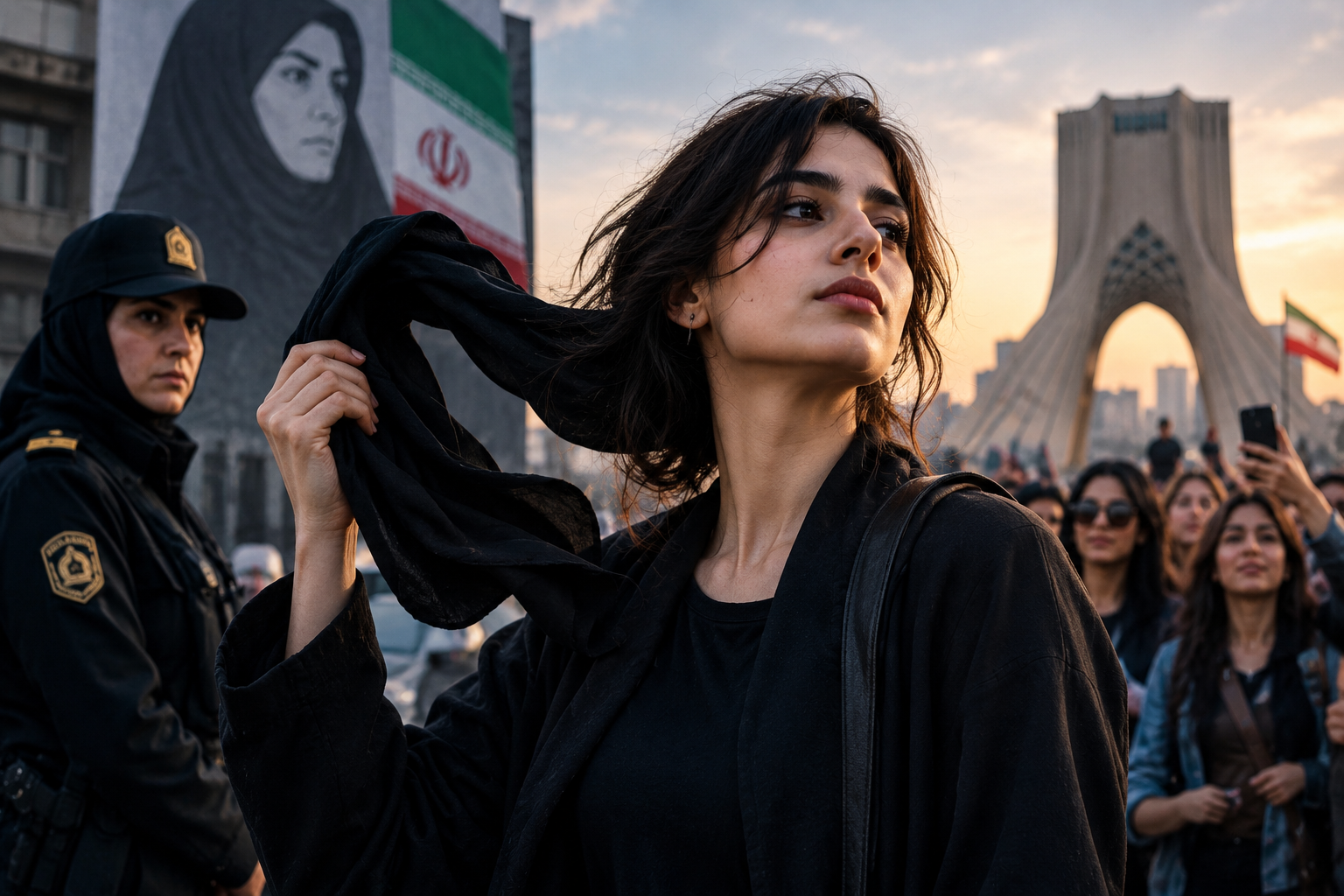
A Law That Exists on Paper, But Not Always in Practice
Since shortly after the 1979 Islamic Revolution, wearing the hijab in public has been legally mandatory for women in Iran. Under Article 638 of the Islamic Penal Code, appearing in public without “Islamic hijab” is a criminal offense though the law never precisely defines what that covers.
But walk through parts of Tehran today, and the picture looks nothing like strict enforcement. Women in crop tops, shorts, and uncovered hair have become an increasingly ordinary sight, especially among the younger generation. As one Tehran resident put it, headscarves are “practically no longer a thing” in many neighborhoods. The law hasn’t changed but the streets have.
From Mahsa Amini to “Woman, Life, Freedom”
To understand where things stand now, it helps to remember how we got here. In September 2022, 22-year-old Mahsa Amini died in police custody after being arrested by Iran’s morality police for allegedly wearing her hijab incorrectly. Her death ignited the “Woman, Life, Freedom” movement the biggest and most sustained challenge to the Islamic Republic’s authority in decades. Protesters, many of them young women, removed and burned their headscarves in the streets, and the movement quickly grew into a broader push against the regime itself.
The crackdown that followed was brutal. According to the Norway-based group Iran Human Rights, more than 500 people were killed by security forces during a wave of unrest in January 2026 alone, layered on top of the deaths and mass arrests since 2022.
Where the Law Stands Today
In 2024, Iran’s hardline parliament passed a much tougher “Hijab and Chastity” law, which would have introduced escalating fines, travel bans, and long prison sentences for women defying the dress code, along with expanded surveillance measures. But facing fears of reigniting mass unrest, Iran’s Supreme National Security Council intervened and halted its implementation. One senior Iranian official went so far as to state publicly that there is “essentially no compulsory hijab law in force” a comment that triggered fury among hardliners in parliament.
That doesn’t mean enforcement has vanished entirely. Human rights monitors have documented recent business closures including several cafes and restaurants in Tehran shut down this year for not enforcing hijab rules on customers along with social media accounts blocked for promoting non-compliance. Amnesty International has described the situation as authorities being forced into “widespread resistance” retreat from the mass arrests of previous years, while still relying on administrative pressure in workplaces and universities to enforce the norm.
Women Are Taking the Risk Anyway
What makes 2026 different from the early days after Amini’s death is the sheer normalization of defiance. Journalists reporting from inside Iran describe women who once kept a headscarf tucked in their bag “just in case” now going out with no head covering at all, in cities across the country — not only in wealthier northern Tehran, historically the most liberal pocket of the capital.
Some of this shift is generational courage born from loss. Following the deadly protests of January 2026, several young women told reporters that watching friends and peers die convinced them they had “nothing left to lose.” For a generation of Iranian teenagers and twenty-somethings, open defiance of the hijab has become less an act of individual rebellion and more a form of collective identity.
The Bigger Picture: Hijab Is One Piece of a Larger Fight
It is worth remembering that the hijab has never been the whole story. As experts on Iranian women’s rights have long pointed out, Iranian women continue to face unequal legal standing in matters of marriage, divorce, child custody, and employment. For many activists, the loosening grip on hijab enforcement is a symbolic but incomplete victory. As one Tehran-based painter told international reporters, seeing women sip coffee bareheaded in cafes doesn’t necessarily signal that “any real change has taken place in people’s freedom,” particularly on the deeper structural inequalities women still face under Iranian law.
What Comes Next
The situation remains fluid and, by most accounts, deliberately ambiguous. The regime appears to be avoiding a return to the visible “morality police” patrols that defined pre-2022 enforcement, wary of provoking another uprising. At the same time, the tougher 2024 hijab law technically remains on the books, unimplemented but not repealed leaving room for authorities to reactivate stricter enforcement if the political climate shifts.
For now, Iran’s women are occupying a strange middle ground: legally still required to cover their hair, but increasingly unwilling and, in growing numbers, unafraid to do so.
Learn more about our site https://archive2in.com
Contact us on iur emailid contactarchive2in@gmail.com
Read out our latest articles on ouur blog section
Leave a Reply
You must be logged in to post a comment.