
Overview
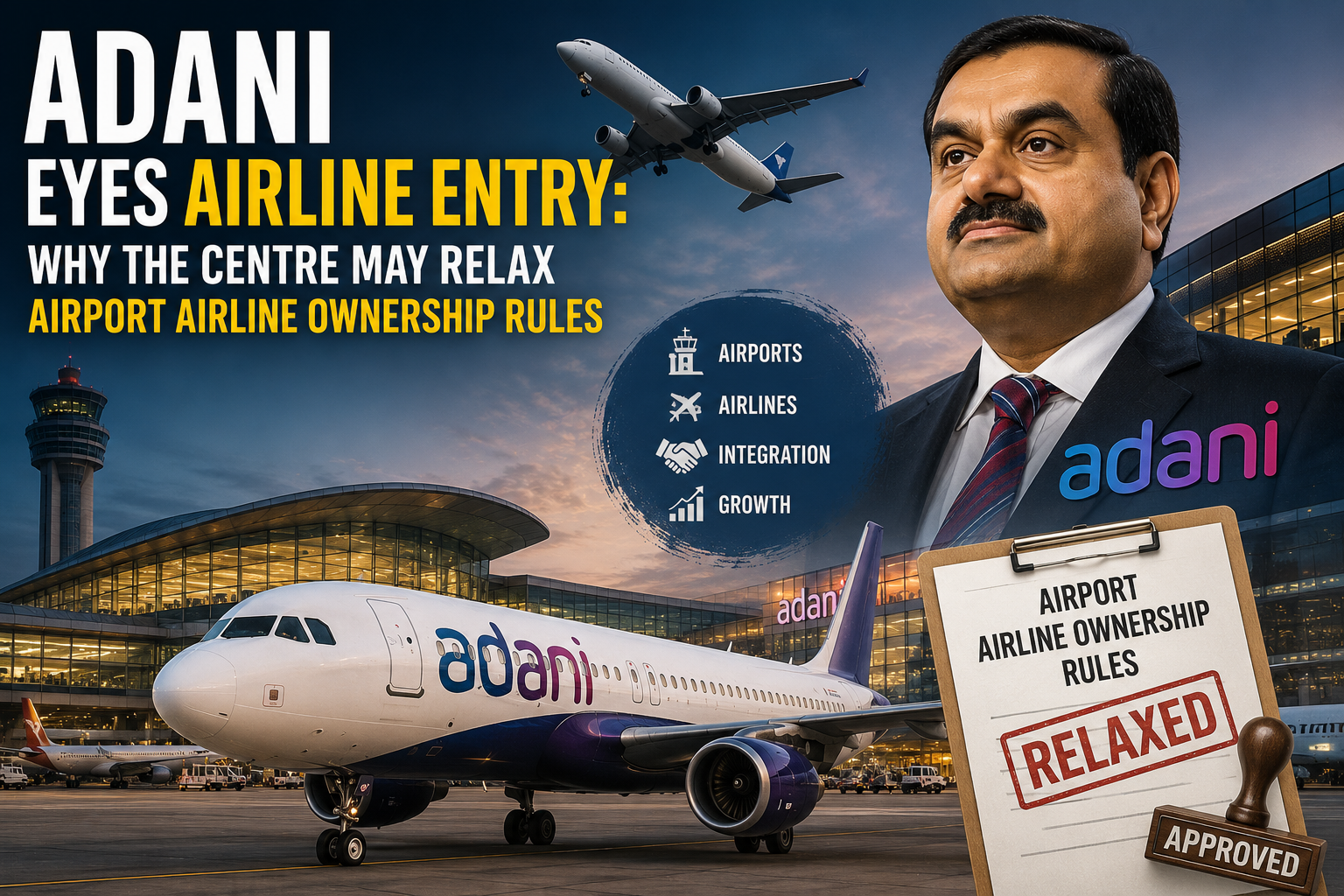
The Adani Group has formally approached the Indian government seeking a relaxation of a long-standing rule that restricts airport operators from holding significant stakes in scheduled airlines. The Adani Group has asked the government to relax an ownership restriction that currently prevents operators of the Delhi and Mumbai airports from holding more than a 10 percent stake in a scheduled airline. The move has triggered fresh discussion in New Delhi over whether India’s aviation ownership rules, framed nearly two decades ago, still make sense in today’s market.
What Exactly Is the Ownership Rule?
The existing regulations, established during the privatisation of major airports like Delhi and Mumbai in 2006, prevent airport operators from holding more than a 10 percent share in an airline.This restriction is part of the agreements signed when the Delhi and Mumbai airports were privatised nearly twenty years ago.
In simple terms, the rule was designed to prevent a single company from controlling both the runway and the airline flying on it avoiding a potential conflict of interest at India’s two busiest hubs.
Why Is Adani Seeking a Change Now?
A relaxation of this rule would clear the way for Adani, which is an infrastructure conglomerate, to either launch its own airline or acquire a controlling interest in an existing carrier, further expanding its footprint across India’s aviation sector.
The Adani Group currently operates eight airports in India and already has a significant presence in other aviation-linked businesses, including ground handling, maintenance, repair and overhaul (MRO), and pilot training.The conglomerate is also planning to set up an aircraft manufacturing facility in India in partnership with Brazilian aerospace company Embraer. Taken together, an airline would be a natural extension of a business Adani has already built out across nearly every other layer of Indian aviation except actually flying planes.
Notably, this marks a shift in position for the group.The move comes even though Adani had earlier signalled it did not intend to enter the airline business, with its stance appearing to change largely due to two factors: the government’s push to increase competition and reduce market concentration, and the group’s plans to set up a final assembly line for Embraer’s aircraft in India.
Is This a Done Deal? Not Yet
Despite the government interest, both Adani and officials have been careful to stress that no final decision has been made. A senior Adani executive said that no concrete decision had been taken and that there were no advanced discussions within the group to acquire an airline.The Adani Group has previously indicated it is not currently in advanced discussions to acquire an existing airline, suggesting any entry into the business would be a longer-term strategic move rather than an immediate one.
What’s Happening Inside the Government
The proposal has moved from an industry request to an active policy conversation within the Ministry of Civil Aviation.Preliminary discussions on easing restrictions on cross-ownership in the airline and airport sectors have begun at the Ministry of Civil Aviation after the Adani Group sought an enabling policy environment.
The Civil Aviation Ministry is seeking legal opinion on whether the provision can be amended retrospectively, and any eventual change would require approval from the Union Cabinet.The deliberations are underway within the Ministry of Civil Aviation, and any waiver would need legal clearance from the law ministry along with approval from the federal Cabinet led by Prime Minister Narendra Modi.
Why the Government May Be Open to the Idea
The government’s own competition concerns appear to be aligning with Adani’s commercial interest. The discussions come amid concerns over the dominance of IndiGo and the Air India group, which together account for around 90 percent of India’s domestic aviation market, with the government pushing for more airlines to operate in the country in order to increase competition in the sector.
The idea behind the policy shift is to widen competition at a time when IndiGo and Air India together control nearly 90 percent of India’s domestic capacity. In other words, Delhi may be willing to loosen the ownership cap not just to accommodate Adani, but as part of a broader push to break up the current two-airline dominance of Indian skies.
Who Else Could Benefit?
Adani isn’t the only airport operator that stands to gain if the rule changes. Any relaxation of the restriction could also apply to GMR Airports, which operates the Delhi airport.A relaxation of ownership norms would allow both the Adani Group whose unit runs the Mumbai airport and seven others and GMR Airports which manages the Delhi airport and four other facilities to own airlines of their own.
Interestingly, if the restrictions are eased, the change could also work in reverse potentially allowing airlines to acquire stakes in airports, not just the other way around.
Conflict-of-Interest Concerns
Not everyone in the industry is enthusiastic about the proposed change.Industry executives have raised concerns about potential conflicts of interest involving airport access, commercially sensitive information, and the allocation of slots to competing airlines.
Critics argue that allowing an airport operator to also run an airline could create unfair advantages in areas such as slot allocation, where takeoff and landing times are critical to a carrier’s operational success, and that if the restriction is lifted for one operator, it could open the door for other large airline groups to acquire airports, fundamentally altering the competitive structure of Indian aviation.
To address these concerns, the government is reportedly considering built-in checks.Government officials said any amendment could include safeguards requiring the airport and airline businesses to operate at arm’s length, with restrictions on sharing sensitive commercial information and on appointing common key managerial personnel.
A Bigger Hurdle: Aircraft Shortage
Even if the policy changes tomorrow, launching a new full-scale airline in India isn’t simple. A global shortage of aircraft remains a key hurdle for any new entrant, with delivery delays at Airbus and Boeing having slowed expansion plans worldwide as pandemic-era supply chain disruptions continue to limit aircraft availabilityAny Adani-backed carrier would likely have to contend with the same production bottlenecks that have already slowed expansion plans for IndiGo, Air India, and other global carriers.
The Bigger Picture: Adani’s Aviation Footprint
This potential rule change fits into a much larger pattern of expansion by the Adani Group in Indian aviation. Adani Enterprises has pursued an aggressive airport expansion strategy in recent years, with its airport subsidiary becoming the largest operator in India by number of airports, as part of a broader multi-billion-dollar investment plan in airport infrastructure.</cite> The group has steadily built out capabilities across airport operations, ground handling, MRO services, and pilot training an airline would effectively be the final piece connecting its aviation ecosystem end to end.
What’s Next
The proposal remains under review, with no formal Cabinet decision yet. Key things to watch:
- Whether the Law Ministry clears the retrospective amendment to the 2006 privatisation agreements
- Whether the Union Cabinet formally approves the rule change
- What conflict-of-interest safeguards are ultimately built into any amended policy
- Whether GMR Airports moves to take advantage of the same relaxed rule
- Whether global aircraft supply constraints affect the timeline for any new airline launch
For now, the Adani Group’s aviation ambitions remain a “watch this space” story one that could reshape the competitive balance of Indian skies if it eventually clears regulatory and Cabinet approval.
Learn more about our site archive2in.com
Contact us on our contactarchive2in@gmail.com
Read out our latest article on our Blogs section
Leave a Reply
You must be logged in to post a comment.