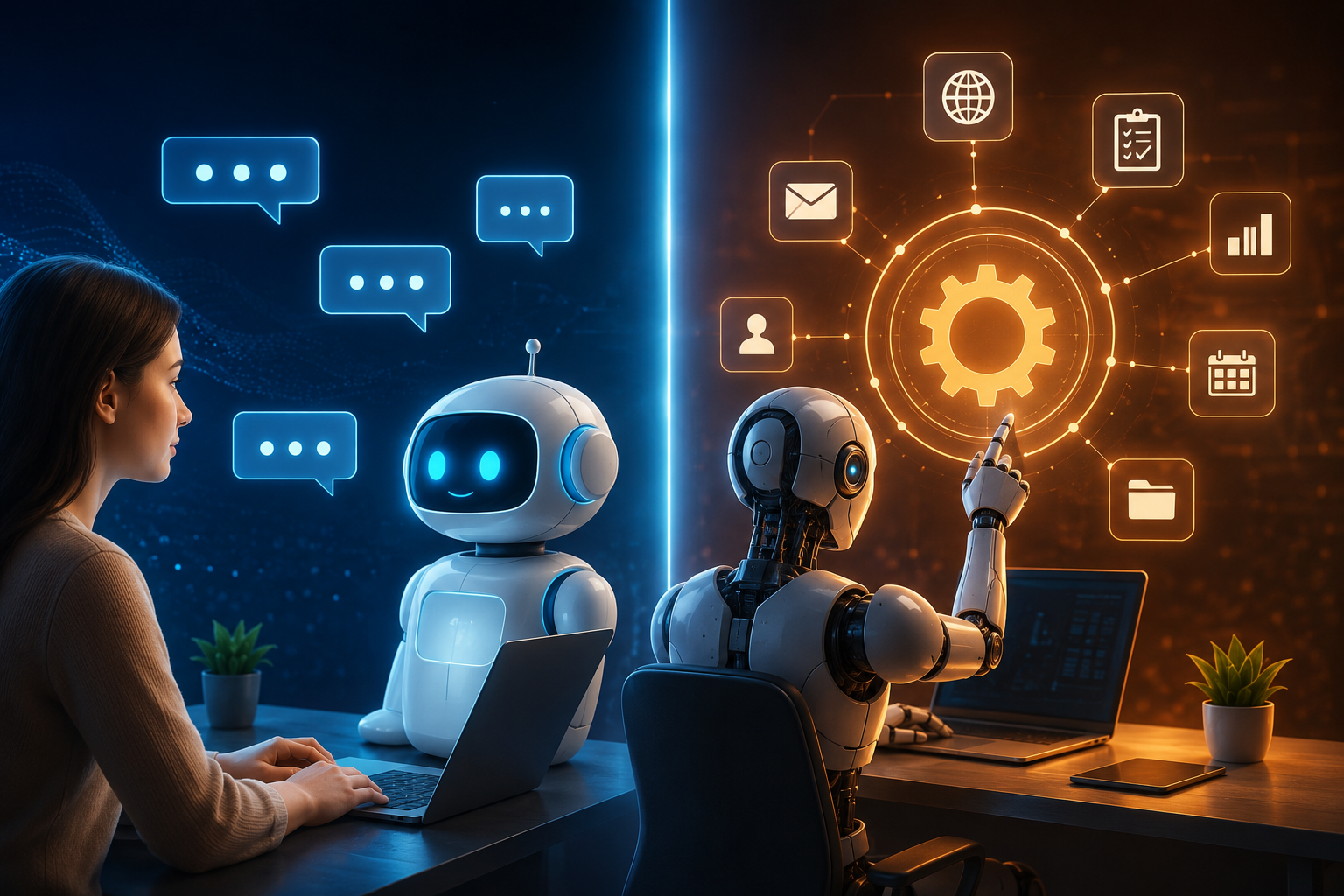
Artificial intelligence has evolved at an astonishing pace over the past few years. While chatbots once dominated customer support, virtual assistance, and online interactions, 2026 is witnessing the rapid rise of AI agents—intelligent systems capable of planning, reasoning, and completing tasks with minimal human intervention.
Although the terms “AI agent” and “chatbot” are often used interchangeably, they represent two very different generations of artificial intelligence. Understanding the difference can help businesses, developers, and everyday users choose the right technology for their needs.
What Is a Chatbot?
A chatbot is an AI-powered application primarily designed to interact with users through conversations. It answers questions, provides information, assists with customer service, and follows predefined instructions.
Modern chatbots powered by large language models are much smarter than earlier rule-based systems. They can understand context, generate human-like responses, and support multiple languages. However, their primary function remains conversation.
Typical chatbot tasks include:
- Answering frequently asked questions
- Booking appointments
- Providing product recommendations
- Offering technical support
- Assisting with simple customer inquiries
Chatbots excel at responding to requests but generally wait for users to initiate interactions.
What Is an AI Agent?
An AI agent goes far beyond conversation. Instead of simply answering questions, it can plan, reason, make decisions, use software tools, and execute multi-step tasks independently.
Think of an AI agent as a digital assistant that doesn’t just tell you how to do something—it actually does it.
For example, if you ask an AI agent to plan a business trip, it can:
- Research flight options
- Compare hotel prices
- Create a travel itinerary
- Add events to your calendar
- Draft emails
- Monitor schedule changes
All of these actions can happen with little or no additional input once the goal has been defined.
Key Differences Between AI Agents and Chatbots
Although both technologies use artificial intelligence, their capabilities differ significantly.
Purpose
Chatbots focus on conversations and answering questions. AI agents focus on completing goals and executing tasks.
Decision-Making
Chatbots typically respond to prompts. AI agents can evaluate multiple options, make decisions, and adjust their actions based on changing conditions.
Autonomy
A chatbot usually waits for user instructions before every step. An AI agent can perform several connected actions without constant supervision.
Tool Usage
Many AI agents can interact with calendars, databases, APIs, browsers, spreadsheets, and other software applications, allowing them to automate complex workflows.
Memory
Advanced AI agents often maintain long-term context and remember ongoing objectives, making them more effective for extended projects.
Real-World Examples in 2026
Businesses across industries are increasingly adopting AI agents because they reduce repetitive work and improve productivity.
Some practical applications include:
- Marketing agents that research trends, generate content, and schedule social media posts.
- Sales agents that qualify leads, send personalized emails, and update CRM systems.
- Customer support agents that resolve issues across multiple platforms without human intervention.
- Financial agents that analyze spending patterns and prepare reports.
- Software development agents that write code, test applications, identify bugs, and suggest improvements.
Traditional chatbots continue to serve an important role in customer communication, but AI agents are becoming valuable digital coworkers.
Which One Is Better?
The answer depends on your objectives.
If your goal is to answer customer questions quickly, a chatbot is often sufficient. It is generally simpler to deploy, easier to maintain, and well suited for high-volume conversations.
However, if you want AI to automate workflows, manage projects, perform research, or complete business operations, an AI agent offers far greater capabilities.
Rather than replacing chatbots entirely, AI agents are expanding what artificial intelligence can accomplish.
Challenges of AI Agents
Despite their impressive capabilities, AI agents are not without limitations.
Organizations adopting autonomous AI should consider:
- Privacy and data security
- Accuracy of generated information
- Human oversight for critical decisions
- Compliance with industry regulations
- Potential operational errors during automation
Human review remains essential, especially for healthcare, finance, legal, and other high-stakes applications.
The Future of AI
Experts expect AI agents to become increasingly integrated into everyday life over the next several years. Future systems may collaborate with one another, coordinate across multiple applications, and complete complex workflows with minimal supervision.
Meanwhile, chatbots will continue to evolve into more intelligent conversational interfaces. Instead of competing, chatbots and AI agents are likely to work together—chatbots serving as the communication layer while AI agents handle the execution behind the scenes.
Conclusion
The shift from chatbots to AI agents marks one of the biggest transformations in artificial intelligence. While chatbots remain excellent conversational tools, AI agents represent the next stage of intelligent automation by combining reasoning, planning, memory, and action.
As organizations increasingly seek productivity and automation, AI agents are expected to become indispensable across industries. Businesses that understand the strengths of both technologies will be better positioned to improve efficiency, enhance customer experiences, and stay competitive in the AI-driven future.
Disclaimer
This article is intended for informational and educational purposes only. The AI industry is evolving rapidly, and the capabilities of AI agents and chatbots may vary depending on the platform, model, and implementation. Readers should evaluate AI solutions based on their specific business or personal requirements before making technology decisions.
Learn more about our site on contactarchive2in.com
Contact us on our email id contactarchive@gmail.com
Leave a Reply
You must be logged in to post a comment.