
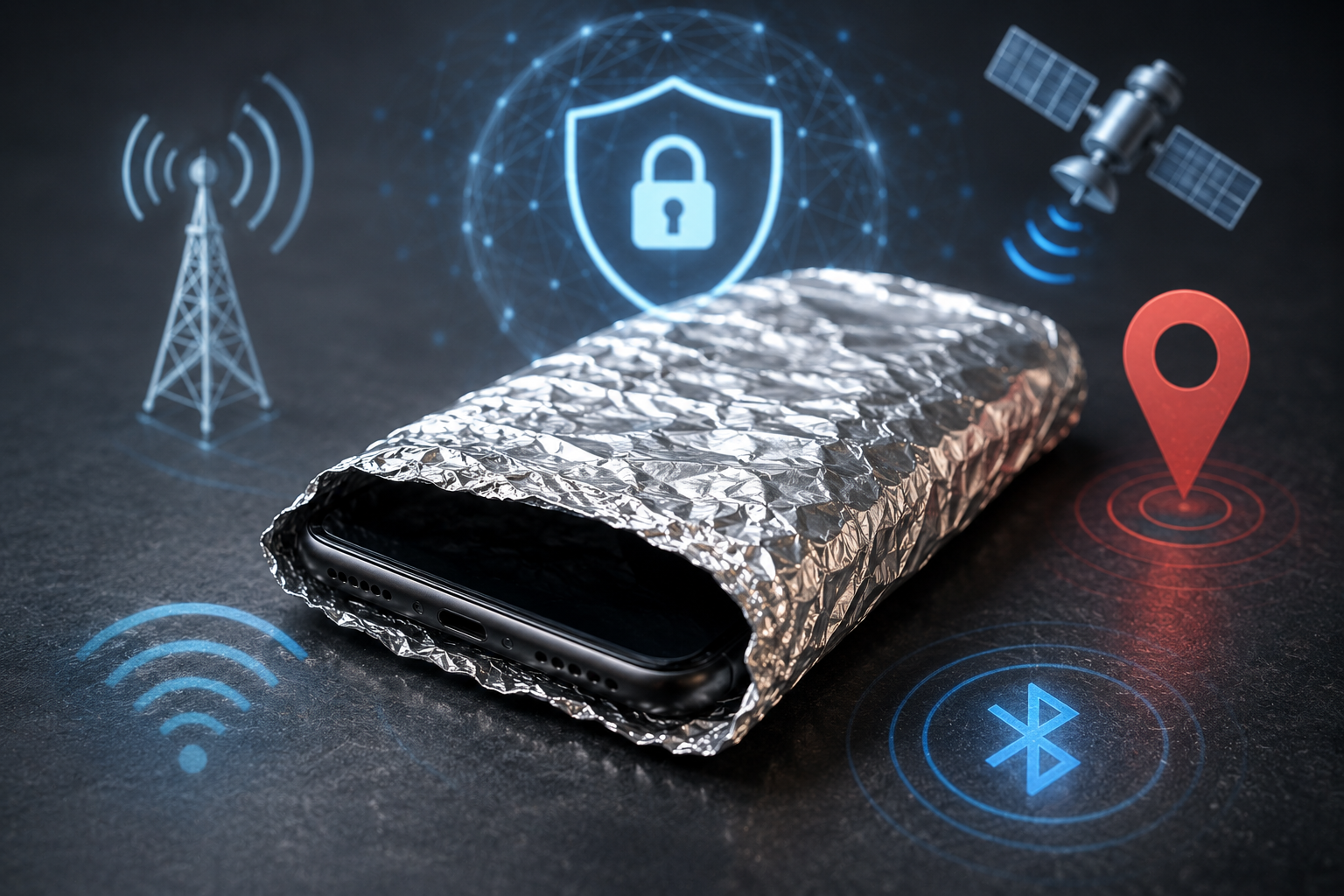
Social media is full of unusual privacy hacks, but one of the most persistent claims is that wrapping your smartphone in aluminum foil can prevent it from being tracked. Videos and online posts often suggest that a simple layer of kitchen foil can block GPS, stop location tracking, and even protect users from surveillance.
But how much of this is actually true?
The short answer is it’s more complicated than viral posts suggest. While aluminum foil can interfere with some wireless signals under certain conditions, it is not a reliable or practical solution for protecting your privacy. Understanding how smartphones communicate helps separate scientific facts from internet myths.
Why People Believe the Aluminum Foil Hack
The idea comes from a real scientific concept known as a Faraday cage.
A Faraday cage is an enclosure made from conductive material that blocks many electromagnetic signals from entering or leaving. Professional laboratories and security facilities sometimes use Faraday bags or shielded rooms to isolate electronic devices.
Because aluminum is conductive, many people assume wrapping a phone in foil creates the same effect.
While there is some truth to this concept, everyday aluminum foil rarely provides complete protection.
Can Aluminum Foil Block GPS?
GPS works by receiving signals from satellites orbiting Earth.
If a phone is completely enclosed inside a properly sealed conductive enclosure, GPS reception can become weak or disappear entirely.
However, wrapping a phone in ordinary household aluminum foil usually produces inconsistent results because:
- Small gaps allow signals to enter.
- Thin foil doesn’t create a perfect shield.
- Modern phones use multiple antennas.
- Signal strength varies by location.
In many cases, GPS may become less accurate rather than completely stop working.
What About Cellular and Wi-Fi Signals?
Your smartphone communicates using several different wireless technologies simultaneously.
These include:
- Cellular networks
- Wi-Fi
- Bluetooth
- GPS
- Near Field Communication (NFC)
A well-designed Faraday enclosure can reduce or block many of these signals.
However, loosely wrapping a phone with kitchen foil often allows enough signal leakage for the device to remain partially connected.
This is why some people notice fewer signal bars, while others see almost no difference.
Can It Stop Location Tracking?
Not entirely.
Modern smartphones determine location using multiple sources.
Besides GPS, phones also use:
- Nearby Wi-Fi networks
- Cellular tower triangulation
- Bluetooth beacons
- Stored location history
- Internet-based location services
Even if satellite signals become weaker, a connected phone may still estimate its location using nearby cellular towers or Wi-Fi networks.
In other words, blocking one signal does not necessarily stop all forms of tracking.
Can Apps Still Collect Data?
Yes.
If your phone reconnects to the internet after being removed from foil, many apps can continue collecting information according to the permissions you’ve granted.
Applications may access:
- Approximate location
- Device identifiers
- Usage statistics
- Network information
- Advertising IDs
The best way to reduce unnecessary data collection is by reviewing app permissions rather than relying on physical barriers.
Better Ways to Protect Your Privacy
Instead of wrapping your phone in aluminum foil, consider these practical privacy measures:
- Review location permissions regularly.
- Disable location access for apps that don’t need it.
- Turn off Bluetooth when not in use.
- Disable Wi-Fi scanning if unnecessary.
- Keep your operating system updated.
- Use strong passwords and two-factor authentication.
- Review privacy settings on Android or iPhone.
- Limit background app activity.
- Install apps only from trusted sources.
These steps provide significantly better protection than viral internet hacks.
When Are Faraday Bags Actually Used?
Specialized Faraday bags have legitimate uses.
They are commonly used by:
- Digital forensic investigators
- Law enforcement agencies
- Cybersecurity professionals
- Military organizations
- Security researchers
Unlike household foil, these products are specifically engineered and tested to block wireless communications more consistently.
The Verdict
So, does aluminum foil stop phone tracking?
Partially—but not reliably.
While aluminum foil may weaken certain wireless signals under ideal conditions, it does not guarantee complete privacy or prevent every tracking method used by modern smartphones.
Privacy today depends far more on software settings, app permissions, encryption, and secure online habits than on wrapping a phone in kitchen foil.
Conclusion
The aluminum foil phone hack is a fascinating example of how a scientific principle can become oversimplified on social media. Although conductive materials can interfere with radio signals, everyday foil is not a dependable privacy solution for modern smartphones.
If you’re genuinely concerned about digital privacy, focusing on secure device settings, responsible app permissions, regular software updates, and trusted security practices will provide far greater protection than any viral internet trick.
Disclaimer
This article is for informational and educational purposes only. It explains how smartphone tracking technologies work based on publicly available technical information. Privacy and security features vary depending on your device, operating system, network, and apps.
Learn more about our site on contactarchive2in.com
Contact us on our email id contactarchive2in@gmail.com
Leave a Reply
You must be logged in to post a comment.