
What Is the Swachh Vayu Survekshan 2026?
Bengaluru :-The Swachh Vayu Survekshan (Clean Air Survey), released annually by India’s Union Environment Ministry, evaluates cities under the National Clean Air Programme (NCAP). Unlike a simple air-quality ranking, this survey measures how effectively cities are implementing pollution control measures including road dust control, solid waste management, construction and demolition waste handling, reduction of vehicular and industrial emissions, and public awareness campaigns.
The fifth edition of the survey assessed 130 NCAP cities across three population categories. The evaluation process combined city self-assessments, review by state-level monitoring committees, scrutiny by the Central Pollution Control Board (CPCB), and field verification by independent teams.
Bengaluru’s Rank in 2026
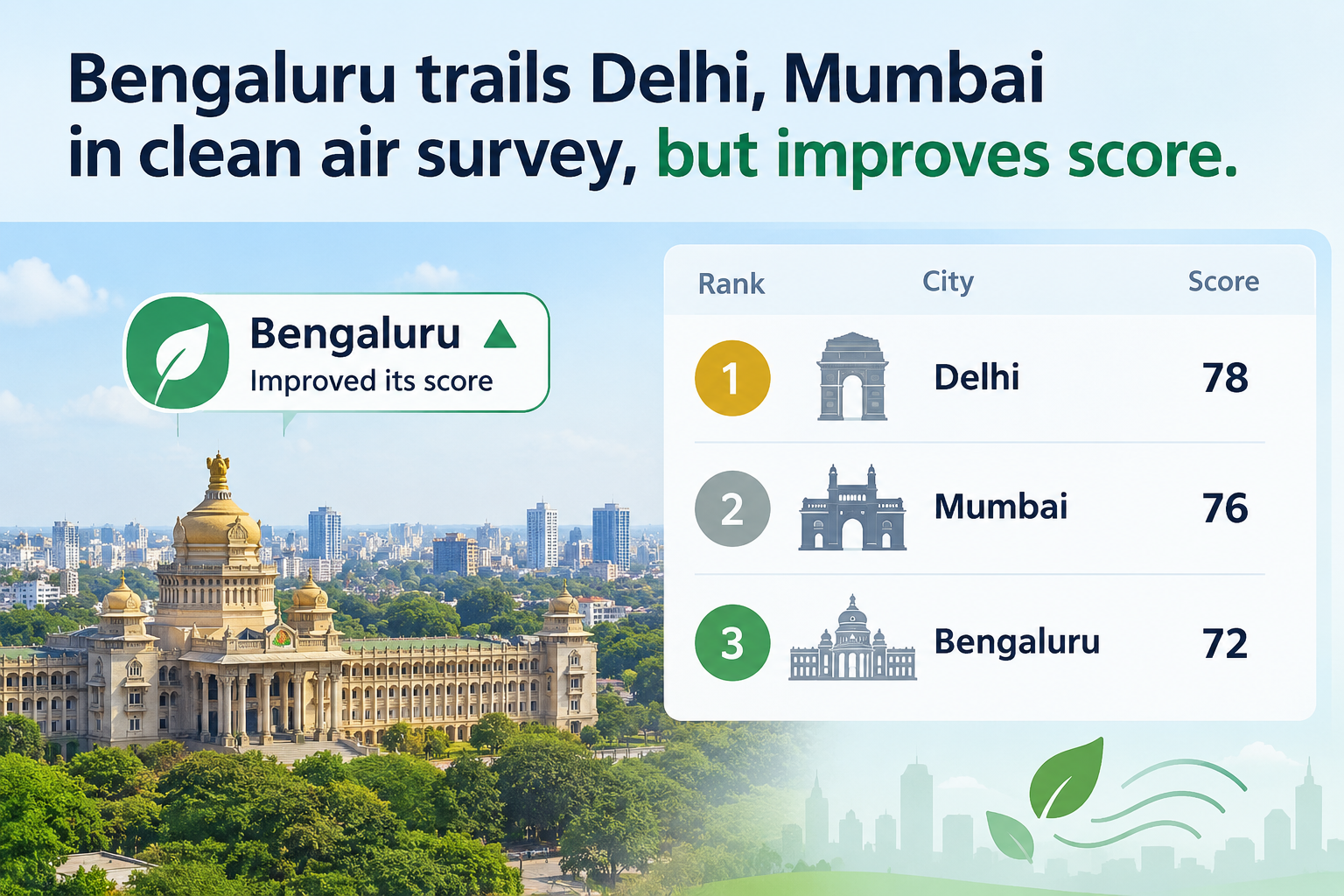
In the category of cities with a population above 10 lakh (1 million), Bengaluru secured the 32nd rank with a score of 152.6 points. That’s an improvement from last year, when Bengaluru stood at 36th in the 2025 edition a jump of four spots.
Still, Bengaluru remains behind India’s other major metros:
| City | Rank (2026) | Score |
|---|---|---|
| Delhi | 21st | — |
| Mumbai | 28th | 160.8 |
| Bengaluru | 32nd | 152.6 |
| Chennai | 35th | 147.7 |
| Kolkata | 38th | 142.2 |
Lucknow topped the overall list again this year, with Indore and Jabalpur sharing second place.
Why Delhi Ranks Higher Despite Worse Air
This might seem counterintuitive: Delhi’s air is widely regarded as India’s most polluted in winter, with AQI often crossing 400 the “severe” category and sometimes exceeding 450. Yet Delhi outranked Bengaluru, Mumbai, Chennai and Kolkata this year, climbing to 21st place.
The reason lies in what the survey actually measures. It doesn’t rank cities by their current air quality but by the strength of their pollution-control implementation. So a city with poor air quality can still rank higher if it demonstrates stronger action on the ground better dust control, waste management, emission-reduction drives, and so on.
What Bengaluru Needs to Work On
Bengaluru’s improved score is a positive sign, but breaking into the top 20 will require sustained work in a few key areas:
- Road dust control — long flagged as one of the city’s biggest pollution contributors.
- Vehicular emissions — expanding public transport and electric mobility infrastructure.
- Construction and demolition waste management — critical given the city’s rapid urban expansion.
- Air quality monitoring — widening the network of monitoring stations for more accurate, city-wide data.
Bengaluru’s Ranking Trend Over the Years
Bengaluru’s journey in the Swachh Vayu Survekshan hasn’t been a straight line upward. The city has fluctuated across editions of the survey as its pollution control programmes matured and as monitoring infrastructure expanded:
- In recent years, Bengaluru’s PM10 levels showed a notable decline among the metros, Hyderabad and Bengaluru recorded roughly a 26% drop in PM10, trailing only Mumbai (44%) and Kolkata (37%).
- Despite this improvement in particulate matter, the city’s overall survey rank has moved more slowly, reflecting how implementation scores factor in a broader basket of actions beyond just pollutant levels.
- The jump from 36th (2025) to 32nd (2026) suggests Bengaluru’s civic agencies including the BBMP and Karnataka State Pollution Control Board (KSPCB) are beginning to translate policy announcements into measurable, verifiable action.
How the Survey Scores Are Calculated
Each city’s final score is built from multiple weighted components rather than a single pollution reading. Broadly, the evaluation covers:
- Source-specific action plans — whether cities have targeted strategies for major pollution sources like road dust, construction sites, and industrial clusters.
- On-ground implementation — actual physical measures taken (paved roads, mechanized sweeping, dust suppression, green cover).
- Emission reduction from transport and industry — steps like promoting cleaner fuels, EV adoption, and stricter industrial compliance.
- Public outreach and awareness — campaigns to inform citizens and build local participation in pollution-reduction efforts.
- Monitoring and data transparency — the density and reliability of a city’s air quality monitoring network.
This multi-factor approach is why a city like Delhi which has one of the most extensive monitoring and enforcement systems in the country despite persistently poor air quality can outrank cities with comparatively cleaner air but weaker on-ground execution.
Frequently Asked Questions
Is the Swachh Vayu Survekshan the same as the Swachh Survekshan? No. The Swachh Survekshan (led by the Ministry of Housing and Urban Affairs) ranks cities on cleanliness and sanitation. The Swachh Vayu Survekshan, run by the Environment Ministry under NCAP, specifically evaluates air pollution control efforts.
Does a high rank mean a city has clean air? Not necessarily. The survey rewards implementation of pollution-control measures, not real-time air quality. A city can rank well even if its AQI remains high, as long as it shows strong action on the ground.
Which city topped the Swachh Vayu Survekshan 2026? Lucknow secured the top position among cities with a population above 10 lakh, with Indore and Jabalpur tied for second place.
The Bottom Line
Bengaluru’s climb from 36th to 32nd in the Swachh Vayu Survekshan 2026 shows its pollution-control efforts are starting to pay off. But with Delhi, Mumbai and other metros still ahead, the city has real ground to cover. The bigger challenge isn’t just climbing the rankings it’s delivering genuinely cleaner air for its residents.
Learn more about our site archive2in.com
Contact us on our email id contactarchive2in@gmail.com
Read out our latest artice on our blog section
Leave a Reply
You must be logged in to post a comment.