
For more than a decade, the smartphone has been the centre of everyday digital life. We use it to communicate, navigate, shop, take photos, work, watch videos and access countless apps.
But in 2026, a new question is gaining attention: what if people no longer need to reach for their phones for every digital task?
The answer may come from AI-powered devices.
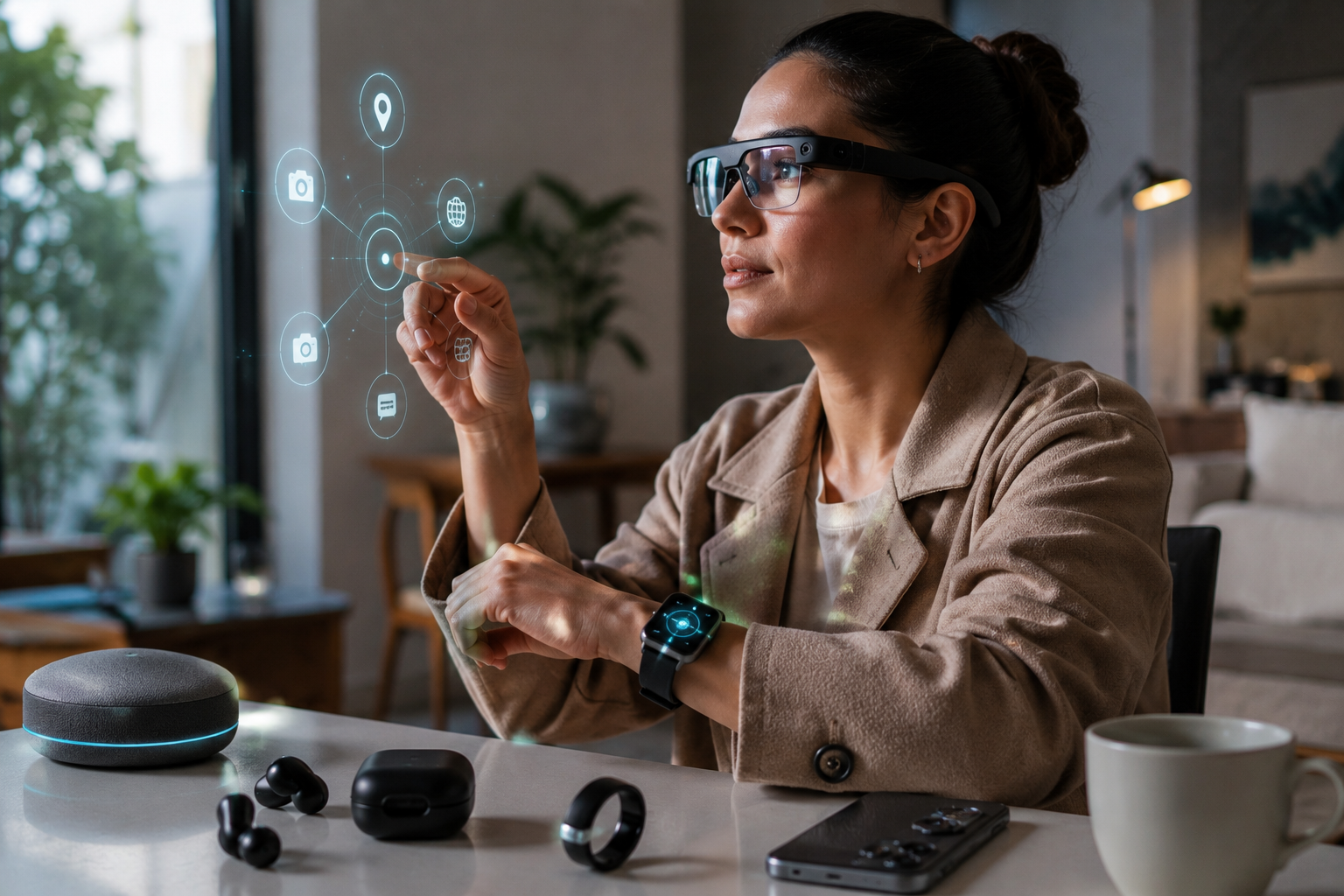
Smart glasses, AI wearables, intelligent earbuds, smartwatches and new AI-focused hardware are increasingly being designed around conversations and automation rather than traditional apps and screens. The shift does not mean smartphones are disappearing overnight. Instead, technology companies are exploring devices that could make digital assistance more natural, hands-free and context-aware.
AI is changing what people expect from devices
Traditional smartphones largely wait for users to tell them what to do. You open an app, type a request, tap a button and then receive a response.
AI-powered devices are being designed around a different experience.
Instead of navigating multiple menus, users can potentially speak naturally to an AI assistant and ask it to summarise information, translate speech, identify something they are looking at or help organise their day.
Research from Forrester suggests consumer generative-AI adoption is growing rapidly, with personal use cases currently dominating professional ones. The research also highlights that AI has a lower barrier to entry because it can be embedded directly into software and devices people already use.
That could make AI less like a separate app and more like a layer sitting across everyday technology.
Smart glasses are becoming one of the biggest AI-device trends
Among emerging AI gadgets, smart glasses are attracting considerable attention.
Unlike a smartphone, glasses can stay on a user’s face while they walk, travel or work. With cameras, microphones and speakers, they can potentially understand aspects of the user’s surroundings and respond without requiring a screen.
The commercial momentum is becoming more visible. EssilorLuxottica, the company behind Ray-Ban, reported that sales of its AI glasses developed with Meta nearly doubled in the second quarter of 2026. The company and Meta have also expanded the range with lower-priced AI glasses.
That does not mean smart glasses have replaced smartphones. But it suggests consumers are beginning to see value in having AI available through a device they can wear rather than constantly holding.
Hands-free technology could be a major attraction
One of the strongest reasons people may prefer AI wearables is convenience.
Imagine walking through a new city and asking your glasses for directions without taking your phone out of your pocket. Or looking at a menu and asking AI to explain an unfamiliar dish. A traveller could potentially translate speech while keeping their attention on the person they are talking to.
Researchers are already exploring this concept. A 2026 study called VisionClaw investigated an AI agent running through smart glasses that could perceive a user’s surroundings and assist with tasks such as creating notes, identifying objects and interacting with digital services.
The technology remains experimental, but it demonstrates the direction the industry is moving towards: AI that understands the physical environment rather than simply responding to typed questions.
AI devices could reduce screen time
Another potential attraction is the possibility of reducing the amount of time people spend staring at screens.
A smartphone requires users to look down at a display for many everyday tasks. Voice-first AI devices can potentially provide information through audio instead.
This could be particularly useful while walking, exercising, cooking, commuting or working.
The broader idea is that the computer becomes less visible. Instead of constantly interacting with a screen, people could simply ask for information and receive assistance when needed.
Companies are exploring devices beyond glasses
Smart glasses aren’t the only emerging category.
Smartwatches are becoming increasingly AI-focused, while smart rings and other wearables are being developed to monitor activity and provide personalised insights. Samsung, for example, is continuing to expand its wearable ecosystem and has been exploring technologies including smart glasses and smart rings.
Meanwhile, OpenAI President Greg Brockman said in July 2026 that the company is developing a “family of devices” for interacting with its AI models. He also described a future in which voice could become a much more important way of interacting with computers.
These developments show that the AI hardware race is no longer limited to smartphones.
But will AI devices actually replace smartphones?
Probably not immediately.
Smartphones still have major advantages: large screens, powerful cameras, reliable connectivity, app ecosystems, keyboards and established payment and authentication systems.
In fact, AI could strengthen smartphones rather than eliminate them. Research from CyberMedia Research reported that 71% of surveyed Indian smartphone users aged 18–35 were using generative-AI features multiple times a week, while 59% considered AI capabilities when buying a new smartphone.
This suggests the future may not be “smartphone versus AI device.” Instead, smartphones could become the central computing hub while wearables handle more specialised tasks.
Privacy remains a major concern
The more an AI device can see, hear and understand, the more important privacy becomes.
AI glasses equipped with cameras and microphones raise obvious questions about recording other people, storing personal information and determining where sensitive data is processed.
Battery life, accuracy, connectivity, price and social acceptance are other challenges that manufacturers must overcome.
For AI devices to become mainstream, consumers will need to trust not only what these gadgets can do but also how they handle personal data.
The future may be about fewer screens, not fewer devices
The biggest change may therefore not be the disappearance of the smartphone.
Instead, consumers could gradually move towards a world where technology is distributed across several devices: glasses for visual and voice assistance, watches for quick notifications and health information, earbuds for conversations and smartphones for more complex tasks.
The smartphone may remain important — but it could become less visible in everyday interactions.
AI devices are still at an early stage, but the direction is clear: technology companies are trying to move computing from screens and apps toward voice, context and intelligent assistance.
For consumers, that could eventually mean spending less time operating devices and more time simply telling them what they need.
Disclaimer
This article is intended for general informational purposes only. AI-device development is rapidly changing, and features, prices, availability and adoption levels may change. References to future smartphone replacement or emerging AI hardware describe industry trends and possibilities rather than guaranteed outcomes. Readers should verify product specifications and privacy policies through official manufacturers before making purchasing decisions.
Learn more about our site on contactarchive2in.com
Contact us on our email id contactarchive2in@gmail.com
Leave a Reply
You must be logged in to post a comment.