
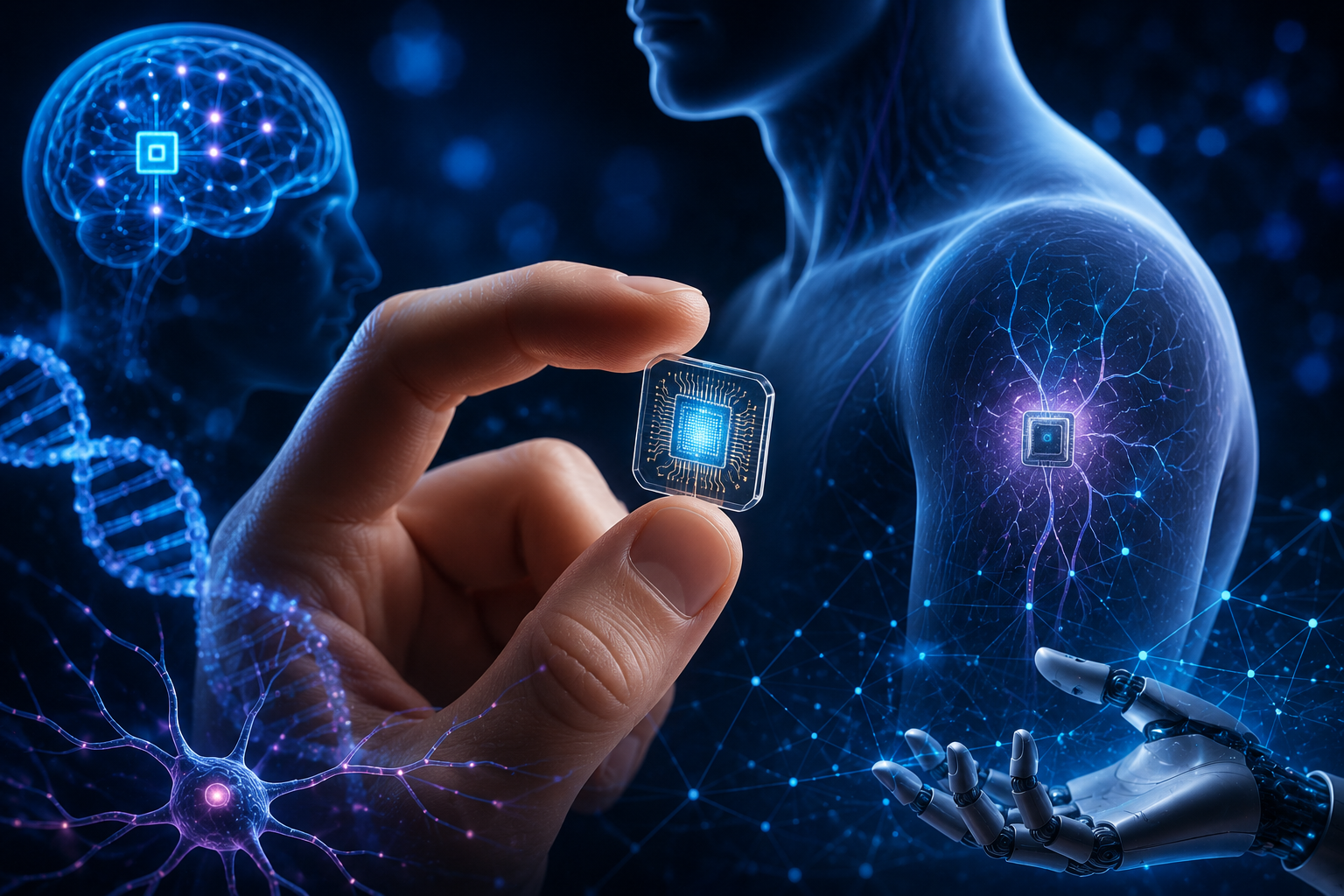
The line between biology and technology is becoming increasingly blurred. One of the most exciting innovations driving this transformation is the biochip—a tiny electronic or biological device designed to interact with living systems. Once considered science fiction, biochips are now being developed for medical diagnostics, disease monitoring, brain–computer interfaces, and personalized healthcare.
As artificial intelligence, biotechnology, and semiconductor technology continue to evolve, biochips could become a key component of the next generation of human–computer interaction. While widespread human enhancement remains a future possibility rather than today’s reality,they are already reshaping healthcare and scientific research.
What Is a Biochip?
A biochip is a miniature device that combines biology with electronics to collect, process, or transmit biological information. Depending on its purpose, a biochip may analyze DNA, detect diseases, monitor body functions, or communicate with medical equipment.
Unlike traditional computer chips that process digital data alone, biochips are designed to interact directly with biological materials such as cells, proteins, tissues, or neural signals.
Common applications include:
- Medical diagnostics
- DNA analysis
- Disease detection
- Continuous health monitoring
- Brain–computer interface research
- Drug development
- Personalized medicine
How Do Biochips Work?
Biochips contain microscopic sensors capable of detecting biological signals or chemical changes.
These sensors collect information such as:
- Blood glucose levels
- Heart activity
- Neural signals
- Protein interactions
- Genetic markers
- Hormone levels
The collected information is converted into digital data that computers or AI systems can analyze almost instantly.
This allows healthcare providers to make faster and more informed decisions.
Biochips in Healthcare
Healthcare is currently the largest area benefiting from biochip technology.
Modern biochips help improve:
Early Disease Detection
Biochips can analyze tiny biological samples to detect diseases much earlier than traditional laboratory methods in some cases.
Researchers are exploring their use for identifying:
- Cancer biomarkers
- Infectious diseases
- Genetic disorders
- Cardiovascular conditions
Earlier diagnosis often improves treatment outcomes.
Personalized Medicine
Every patient responds differently to medication.
Biochips combined with AI can analyze genetic information to help doctors identify treatments that may be more effective for individual patients rather than relying on generalized approaches.
Continuous Health Monitoring
Wearable and implantable biochips may continuously monitor important health indicators.
Potential applications include:
- Blood sugar monitoring
- Heart rhythm tracking
- Oxygen measurement
- Neurological monitoring
Continuous monitoring enables earlier intervention if abnormal patterns appear.
Brain–Computer Interfaces
One of the most widely discussed applications of biochips involves brain–computer interfaces (BCIs).
Researchers are developing systems that allow electronic devices to interpret certain neural signals.
Potential future applications include:
- Helping paralyzed patients communicate
- Restoring movement through robotic prosthetics
- Assisting people with neurological disorders
- Improving rehabilitation after injuries
Although remarkable progress has been made, these technologies remain highly specialized and are still under active research.
AI and Biochips
Artificial intelligence dramatically increases the value of biochip technology.
AI can rapidly analyze enormous amounts of biological data collected by biochips to:
- Detect abnormalities
- Predict disease risks
- Recommend treatments
- Monitor patient recovery
- Support medical decision-making
Together, AI and biochips could significantly improve the speed and accuracy of healthcare.
Beyond Healthcare
Biochips have applications beyond medicine.
Researchers are exploring their use in:
- Food safety testing
- Environmental monitoring
- Agricultural research
- Drug discovery
- Veterinary medicine
- Scientific laboratories
These technologies could help identify contaminants, monitor ecosystems, and accelerate biological research.
Challenges and Ethical Questions
Despite their promise, biochips also raise important questions.
Key concerns include:
- Data privacy
- Cybersecurity
- Medical safety
- Long-term reliability
- Ethical use of implanted technologies
- Regulatory oversight
Protecting sensitive biological information will be essential as these technologies become more advanced.
The Future of Human–Computer Integration
Experts believe biochips will become increasingly sophisticated during the coming decades.
Future possibilities may include:
- Smarter medical implants
- Real-time disease prediction
- AI-assisted diagnostics
- Improved prosthetic control
- Faster neurological rehabilitation
- More advanced wearable health devices
While concepts such as enhanced memory or direct human–AI communication often appear in science fiction, most current research remains focused on medical and therapeutic applications.
Final Thoughts
Biochips represent one of the most promising intersections of biology, artificial intelligence, and computing. By enabling computers to interact more effectively with biological systems, they have the potential to transform healthcare, accelerate scientific research, and improve the quality of life for millions of people.
Although many advanced human–computer integration technologies are still years away from widespread adoption, biochips are already making a measurable impact in diagnostics, personalized medicine, and medical research. As innovation continues, these tiny devices may become one of the defining technologies of the future.
Disclaimer
This article is for informational and educational purposes only. It explores current and emerging biochip technologies based on publicly available scientific research and industry developments. Many human–computer integration technologies are still in research, testing, or early commercial stages and are not yet widely available.
Learn more about our site on contactarchive2in.com
Contact us on our email id contactarchive2in@gmail.com
Leave a Reply
You must be logged in to post a comment.