
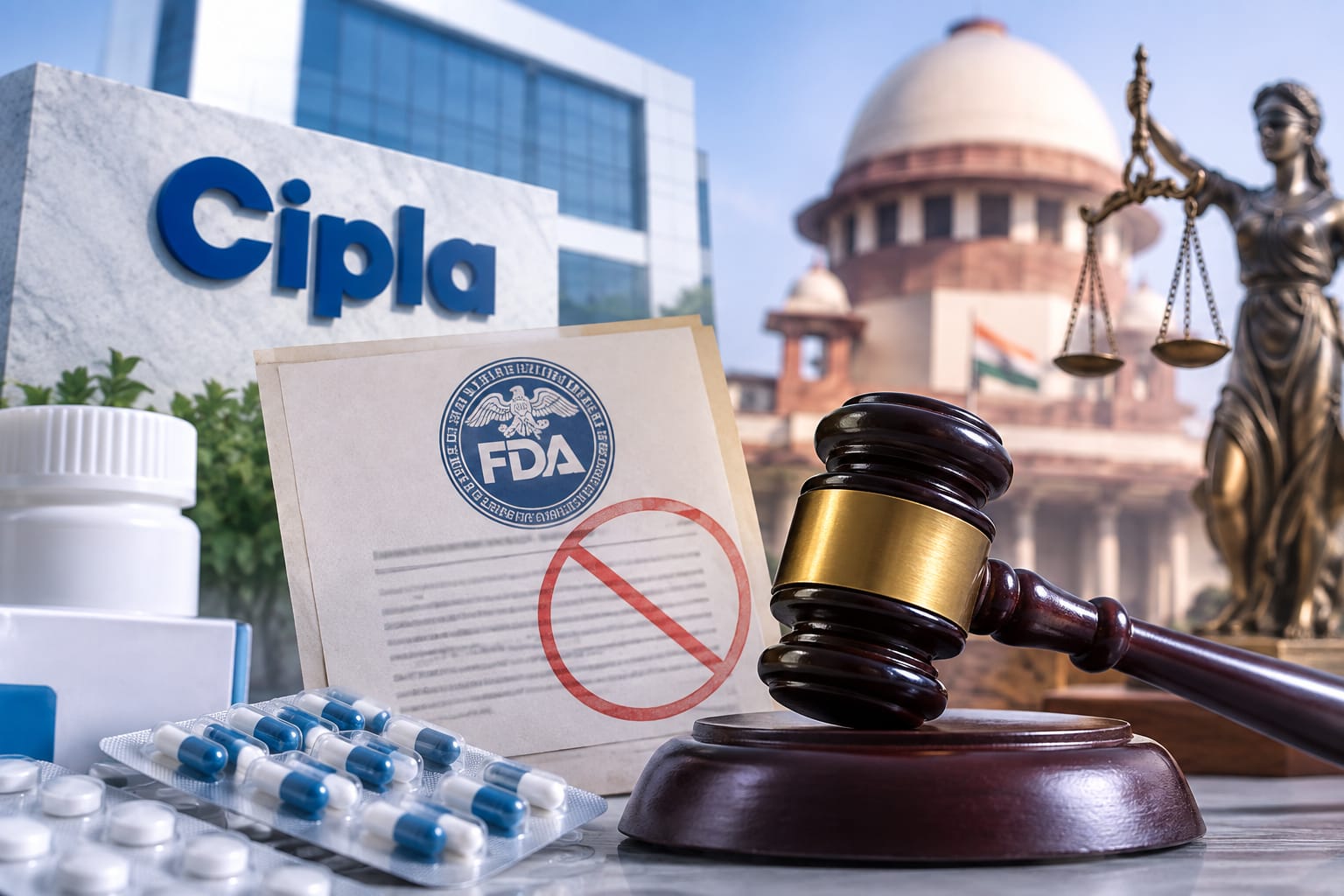
The Maharashtra Food and Drug Administration (FDA) has withdrawn its order cancelling the drug-sale licences of Cipla Pharma & Life Sciences Ltd’s carrying and forwarding facility at Wadki in Pune, after the Bombay High Court sharply criticised the regulator’s procedure.
The development came just days after the state FDA took action against the facility over alleged regulatory irregularities involving Reactin Plus Tablets, a Schedule H prescription medicine. The High Court questioned whether the regulator had followed proper procedure and accused it of going “overboard” and acting in a “high-handed” manner.
The FDA has now agreed to withdraw the cancellation order and issue a fresh show-cause notice to Cipla. A fresh, reasoned decision will be taken after the company gets an opportunity to respond.
Why did the FDA cancel Cipla’s licence?
The dispute began following an inspection of Cipla’s Pune facility in June.
According to the Maharashtra FDA, officials found several alleged violations relating to the handling and distribution of Reactin Plus Tablets. One of the issues concerned packaging carrying the words “analgesic and antipyretic” on a Schedule H prescription medicine.
The regulator considered the wording to be unauthorised promotional material. Its concern was that promotional language on a prescription medicine could potentially encourage consumers to use the product without appropriate medical advice.
The FDA also cited other alleged irregularities, including discrepancies between physical and computerised stock records, gaps in purchase and sales documentation, and concerns about compliance with instructions relating to the recall of the medicine.
The regulator subsequently cancelled the drug-sale licences connected to the facility, with the cancellation taking effect from August 27.
Cipla challenged the action before the Bombay High Court.
Why did the Bombay High Court intervene?
The central issue before the court was not simply whether the FDA had the authority to regulate pharmaceutical companies.
Instead, the judges focused heavily on how the cancellation decision had been reached.
Cipla’s lawyers told the court that the company had been asked by email to appear for a hearing on August 26. That date was a state-declared public holiday, and Cipla said it did not have a representative available to attend. The company requested an adjournment.
According to the company’s submission, the FDA nevertheless proceeded to pass the cancellation order without providing Cipla an effective opportunity to be heard.
That prompted strong observations from a bench comprising Acting Chief Justice Ravindra Ghuge and Justice Gautam Ankhad.
The court questioned whether it was fair and transparent to ask a company to appear for a hearing on a public holiday and then proceed with an adverse order after the company sought more time.
The bench described the FDA’s conduct as “high-handed” and said the regulator had acted against the principles of natural justice.
FDA agrees to withdraw the order
Following the court’s intervention, the Maharashtra FDA informed the bench that the cancellation order would be withdrawn immediately.
The regulator also agreed to issue a fresh show-cause notice to Cipla and consider the company’s response before passing a new, reasoned order. Reports indicate that fresh notices were to be served before September 4.
This is an important distinction.
The withdrawal does not necessarily mean that the FDA has concluded that no violations occurred. Rather, the earlier cancellation has been withdrawn because the procedure followed by the regulator came under serious judicial scrutiny.
The FDA can still examine the alleged violations and take a fresh decision after following the required process.
Cipla says there was no product-safety concern
Another important aspect of the case is Cipla’s clarification about what the FDA order did—and did not—allege.
The company said the cancellation action did not raise concerns about the safety, quality or efficacy of its products, and did not involve or indicate a patient-safety issue.
That distinction is significant for consumers.
The dispute centres on alleged regulatory and compliance issues at a distribution facility, including packaging, stock records, storage and recall-related procedures. It should therefore not automatically be interpreted as an announcement that Reactin Plus or Cipla’s wider product portfolio was found to be unsafe.
What happens next?
The next stage will likely involve a fresh regulatory process.
The Maharashtra FDA is expected to serve Cipla with a new show-cause notice. The company will then have an opportunity to respond to the allegations. After considering that response, the regulator can pass a fresh order.
Depending on what happens, the matter could potentially return to court.
For Cipla, the immediate withdrawal removes the effect of the earlier cancellation order, but it does not necessarily bring the underlying regulatory dispute to an end.
For the FDA, meanwhile, the episode serves as a reminder that strong enforcement action must still comply with procedural safeguards.
Why the case matters beyond Cipla
The dispute is significant because it highlights the delicate balance between strict pharmaceutical regulation and due process.
Drug regulators have an important responsibility to act when they identify possible violations involving medicines, distribution systems or patient protection. At the same time, companies facing regulatory action are entitled to a fair process, including a meaningful opportunity to respond where required.
The Bombay High Court’s intervention therefore does not amount to a rejection of pharmaceutical regulation. Instead, it reinforces the principle that regulatory power must be exercised through a fair and transparent procedure.
The case also illustrates why show-cause notices and hearings matter. They allow a company to explain circumstances, challenge findings and present evidence before a potentially serious licence-related decision is finalised.
The bigger picture
The Cipla episode is now likely to be watched closely by India’s pharmaceutical industry.
For regulators, the message is clear: enforcement can be firm, but procedure matters.
For pharmaceutical companies, it is another reminder that compliance systems covering packaging, inventory records, recalls, storage and distribution need to remain robust.
And for consumers, the immediate takeaway is that the FDA’s withdrawn cancellation order should not be interpreted as a finding that Cipla medicines are unsafe. The regulator’s underlying allegations will now be examined through a fresh process.
Ultimately, the next significant development will come when the FDA issues its fresh notice and, later, a reasoned decision.
Until then, the Cipla licence controversy remains less about a final regulatory verdict and more about whether enforcement authorities follow the rules while enforcing the rules.
Disclaimer
This article is intended for informational and news-reporting purposes only. The allegations concerning Cipla’s facility are based on statements and reports regarding the Maharashtra FDA’s inspection and regulatory action. The Bombay High Court’s criticism concerned the procedure followed in cancelling the licence, and the FDA has withdrawn the earlier order and indicated that it will issue a fresh show-cause notice. The withdrawal should not be interpreted as a final determination that either Cipla or the FDA was ultimately right or wrong on the underlying regulatory allegations. Readers should rely on official regulatory and court documents for any future developments.
Learn more about our site on contactarchive2in.com
Contact us on our email id contactarchive2in@gmail.com
Leave a Reply
You must be logged in to post a comment.