
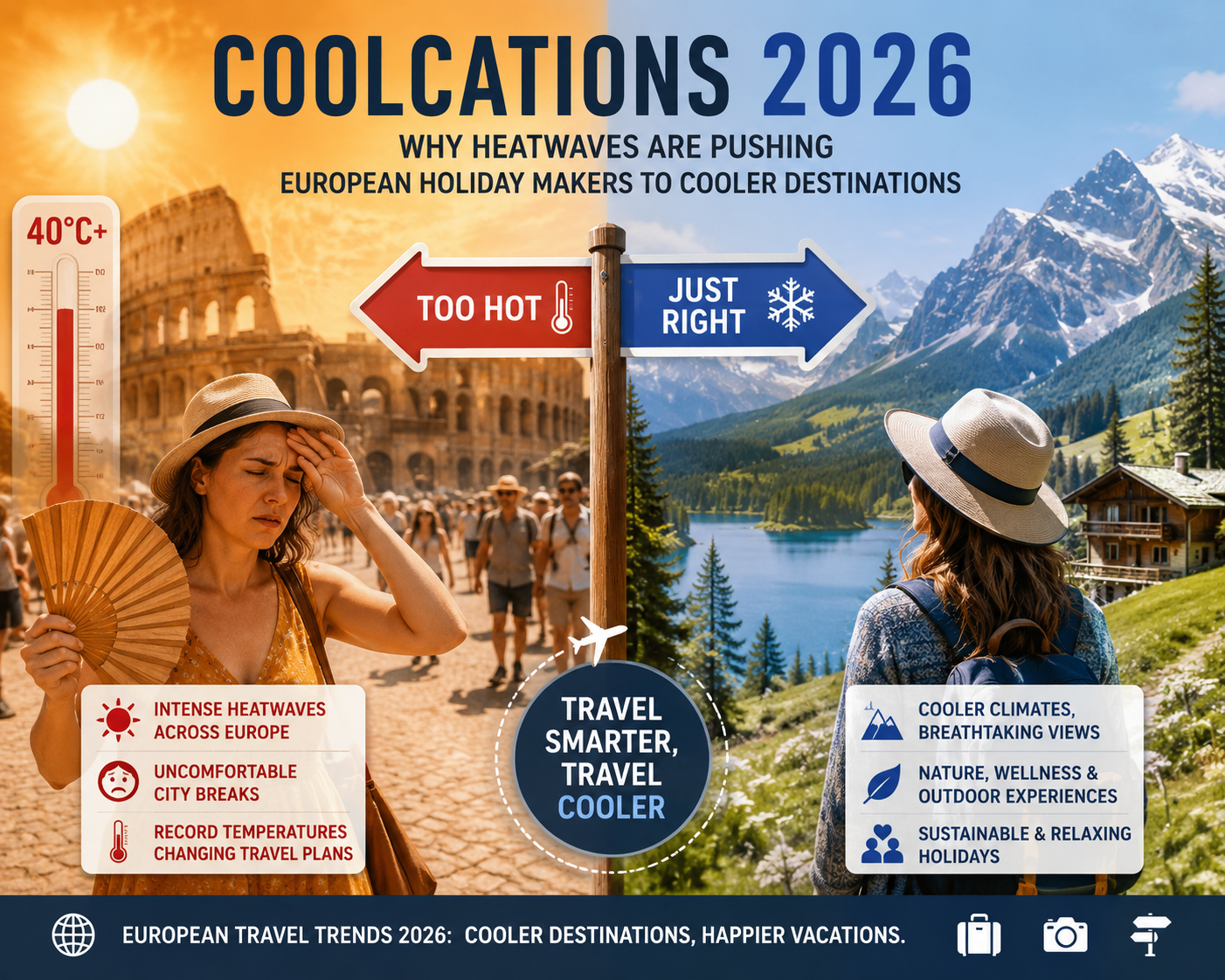
The Mediterranean Is Losing Its Shine
For decades, a European summer meant one thing: the Mediterranean. Sun loungers in Spain, gelato in Italy, beach clubs in Greece. But in 2026, that formula is starting to crack and the reason is simple. It’s just too hot.
Since May, heatwaves have hit the UK, Portugal, France, Ireland, Spain, Germany, Benelux, and Romania, with peak temperatures reaching over 40°C in Portugal. That kind of heat isn’t just uncomfortable for a growing number of travelers, it’s a dealbreaker. Enter the “coolcation”: a holiday planned deliberately around milder weather, usually somewhere north.
What Exactly Is a Coolcation?
A coolcation is a trip built around comfort rather than sunbathing think Nordic fjords, Alpine trails, and glacier lagoons instead of crowded beaches under a heat dome. The core idea is straightforward: a holiday planned around a comfortable climate rather than a hot one.
It’s not a brand-new idea, but 2026 seems to be the year it went mainstream. The concept has been gathering pace for a few years but appears to have exploded this year.
The Numbers Behind the Shift
This isn’t just a vibe the booking data backs it up in a big way:
- On the French version of Hotels.com, searches for rooms in Copenhagen jumped 246% since the first heatwave struck France in May, while Dublin searches rose 151%
- Oslo has seen booking growth of 154% year-over year and Helsinki 124%, according to one travel advisor
- Trip.com data shows searches for coolcations have surged 74% year-on-year since the start of 2026
- Travel to Scandinavia is projected to rise by up to 35% in 2026
Search terms tell their own story too phrases like “escape the heat,” “summer escapes,” and “cool summer retreat” are trending across booking platforms.
Where Everyone’s Headed
The clear winners of this shift are the cooler corners of Europe:
- Iceland — Iceland’s sub-Arctic maritime climate keeps peak July temperatures between 10°C and 15°C, with North Atlantic winds preventing heat buildup, plus glacier lagoons, waterfalls, and geothermal bathing without the heat stress
- Norway, Sweden, and Finland — steady favorites for fjords, lakes, and long daylight hours without the scorching heat
- Ireland and the UK — riding a wave of interest from travelers who don’t want to fly far to escape the heat
- Alpine regions — Northern European and Alpine destinations are gaining ground as heatwaves reshape European summer demand, with mountain resorts also seeing a lift in summer popularity
But Is It Really About the Heat Or Something Else?
Not every expert is convinced this is purely a climate story. Some argue the shift is more nuanced than a simple mass exodus from the Mediterranean. According to one tourism specialist, all European countries have recorded an increase in tourist arrivals, with no clearly discernible trend linked purely to heat, since factors like culture, environment, and prices also shape where people choose to go.
And the Mediterranean isn’t exactly empty either in Spain, tourist spending has already risen more than 8% in the second quarter of 2026, showing that traditional sun and sand destinations still have plenty of pull.
A Broader Shift in How Europeans Travel
Coolcations aren’t happening in isolation they’re part of a wider change in summer travel habits. Trips are also getting shorter: average trip duration for summer bookings now ranges from just under three to under four days. Family travel is also on the rise, with travelling with family now seen as the most appealing type of holiday, particularly among European ,UK and German travelers and older Millennials aged 35 to 44.
Fad or the New Normal?
The big question is whether coolcations are a passing reaction to a few brutal summers, or a lasting shift in how Europeans plan their holidays. Right now, it looks less like a trend and more like a symptom of a bigger reality: as heatwaves become more frequent and intense across southern European, comfort is starting to compete with sunshine as the top priority for summer travel.
One thing seems clear as long as thermometers keep climbing past 40°C in traditional hotspots, the fjords, lakes, and glaciers of the north are only going to look more appealing.
Learn more about our site archive2in.com
Contact us on contactarchive2in@gmail.com
Read out our latest articles on our BLOG section
Leave a Reply
You must be logged in to post a comment.