
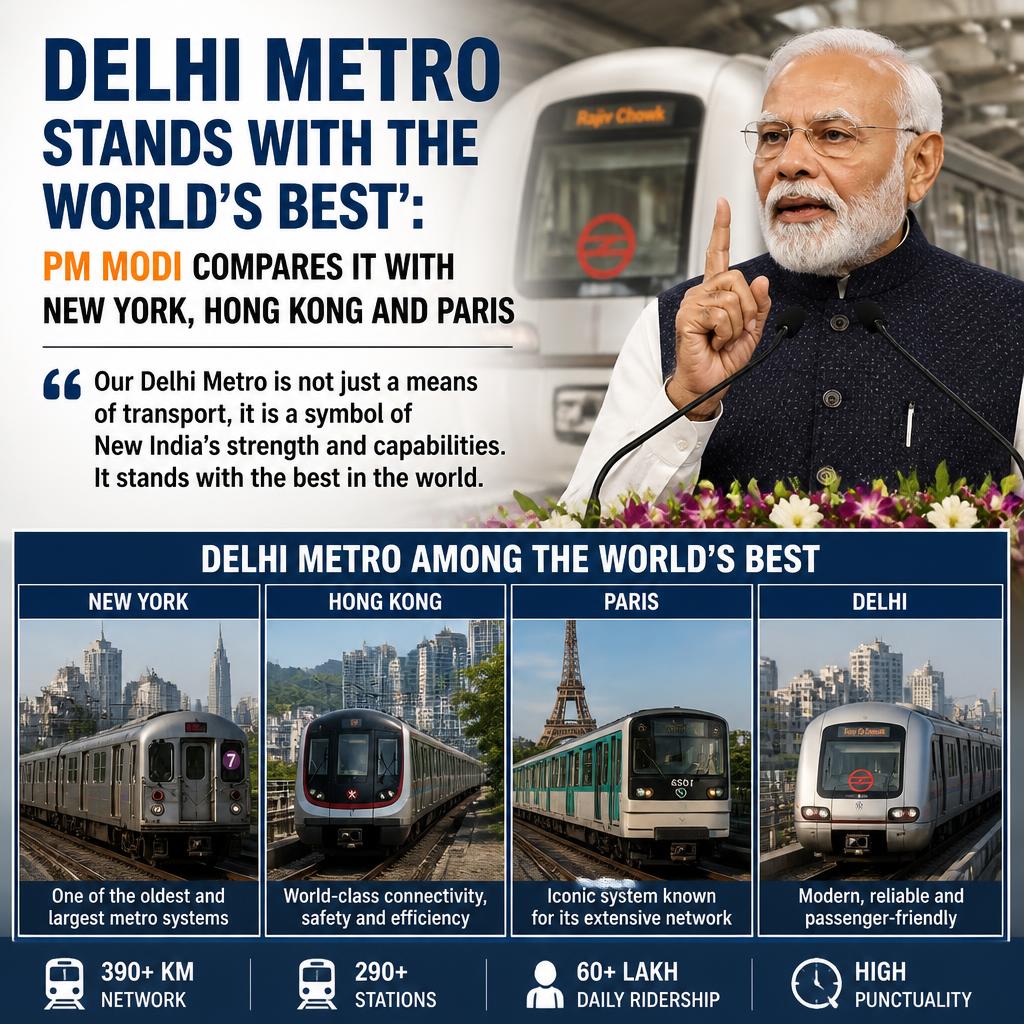
Prime Minister Narendra Modi has put the Delhi Metro in the same global conversation as some of the world’s most famous urban rail systems, comparing it with the metro networks of New York, Hong Kong and Paris while highlighting India’s rapid transformation in urban infrastructure.
The comparison came as PM Modi spoke about India’s expanding transport network and the broader changes taking place in the country’s cities. His remarks reflect a larger argument made repeatedly by the government: that India’s metro revolution is no longer limited to a handful of major cities and that systems such as the Delhi Metro are increasingly being viewed as symbols of modern, large-scale urban mobility.
But what exactly does this comparison mean, and how does the Delhi Metro fit into the global league of New York, Hong Kong and Paris?
Delhi Metro and the Global Benchmark
New York, Hong Kong and Paris operate some of the most recognizable and heavily used urban rail networks in the world. Each system has developed under very different historical, geographical and economic conditions.
The New York City Subway is one of the world’s oldest and largest urban transit systems, while the Paris Métro is globally known for its dense station network and deep integration with the French capital. Hong Kong’s MTR, meanwhile, is often cited for its operational efficiency, connectivity and integration with the wider urban environment.
The Delhi Metro is much younger than these networks, but its growth has been remarkably rapid. Since beginning operations in 2002, it has expanded into a vast network serving Delhi and the wider National Capital Region. The system has also become a model for metro development elsewhere in India.
PM Modi’s comparison, therefore, is less about suggesting that all four networks are identical. Instead, it places Delhi’s metro system among major international examples of how large cities use rapid transit to manage population, congestion and mobility.
From Delhi’s First Metro Line to a National Metro Revolution
The rise of the Delhi Metro is also part of a much larger transformation across India.
According to government data, India’s metro network expanded from 248 kilometres in 2014 to more than 1,000 kilometres by 2025, with metro connectivity spreading from five cities in 2014 to 26 cities by 2025. By 2026, the government said the country’s operational metro network had grown beyond 1,155 kilometres, making India home to the world’s third-largest metro network.
This expansion has changed the role of the metro in India’s urban development.
For millions of commuters, metro systems are no longer simply premium transport projects. They have become part of everyday life, connecting residential areas with offices, markets, airports, railway stations, universities and government districts.
Delhi remains at the centre of this transformation.
The capital’s network has continued to expand through new corridors, extensions and interchange stations. In December 2025, the Union Cabinet approved three additional corridors under Delhi Metro’s Phase V(A), covering more than 16 kilometres and including the R.K. Ashram Marg–Indraprastha, Aerocity–IGD Airport Terminal 1 and Tughlakabad–Kalindi Kunj routes.
Delhi Metro’s Expansion Is Far From Over
The government has continued to push new infrastructure projects in the capital.
In March 2026, PM Modi inaugurated additional Delhi Metro corridors and laid the foundation stone for further expansion under Phase V(A). The projects included the Majlis Park–Maujpur Babarpur section of the Pink Line and the Deepali Chowk–Majlis Park section of the Magenta Line.
Work has also begun on the Central Vista Corridor, a nearly 10-kilometre underground route designed to improve connectivity to key administrative and public areas of New Delhi. Central Secretariat is set to become an important triple-interchange point connecting the new corridor with the existing Yellow and Violet lines.
These projects underline why Delhi Metro remains central to the government’s vision of urban mobility. The goal is not simply to add more tracks, but to build a more interconnected transport ecosystem.
More Than Just a Metro System
The Delhi Metro has also become an example of how mass transit can influence the way a city develops.
A reliable metro network can reduce dependence on private vehicles, ease pressure on congested roads and make long-distance commuting more predictable. It can also reshape real estate development and commercial activity around stations.
Government-backed research released in 2026 has highlighted broader economic effects linked to metro connectivity, including lower transport costs and reduced financial stress for households. A study referenced by the government found that improved metro access was associated with changes in household mobility patterns and financial behaviour in several Indian cities, including Delhi.
Of course, metro systems also face challenges. Rapid population growth, overcrowding during peak hours, the need for last-mile connectivity and the high cost of infrastructure remain major issues. Expanding a network is only one part of building an efficient urban transport system.
Why PM Modi’s Comparison Matters
By comparing the Delhi Metro with networks in New York, Hong Kong and Paris, PM Modi is making a broader statement about India’s infrastructure ambitions.
For decades, metro rail was largely associated with the world’s established global cities. India is now attempting to build urban transport networks at a similar scale while doing so across multiple cities at the same time.
The Delhi Metro represents one of the clearest examples of that ambition. What began as a new transport system in the early 2000s has grown into the backbone of public transit for one of the world’s largest urban regions.
India’s metro story is still evolving, and the Delhi Metro is still expanding. Whether it can match the operational maturity, density and historical scale of New York, Hong Kong or Paris is a more complicated question—one that depends on the specific metric being used.
But in terms of ambition, expansion and its role in transforming daily life, Delhi Metro has clearly earned a place in the global conversation.
Disclaimer: This article is based on publicly available reports and official government information available as of August 2026. Comparisons between metro systems should be understood in context, as network size, age, ridership, geography, operational models and service conditions vary significantly between Delhi, New York, Hong Kong and Paris.
Learn more about our site on contactarchive2in.com
Contact us on our email id contactarchive2in@gmail.com
Leave a Reply
You must be logged in to post a comment.