
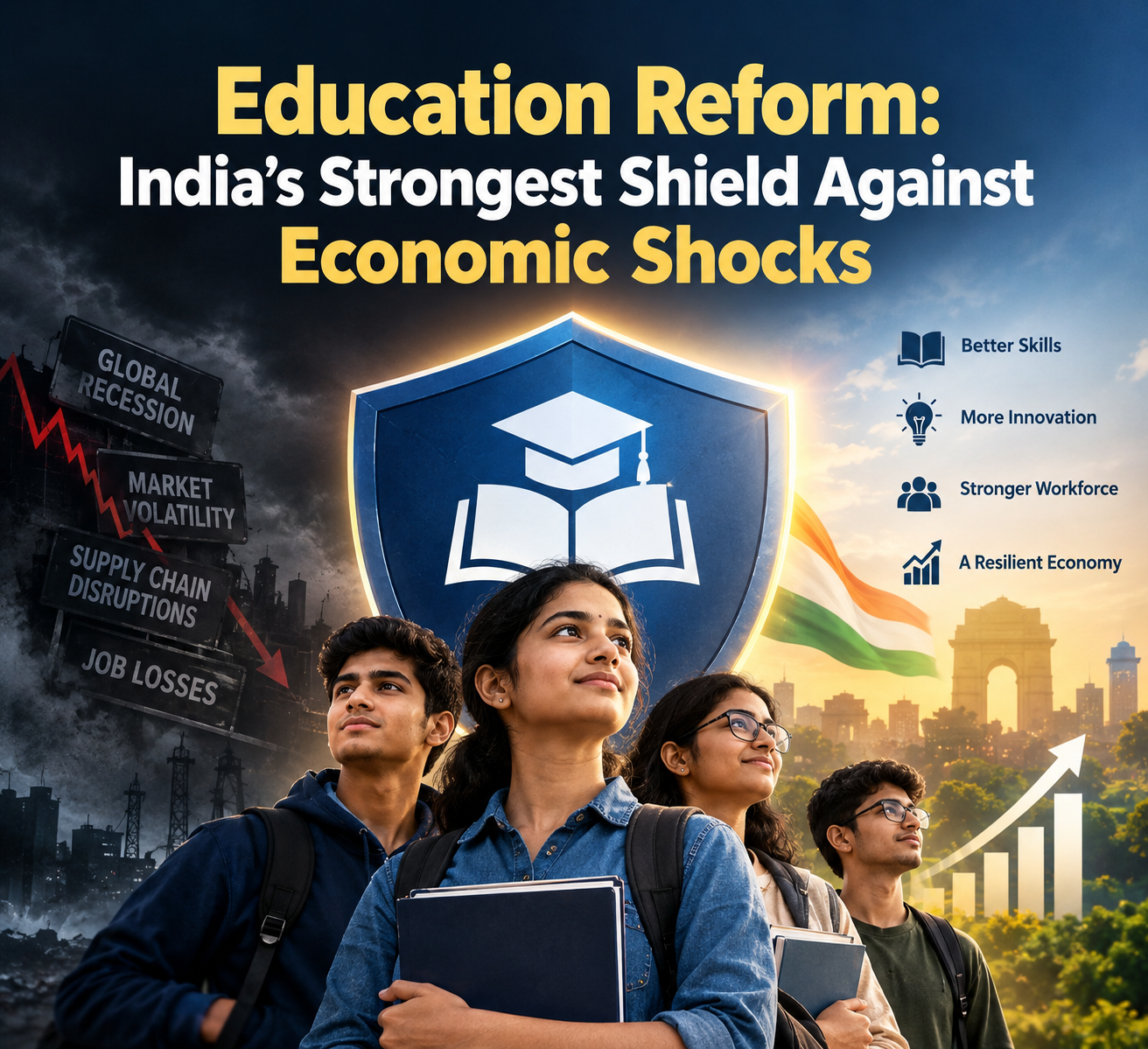
Introduction: Why Education Is the Real “Economic Shock Absorber”
Every time an economic crisis hits whether it was the 2008 global recession, the COVID-19 pandemic, or today’s global trade uncertainty developing economies like India face one core challenge: keeping jobs and incomes stable. At the root of that stability lies a factor often overlooked: the quality and resilience of the education system.
Research from around the world shows that regions with strong universities and higher education institutions tend to weather recessions and industrial decline far better than regions without them. A well-known U.S. study found that counties with regional universities largely offset the negative effects of manufacturing decline, while counties without such institutions struggled to recover.
This lesson is deeply relevant for India.
1. The Direct Link Between Education and Economic Resilience
Education isn’t just about issuing degrees — it strengthens a society in three key ways:
- A hub of knowledge and skill — Universities generate new ideas, technology, and research that become the foundation for new industries and startups.
- A stable economic anchor — Because of steady public funding and institutional permanence, the education sector tends to be less volatile than private industry during downturns, offering the local economy a cushion.
- A connecting bridge — Universities link local talent to global opportunities, reducing brain drain and encouraging the exchange of new ideas.
A well-educated workforce adapts faster during economic shocks, picks up new skills more quickly, moves more easily between industries, and avoids long-term unemployment that is what real economic resilience looks like.
2. India’s Core Challenge: The Gap Between Education and Employability
India’s biggest education problem has long been the mismatch between degrees and employability. Multiple surveys have shown that a large share of engineering and undergraduate degree holders are not adequately skilled for what industries actually need.
The main reasons behind this gap include:
- Outdated, overly theoretical curricula that don’t match industry demand
- Low investment in research and innovation
- Regional inequality a wide quality gap between urban and rural education
- A shortage of skill-based and vocational education pathways
This is precisely why, whenever a global slowdown or technological shift (like automation or AI) arrives, a large segment of India’s youth finds itself vulnerable.
3. Pillars of Education Reform That Can Strengthen India
a) Industry-Aligned Curricula
Curricula need regular updates, co-designed with industry, so students are prepared for real-world problems rather than outdated theory.
b) Investment in Research and Innovation
In resilient economies, universities aren’t just teaching centers — they double as research hubs and startup incubators. India needs to significantly increase research funding at higher education institutions.
c) Skilling and Reskilling Systems
The most valuable asset during an economic shock is the ability to learn new skills quickly. Government initiatives like Skill India need deeper integration with universities and colleges.
d) Strengthening Regional Universities
Quality higher education shouldn’t be confined to major metros. Building strong universities in tier-2 and tier-3 cities can give local economies the same buffer that big cities already enjoy.
e) Digital and Financial Inclusion
Promoting online education and digital learning platforms can bring quality education to remote areas, improving both access and equity across the country.
4. Global Examples India Can Learn From
- America’s “Rust Belt” cities like Pittsburgh, where strong universities helped the local economy stay resilient even as manufacturing declined.
- Asia-Pacific’s response to global recessions, where higher education institutions turned crisis into opportunity through scholarships, loan assistance, and vocational training for vulnerable populations.
India can draw on these models to strengthen and future-proof its own education policy.
Conclusion: Education Reform Is No Longer Optional It’s Essential
In the years ahead, India will face multiple economic shocks from climate change to technological disruption (AI and automation) to volatility in global trade. In this environment, education reform isn’t just a social responsibility it’s a strategic economic investment.
Countries that continuously evolve their education systems aligning curricula with industry needs, investing in research, and delivering quality education across every region are the ones best equipped to withstand future economic shocks. For India, this is the most sustainable and secure path forward.
Learn more about our site archive2in.com
Contact us on our email id contactarchive2in@gmail.com
Read out our latest artice on our blog section
Leave a Reply
You must be logged in to post a comment.