
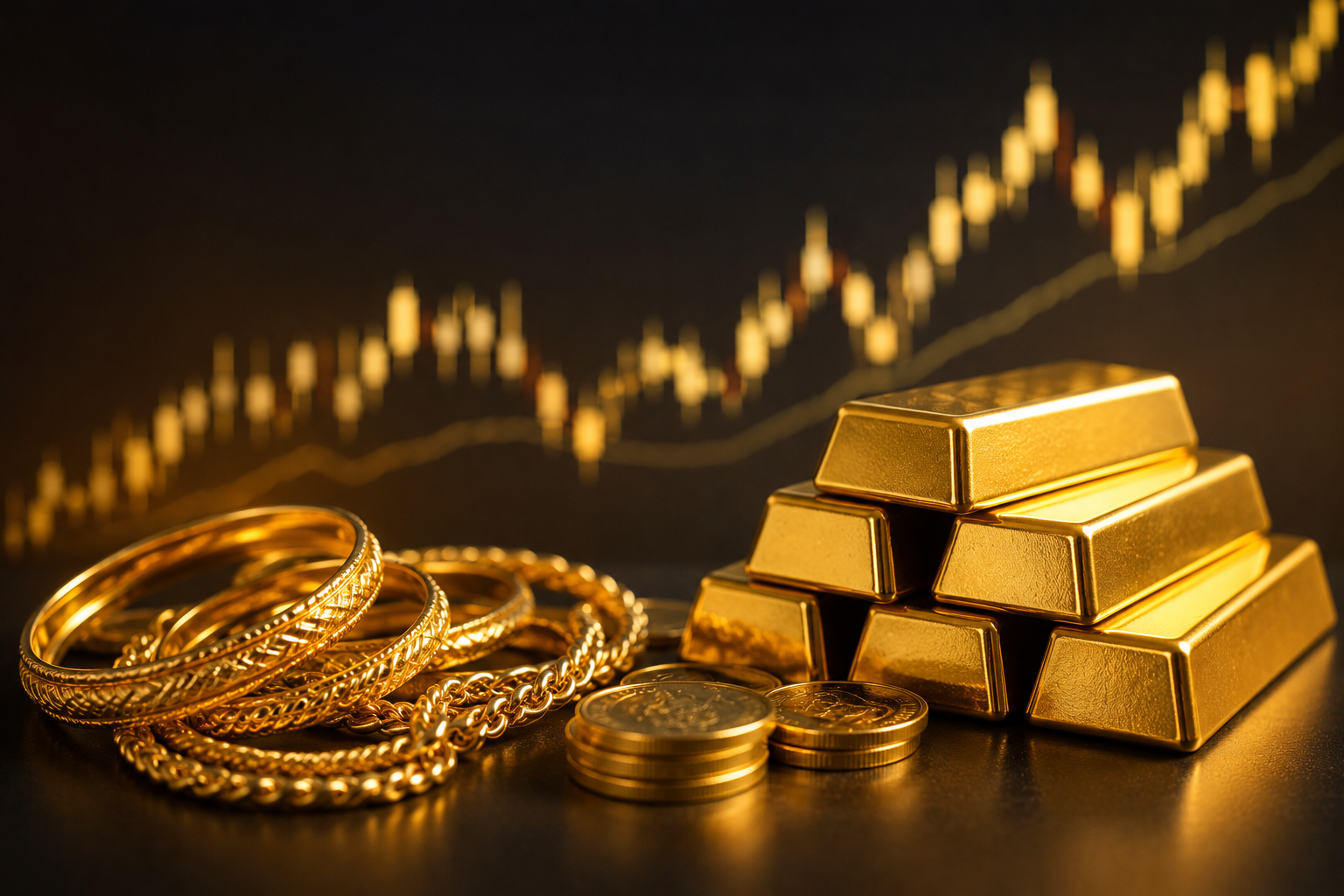
Gold’s latest rally is putting investors in a familiar position: take profits, stay invested, or buy more at higher prices? The right answer depends less on whether gold is “good” or “bad” and more on your time horizon, existing allocation and reason for owning it.
I’ll frame the blog around those three choices and distinguish long-term investing from short-term speculation.
Gold Price Is Rising Again: Should You Sell, Hold or Buy More? Experts Explain
Gold is back in the spotlight after another sharp move in prices, leaving investors with a difficult question: Is this the moment to book profits, stay invested, or buy more?
The answer is not the same for everyone.
A short-term trader, a long-term investor, someone holding inherited jewellery and a first-time buyer all face different decisions. What makes the latest rally particularly challenging is that gold has already experienced significant volatility in 2026. After hitting record levels earlier in the year and then falling sharply, prices have climbed again, supported by a combination of a weaker US dollar, shifting interest-rate expectations, geopolitical uncertainty and renewed investor demand. (World Gold Council)
In India, the recent move has been particularly noticeable. According to recent reporting, MCX gold rose sharply during August, prompting renewed debate over whether investors should sell, hold or add to their positions. (The Economic Times)
So, what should you do?
Why Is Gold Rising Again?
Gold does not generate interest or dividends, so its appeal often depends heavily on the wider economic environment.
One major factor behind the latest rally has been movement in the US dollar and expectations surrounding monetary policy. A weaker dollar can make gold more attractive to buyers using other currencies, while changes in interest-rate expectations can also influence demand for a non-yielding asset such as gold. Recent market moves have reflected investors reacting closely to US inflation data and signals about the Federal Reserve’s next steps. (Reuters)
Geopolitical uncertainty has also remained an important driver. Gold has traditionally been viewed as a defensive asset during periods of financial or political instability, although that does not mean its price rises every time uncertainty increases. The World Gold Council has said geopolitical factors are expected to remain important drivers of gold demand, alongside investment flows and central-bank activity. (World Gold Council)
Another major source of support has been central-bank demand. In its 2026 survey, the World Gold Council reported that 89% of surveyed reserve managers expected global central-bank gold holdings to continue increasing over the following 12 months, while 45% expected their own institutions to increase holdings. (World Gold Council)
That does not guarantee higher prices, but it provides an important piece of the bigger demand picture.
Should You Sell Gold and Book Profits?
If gold now represents a much larger share of your investment portfolio than you originally intended, taking some profits may be worth considering.
For example, imagine an investor initially wanted 10% of their portfolio in gold. A major rally could push that allocation to 15%, 20% or even higher without the investor buying another gram.
In that situation, selling a portion and rebalancing the portfolio is not necessarily a bet that gold will crash. It can simply be a way of returning to your original investment plan.
Selling may also make sense if:
- You bought gold primarily for a short-term trade.
- You have reached a financial goal.
- You need the money for an upcoming expense.
- Your gold allocation has become disproportionately large.
- You are uncomfortable with the possibility of a sharp correction.
However, selling everything simply because prices have risen can be risky. Gold has experienced powerful rallies before continuing higher, particularly when macroeconomic or geopolitical conditions remain supportive.
The key question is not, “Has gold gone up?”
It is, “Why did I buy it in the first place, and does it still serve that purpose?”
Should You Hold?
For many long-term investors, holding may be the simplest option.
Gold is often included in a diversified portfolio as a hedge against certain risks rather than as a vehicle for generating regular income. If your allocation remains close to your target and your original investment thesis has not changed, a price rally alone may not be a reason to sell.
The World Gold Council’s 2026 outlook suggests that gold remains highly sensitive to economic growth, inflation, interest rates, geopolitical developments and investor sentiment. Its analysis also points to continued support from investment and central-bank demand, while warning that changes in those conditions could create pressure on prices. (World Gold Council)
In other words, the bullish case is still alive—but so is the possibility of volatility.
That makes holding particularly suitable for investors who already have a sensible allocation and do not need to chase every short-term move.
Should You Buy More Gold?
Buying after a strong rally can feel uncomfortable, and there is a genuine risk of purchasing near a temporary peak.
That is why investors considering additional exposure may want to avoid putting a large lump sum into gold purely because of headlines or fear of missing out.
A more measured approach could involve gradual buying, sometimes called rupee-cost averaging or systematic investing. Instead of trying to predict the perfect entry point, an investor spreads purchases over time.
This does not guarantee profits or protect against falling prices. But it can reduce the risk of committing all your money immediately before a correction.
Buying more may be worth considering if:
- You currently have little or no exposure to gold.
- Gold remains below your intended portfolio allocation.
- You are investing with a long-term horizon.
- You understand that prices can fall sharply even during a broader bullish trend.
- You are adding gold for diversification rather than chasing quick profits.
Investors should also consider how they gain exposure. Physical gold, jewellery, gold ETFs, funds and other products can have very different costs, liquidity, taxation and risks. Jewellery, in particular, includes making charges and may not function like a pure investment in the metal.
The Biggest Mistake: Making an All-or-Nothing Decision
The current gold rally does not necessarily demand an extreme response.
You do not have to choose between selling every gram you own and investing all your savings in gold.
For many investors, the more sensible approach may be to rebalance.
If you own too much after the rally, consider reducing exposure. If you own too little and believe gold has a role in your long-term portfolio, consider adding gradually. And if your existing allocation already matches your financial plan, holding may be perfectly reasonable.
The latest rally also comes with a reminder: gold prices can move in both directions quickly. After reaching a more than three-month high earlier this week, gold subsequently pulled back following US inflation data, underlining how rapidly sentiment can change. (Reuters)
So, Sell, Hold or Buy More?
There is no universal answer, but a simple framework can help:
Sell or partially book profits if gold has become an oversized part of your portfolio or you need the money.
Hold if your allocation is already appropriate and you own gold for long-term diversification.
Buy gradually if you are under-allocated, have a long investment horizon and are prepared for volatility.
What investors should generally avoid is making a decision based solely on the belief that a rising price must keep rising—or that a sharp rally automatically means a crash is imminent.
Gold’s outlook will continue to depend on interest rates, the US dollar, inflation, geopolitical developments, investment flows and central-bank demand. Those forces can support prices, but they can also change quickly. (World Gold Council)
For now, the most important question may not be “Where will gold go next?”
It may be: “How much gold should I own, and why?”
Disclaimer
This article is for informational and educational purposes only and does not constitute financial, investment or tax advice. Gold prices are volatile and can rise or fall significantly. Past performance and expert opinions do not guarantee future results. Investors should consider their financial goals, risk tolerance, time horizon, existing portfolio allocation, costs and applicable taxes before making investment decisions, and may wish to consult a qualified financial adviser.
Learn more about our site on contactarchive2in.com
Contact us on our email id contactarchive2in@gmail.com
Leave a Reply
You must be logged in to post a comment.