
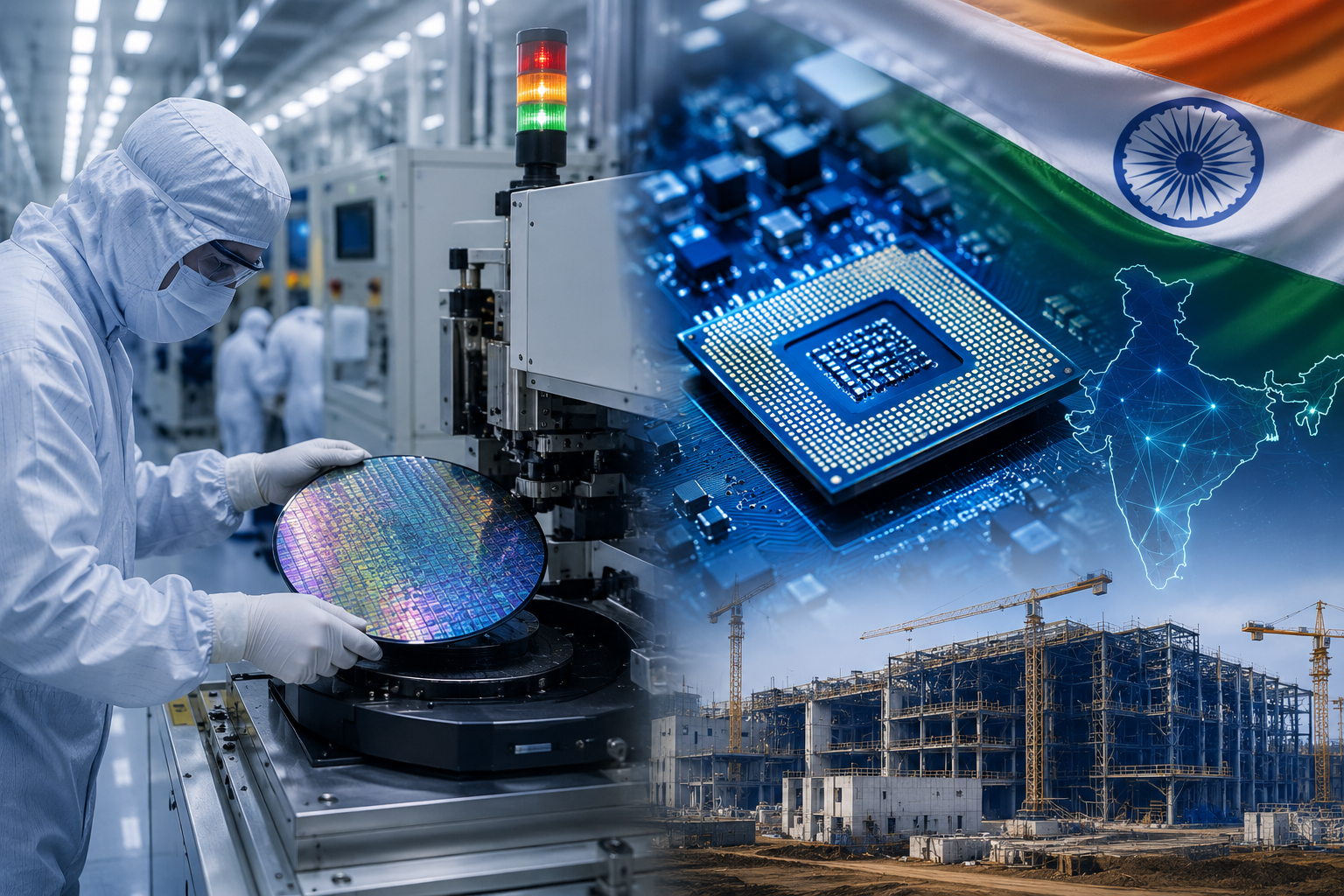
India is stepping up its ambitions in one of the world’s most strategically important industries. Prime Minister Narendra Modi has said that five to eight more semiconductor plants could come up in India over the next seven to eight years, building on the country’s recent progress in chip manufacturing. (The Economic Times)
The announcement came during Modi’s Independence Day address from the Red Fort on August 15, 2026, where he highlighted semiconductor manufacturing as an important part of India’s push for technological self-reliance.
The announcement is significant because India has spent years trying to establish a semiconductor manufacturing ecosystem. The country is now moving from policy announcements and project approvals toward actual commercial production.
India has already started producing semiconductors
India’s semiconductor story is no longer limited to future plans.
According to the government, three semiconductor facilities had entered commercial production by July 2026. These include facilities associated with Micron, Kaynes and CG Semi. The government said two additional plants were expected to begin operations in the coming months, potentially taking the number of operational plants to five by the end of 2026.
That represents a major change for an industry that requires enormous investments, specialised infrastructure and highly trained workers.
Modi said that exports have also begun from the semiconductor production that has already started, suggesting that India’s ambitions extend beyond meeting domestic demand.
Why are semiconductors so important?
Semiconductors are the foundation of modern technology.
They are used in smartphones, computers, cars, medical equipment, telecommunications systems, industrial machinery, defence equipment and artificial-intelligence systems.
Almost every major digital product depends on chips.
This makes semiconductor manufacturing a strategic issue for governments around the world. Disruptions in global chip supplies during the pandemic demonstrated how quickly shortages can affect automobile production, electronics and other industries.
For India, developing domestic manufacturing could therefore provide greater resilience while also creating opportunities to become part of global technology supply chains.
Government has committed major funds to the sector
India launched the Semicon India Programme in 2021 with an initial outlay of ₹76,000 crore to develop semiconductor and display manufacturing capabilities.
The programme has since expanded.
In July 2026, the Union Cabinet approved Semicon 2.0, with a total budget of ₹1,27,500 crore. The programme is designed to support not only chip manufacturing but also semiconductor design, machinery, materials, chemicals, gases and advanced packaging.
The broader strategy is important because building a successful semiconductor industry requires much more than constructing a factory.
India wants an entire semiconductor ecosystem
A modern chip industry depends on a complicated network of suppliers.
Factories need specialised manufacturing equipment, ultra-pure materials, chemicals, gases, packaging facilities and testing infrastructure.
Semicon 2.0 therefore focuses on several areas, including chip design, semiconductor manufacturing, equipment and materials, and ATMP/OSAT packaging and testing facilities.
This could create opportunities for Indian companies beyond the large semiconductor plants themselves.
Startups and smaller manufacturers could potentially participate in chip design, electronics manufacturing, industrial equipment, materials and other supporting industries.
AI is adding another reason to build chips in India
The rapid growth of artificial intelligence is making semiconductors even more important.
AI applications require enormous amounts of computing power, which in turn requires advanced processors, memory and specialised chips.
India’s semiconductor ambitions therefore coincide with its broader push to become a major player in artificial intelligence.
The government has also said that Indian startups are already working on semiconductor designs for areas such as AI systems, telecommunications, drones, satellite communications, Internet-of-Things devices and smart meters.
If this ecosystem develops successfully, India could potentially participate in multiple stages of the global chip industry rather than simply importing finished components.
What could more semiconductor plants mean for India?
The benefits could extend well beyond chip production.
More skilled jobs
Semiconductor facilities require engineers, technicians, equipment specialists, researchers and manufacturing workers.
They can also generate indirect employment through construction, logistics, maintenance, security and supplier companies.
Stronger electronics manufacturing
A domestic semiconductor ecosystem could support India’s growing electronics manufacturing industry by improving access to locally produced components.
Reduced supply-chain dependence
Producing more chips domestically could reduce India’s exposure to disruptions in international semiconductor supply chains.
More technology investment
Large semiconductor projects can attract additional companies involved in electronics, materials, equipment and research.
There are still major challenges
Building semiconductor plants is extremely difficult and expensive.
Factories require reliable electricity, high-quality water, sophisticated equipment, highly controlled manufacturing environments and a specialised workforce.
India will also have to compete with established semiconductor manufacturing hubs such as Taiwan, South Korea, Japan, the United States and China.
The success of the country’s strategy will therefore depend not simply on the number of factories announced, but on whether those facilities can achieve commercial-scale production efficiently and remain competitive over the long term.
A long-term bet on India’s technology future
Modi’s announcement of five to eight additional plants shows that India’s semiconductor ambitions are becoming increasingly long-term.
The country has moved from having virtually no large-scale commercial chip manufacturing to having three facilities in production, with additional projects progressing. At the same time, the government is expanding financial support through Semicon 2.0. (Press Information Bureau)
The next seven to eight years will determine whether these efforts can transform India into a significant semiconductor manufacturing and design hub.
If the plans succeed, the impact could reach far beyond the chip industry. Smartphones, cars, AI systems, industrial equipment and countless other technologies could increasingly have an important part of their supply chain rooted in India.
For a country seeking greater technological self-reliance, the semiconductor race could become one of the defining industrial stories of the next decade.
Disclaimer
This article is for informational and educational purposes only. Semiconductor projects, investment figures, production timelines and government policies can change. The announcement of a proposed facility does not guarantee that a plant will be completed or reach commercial production on schedule. Readers should consult official government and company announcements for the latest developments.
Learn more about our site on contactarchive2in.com
Contact us on our email id contactarchive2in@gmail.com
Leave a Reply
You must be logged in to post a comment.