
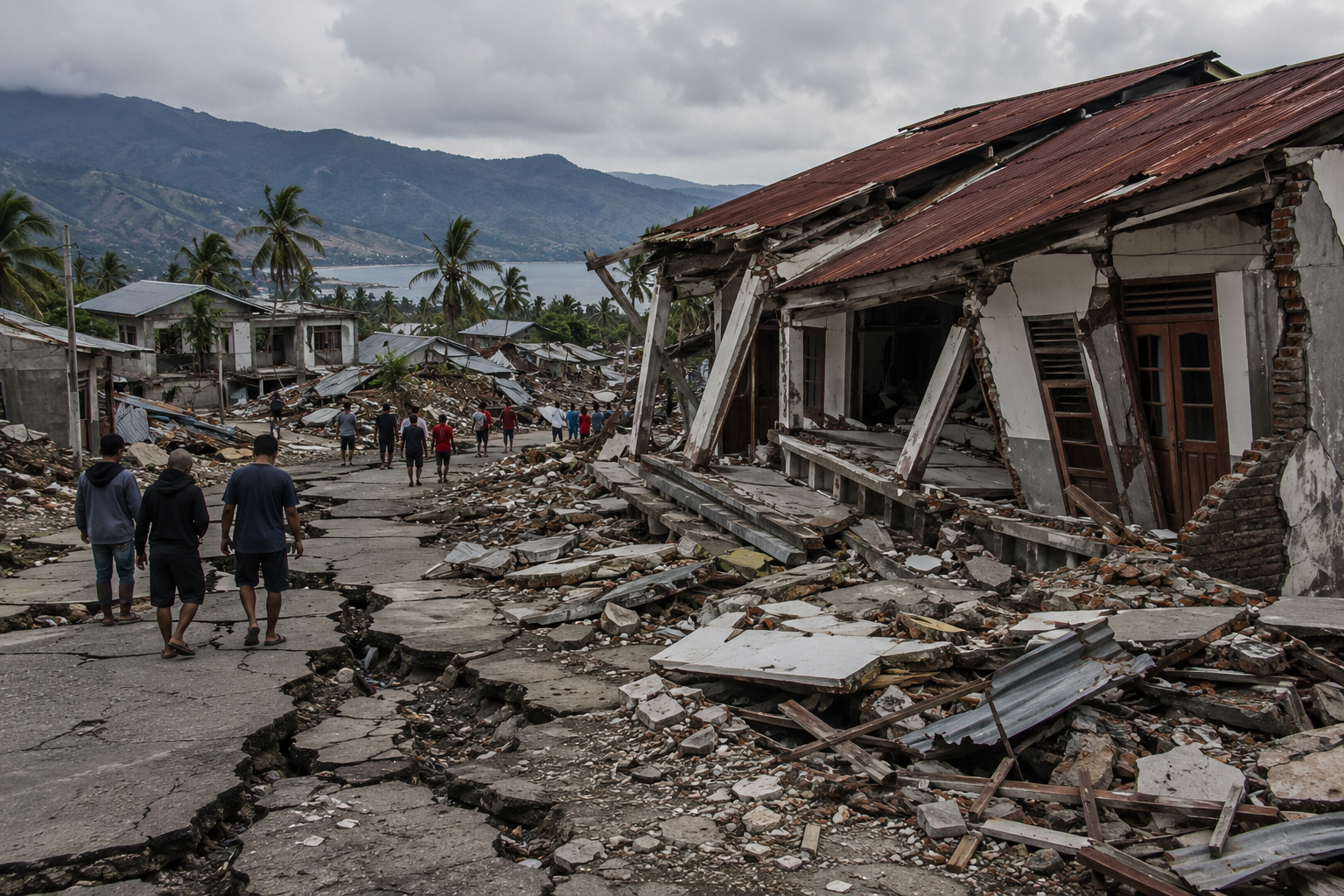
A powerful magnitude 7.7 earthquake struck off the coast of Indonesia’s Flores region on Saturday, causing widespread destruction, landslides and panic across parts of East Nusa Tenggara.
The disaster initially left at least 40 people dead, according to early reports, while dozens more were injured. The death toll later rose as rescue teams reached damaged and isolated areas. Reuters reported on August 16 that at least 51 people had died, with rescue operations continuing.
The earthquake also prompted authorities to issue a tsunami warning, which was later lifted after monitoring showed that there was no continuing major tsunami threat.
A powerful earthquake strikes near Flores
The earthquake struck early Saturday near the island of Flores.
The U.S. Geological Survey placed the epicentre about 68 kilometres north-northwest of Ende, in East Nusa Tenggara province. The relatively shallow earthquake caused severe shaking across nearby communities.
Buildings collapsed, homes were damaged and landslides blocked roads in several areas.
The impact was particularly serious in parts of Nagekeo, Maumere and surrounding districts, where rescue teams faced difficulties reaching communities because roads and communications had been disrupted.
Tsunami warning was issued and later cancelled
Because the earthquake occurred offshore, flores Indonesian authorities initially issued a tsunami warning for several areas.
The warning sent residents rushing toward higher ground as authorities urged people in vulnerable coastal areas to move away from the shoreline.
Small tsunami waves were subsequently recorded. AP reported that the highest recorded wave reached approximately 1.61 metres in Riung village. Authorities later lifted the tsunami warning after monitoring indicated that there was no longer a significant threat.
Although the warning was cancelled, residents still had to contend with aftershocks and the risk of additional landslides and structural collapses.
Rescue operations face major challenges
The earthquake caused more than just collapsed buildings.
Landslides blocked roads, power outages affected communities and damaged communications made it difficult for emergency teams to assess the situation.
The Trans-Flores Highway, an important transport route, was also affected, making it harder to move rescue workers and supplies into some areas.
Thousands of people were evacuated or moved into temporary shelters because many residents were afraid to return to damaged buildings while aftershocks continued.
Reuters reported that more than 5,000 people had been evacuated, with emergency workers and security personnel assisting rescue and relief efforts.
Hundreds of aftershocks followed
The main earthquake was followed by a large number of aftershocks.
Authorities recorded hundreds of additional tremors, including several strong ones. The continuing seismic activity added another layer of danger for residents and rescue workers working around damaged structures.
Aftershocks can cause buildings already weakened by the main earthquake to collapse, which is why emergency teams often have to work carefully around damaged structures.
Indonesia’s location makes earthquakes a constant threat
Indonesia is one of the world’s most earthquake-prone countries.
The country lies along the Pacific Ring of Fire, an area where several tectonic plates meet and where earthquakes and volcanic activity are common.
Flores itself has experienced devastating earthquakes before. In 1992, a magnitude 7.7 earthquake struck the island and generated a major tsunami, killing thousands of people.
That history means communities in the region are particularly aware of the dangers posed by earthquakes and tsunamis.
Why was the tsunami warning lifted?
A tsunami warning does not necessarily mean that a destructive tsunami will occur.
Following a major undersea earthquake, authorities monitor sea levels and other data to determine whether dangerous waves are developing.
In this case, small waves were observed, but authorities later determined that there was no continuing major tsunami threat and cancelled the warning.
The decision allowed coastal residents to begin returning from evacuation areas, although authorities continued to warn people about aftershocks and damaged buildings.
What happens next?
The immediate priority is finding survivors, treating the injured and providing shelter, food and other essential supplies to displaced residents.
Emergency teams also need to restore roads, electricity and communications while assessing the safety of damaged buildings.
The final impact of the earthquake may take days to become clear because some communities are remote and difficult to reach.
As rescue operations continue, authorities are also expected to assess whether additional emergency measures are needed to support affected communities.
A reminder of Indonesia’s seismic vulnerability
The Flores earthquake is another reminder of the risks faced by communities living in Indonesia’s seismically active regions.
The lifting of the tsunami warning has reduced one immediate danger, but the earthquake’s aftermath continues to pose serious challenges.
Flores With roads blocked, infrastructure damaged and aftershocks continuing, the focus now is on reaching isolated communities and helping thousands of people who have been forced from their homes.
For Flores, the disaster is not simply a story about an earthquake. It is a major humanitarian challenge that will likely require sustained rescue, relief and rebuilding efforts in the days and weeks ahead.
Disclaimer
This article is intended for informational purposes. Earthquake casualty figures and damage assessments can change rapidly as rescue teams reach affected areas. Readers should rely on Indonesian authorities and recognised emergency agencies for official safety instructions.
Learn more about our site on contactarchive2in.com
Contact us on our email id contactarchive2in@gmail.com
Leave a Reply
You must be logged in to post a comment.