
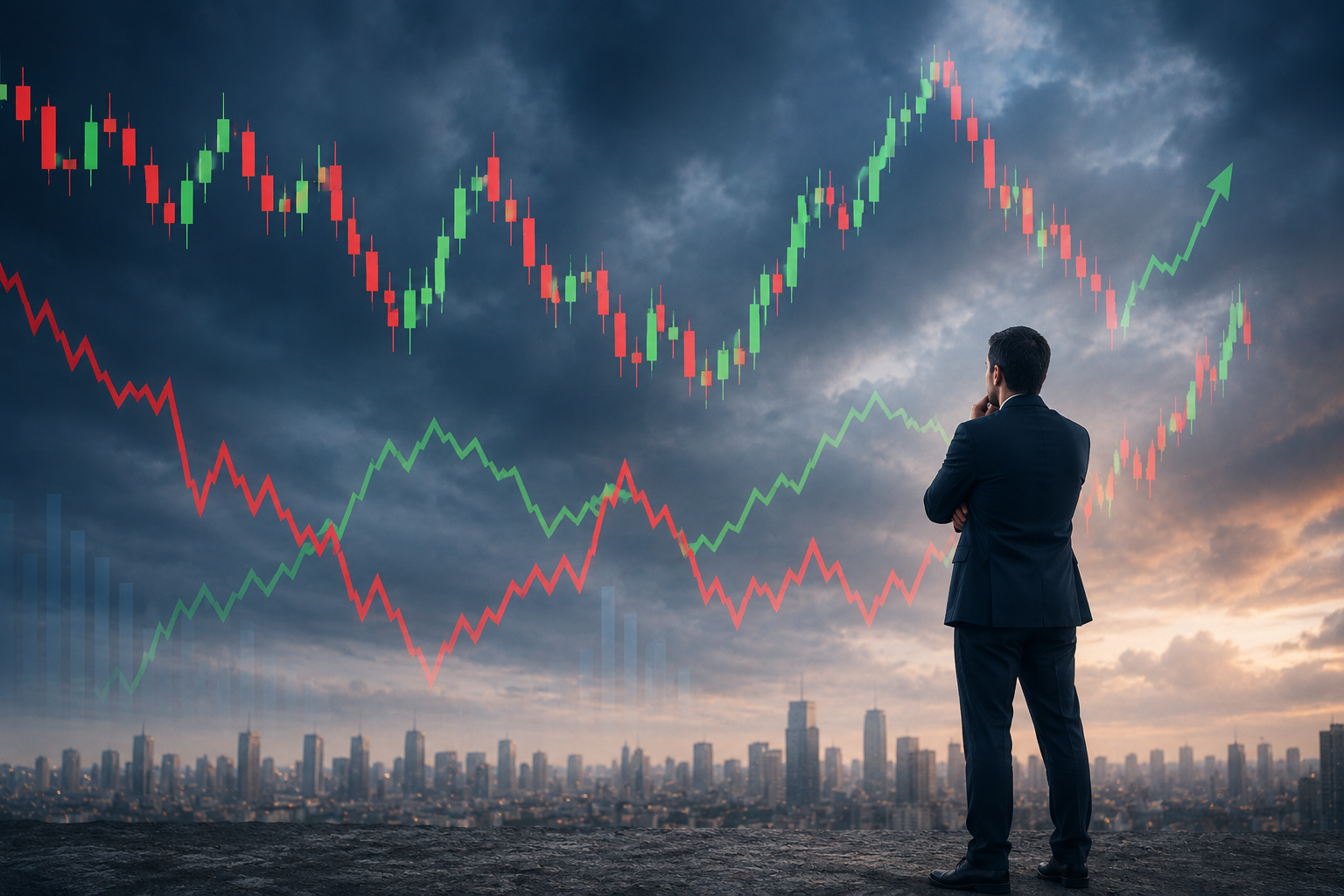
Stock markets rarely move in a straight line. Prices can rise sharply one day and fall just as quickly the next. For new investors, these sudden movements can be confusing—and sometimes frightening.
This movement is known as market volatility. While volatility is a normal part of investing, how an investor responds to it can have a major impact on long-term financial outcomes.
Instead of reacting emotionally to every market decline, investors can focus on their financial goals, investment horizon and risk tolerance.
What is market volatility?
Market volatility refers to how significantly and how quickly the price of an investment or financial market changes over a particular period.
When prices move sharply and frequently, the market is considered highly volatile. When prices remain relatively stable, volatility is lower.
Volatility can affect stocks, mutual funds, bonds, commodities and other investments.
For example, imagine an investment worth ₹1 lakh. If its value moves between ₹95,000 and ₹1.05 lakh within a short period, the investor is experiencing noticeable volatility—even though the long-term value may eventually recover or increase.
Volatility itself does not necessarily mean something is wrong with an investment.
Why do markets become volatile?
Several factors can cause markets to move rapidly.
Economic developments
Changes in inflation, interest rates, economic growth and employment data can influence investor expectations.
If investors believe the economy is slowing, they may become more cautious. Conversely, stronger-than-expected economic data can encourage buying.
Global events
International conflicts, geopolitical tensions, trade disputes and changes in global commodity prices can create uncertainty.
Because modern financial markets are closely connected, events in one country can influence markets around the world.
Company performance
Individual stocks can become volatile when companies announce earnings, acquisitions, management changes, product launches or disappointing financial results.
Investor sentiment
Markets are influenced not only by economic data but also by expectations and emotions.
When investors become optimistic, buying can push prices higher. When fear spreads, selling can accelerate declines.
Is volatility always bad?
No.
Volatility creates risk, but it can also create opportunities for long-term investors.
A temporary decline can allow investors with a long investment horizon to purchase investments at lower prices. However, this does not mean every market decline is a buying opportunity.
Some companies or investments may continue falling because their underlying financial conditions have deteriorated.
The key is to distinguish between normal market fluctuations and a fundamental change in an investment’s long-term prospects.
Don’t make decisions based on panic
One of the most common mistakes investors make during volatile markets is selling simply because prices are falling.
Suppose an investor buys an asset for ₹10,000 and its value falls to ₹8,000. Selling at that point turns the temporary decline into a permanent loss.
If the investor’s original investment thesis remains valid and the investment is appropriate for their risk profile, staying invested may allow time for recovery.
However, holding an investment indefinitely is not automatically the correct decision. Investors should regularly review whether their investments still match their goals.
Think long term
Long-term investing can make short-term market movements easier to manage.
Someone investing for retirement 25 years from now generally has a different risk capacity from someone who needs the money within two years.
This is why investment decisions should be connected to a time horizon.
Money required in the near future generally needs greater stability, while long-term money may have more room to tolerate market fluctuations.
Diversification can reduce portfolio risk
Diversification means spreading investments across different assets rather than depending heavily on one investment.
For example, an investor might have exposure to different companies, sectors or asset classes.
The goal is not to eliminate risk—diversification cannot guarantee profits or prevent losses—but to reduce the impact of poor performance from any single investment.
Investors should consider their overall portfolio rather than judging their financial situation based on one stock or one day’s market movement.
Continue investing—but review your strategy
Investors who use systematic investment approaches, such as SIPs, may continue making regular contributions during fluctuations.
Regular investing can reduce the pressure to predict the exact best time to enter the market.
However, investors should not blindly continue investing without reviewing their financial circumstances. Changes in income, goals, debt obligations or risk tolerance may require adjustments.
Avoid trying to predict every market move
Even experienced investors cannot consistently predict exactly when it will rise or fall.
Trying to buy at the absolute bottom and sell at the absolute top can lead to unnecessary trading and emotional decision-making.
Instead, investors can focus on factors they can control:
- How much they save
- How much risk they take
- How diversified their portfolio is
- How long they remain invested
- Whether their investments match their financial goals
- How frequently they review their portfolio
Keep an emergency fund separate
An emergency fund can be particularly important during volatile.
If an investor needs money unexpectedly but all their savings are invested in assets that have fallen, they may be forced to sell at an unfavourable time.
Maintaining an appropriate emergency reserve can reduce the need to liquidate long-term investments during temporary market declines.
What should investors do during a market crash?
There is no universal response that works for everyone.
A sensible approach is to:
- Avoid panic selling.
- Review your investment goals.
- Check whether your asset allocation still matches your risk tolerance.
- Maintain adequate emergency savings.
- Avoid making decisions based solely on social media or market rumours.
- Consider professional financial advice if you are unsure about your strategy.
The right response depends on the investor’s individual circumstances.
Volatility is part of investing
Market volatility can be uncomfortable, but it is an unavoidable part of investing in market-linked assets.
Successful long-term investing is not about avoiding every decline. It is about creating a strategy that can withstand reasonable fluctuations while remaining aligned with your financial goals.
Instead of asking, “How can I avoid volatility?”, investors may benefit from asking, “How much volatility can I comfortably handle without abandoning my long-term plan?”
Understanding that distinction can help investors make calmer and more disciplined decisions when markets become unpredictable.
Disclaimer
This article is intended for general informational and educational purposes only and should not be considered financial, investment or tax advice. Market-linked investments carry risk, and past performance does not guarantee future returns. Investors should consider their individual financial goals, investment horizon and risk tolerance and consult a qualified financial adviser before making investment decisions.
Learn more about our site on contactarchive2in.com
Contact us on our email id contactarchive2in@gmail.com
Leave a Reply
You must be logged in to post a comment.