
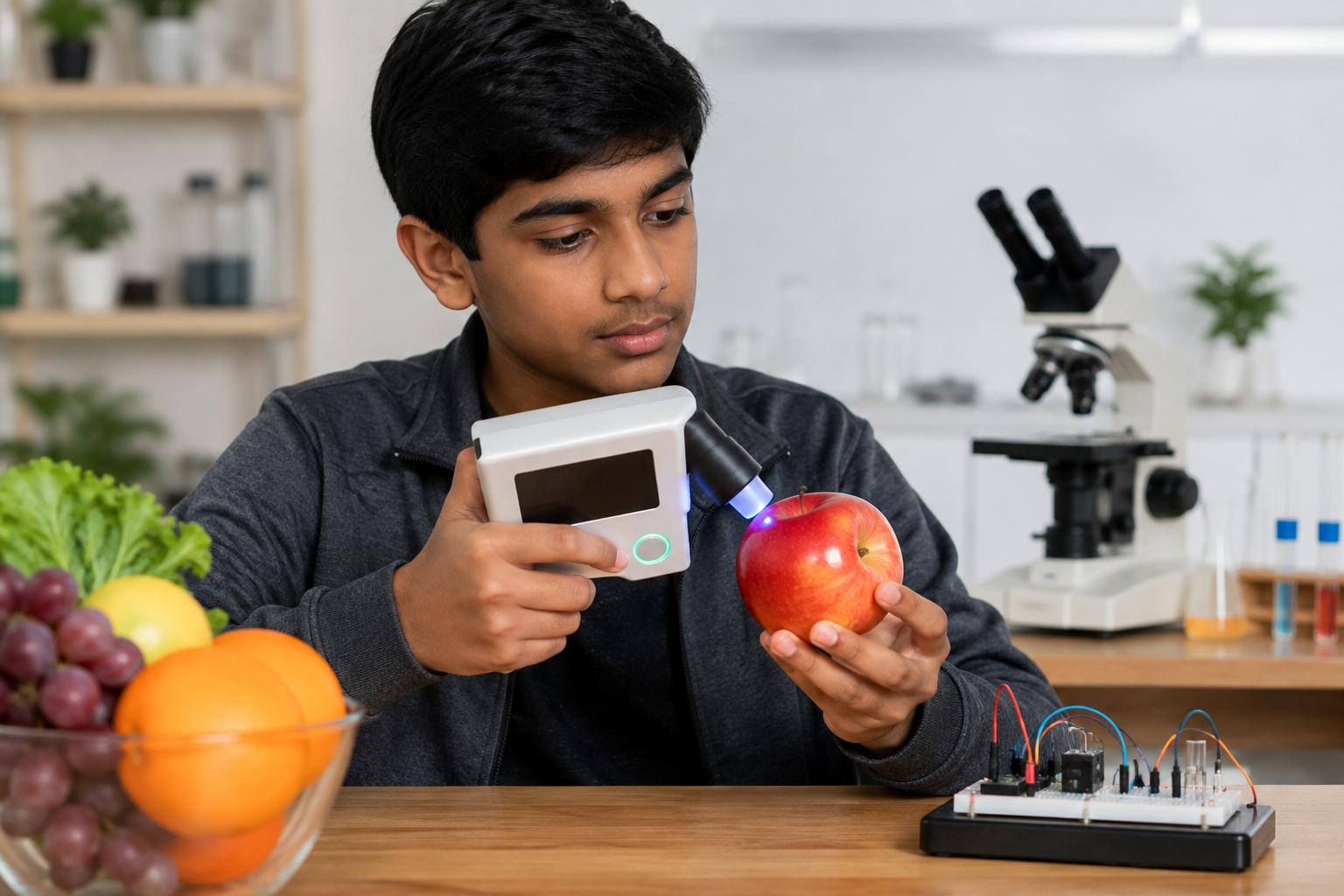
What started with a simple question about washing fruits and vegetables turned into an award-winning science project for American student Sirish Subash.
At just 13, Subash began developing Pestiscand, a handheld device designed to detect pesticide residues on fresh produce. The project later helped him win the 2024 3M Young Scientist Challenge, earning him the title of “America’s Top Young Scientist” and a $25,000 prize.
The invention is designed to use light, sensors and artificial intelligence to identify pesticide residues without damaging the fruit or vegetable being tested.
The question that started the project
Like many parents, Subash’s family encouraged him to wash fruits and vegetables before eating them.
That routine made him curious: How effective is washing, and how would someone know whether pesticide residues were still present?
Instead of simply accepting the conventional advice, he decided to investigate the problem himself.
According to the 3M Young Scientist Challenge, Subash developed a method that uses an AI-based handheld detector to identify pesticide residues on consumable produce.
His project eventually became known as Pestiscand.
How does Pestiscand work?
The device combines spectrophotometry with machine learning.
Spectrophotometry is a scientific technique that measures how light interacts with a material. Different substances can absorb or reflect different wavelengths of light.
Pestiscand uses this principle by directing light toward the surface of produce and measuring the reflected light. The resulting data is then processed using a machine-learning model designed to identify patterns associated with pesticide residues.
The important feature is that the method is non-destructive. In other words, the fruit or vegetable does not need to be cut apart or chemically destroyed during the scanning process.
Why is this technology interesting?
Pesticide residues can be difficult for consumers to identify because they are generally invisible.
A fruit may look perfectly clean while still carrying chemical residues on its surface. Conventional laboratory testing can provide detailed analysis, but such testing can require specialised equipment, trained personnel and more time.
A compact screening device could potentially make preliminary testing more accessible.
That is the problem young scientist Subash was trying to address: create a portable tool that could provide information about produce without requiring a conventional laboratory setup.
However, Pestiscand should be viewed as a student-developed prototype, rather than a replacement for certified laboratory pesticide testing.
The role of artificial intelligence
The AI component is one of the most interesting aspects of the invention.
The device collects optical data from the produce, while the machine-learning system analyses the patterns in that data.
According to young scientist Subash’s project description, the system was developed to distinguish produce with pesticide residues from samples without them. The project demonstrates how AI can be combined with established scientific techniques to explore real-world problems.
This is also an example of how machine learning is increasingly being used outside traditional software applications.
Instead of generating text or images, AI can analyse patterns in measurements and help researchers identify signals that may otherwise be difficult to interpret.
From school project to national recognition
Subash’s work earned him a place among the finalists of the 2024 3M Young Scientist Challenge.
The competition brought together young students scientist developing solutions to real-world problems. Subash ultimately won the competition in October 2024.
He received the $25,000 grand prize and the title of America’s Top Young Scientist.
At the time of the competition, he was a student at Gwinnett School of Mathematics, Science, and Technology in Snellville, Georgia.
His achievement also attracted attention because the project combined several fields—including chemistry, optics, electronics and artificial intelligence.
Could a device like this change food safety?
The concept has potential, but more research and validation would be needed before a device like Pestiscand could be relied upon for regulatory or consumer safety decisions.
Detecting pesticide residues at very low concentrations can be technically challenging. Produce also varies considerably in texture, colour, moisture and chemical composition.
A consumer device would therefore need extensive testing across many types of fruits and vegetables, pesticide compounds and environmental conditions.
Certified laboratory methods would still be important for confirming results.
Why this young inventor’s story matters
Perhaps the most impressive part of Subash’s story is not simply the device itself.
It is the question behind it.
A routine instruction—wash your fruits and vegetables—led a teenager scientist to ask how anyone could actually measure whether that process was effective.
That curiosity became an engineering project, which then became a national science competition-winning invention.
Stories like this show how scientific innovation can begin with very ordinary observations. A question asked at home can sometimes become the starting point for research that explores a much larger problem.
Pestiscand may still require significant development before it becomes a widely used food-safety tool. But its underlying idea demonstrates how young scientists can combine existing technologies in creative ways to tackle everyday challenges.
And for Subash, the journey began with something remarkably simple: wondering what was really left on the fruit after washing it.
Disclaimer
This article is for informational and educational purposes only. Pestiscand is a student-developed prototype and should not be treated as a certified food-safety or pesticide-testing device. The device’s reported capabilities should not be interpreted as a guarantee that produce is free from harmful pesticide residues. For official food-safety testing, consumers and businesses should rely on validated laboratory methods and guidance from relevant regulatory authorities.
Learn more about our site on contactarchive2in.com
Contact us on our email id contactarchive2in@gmail.com
Leave a Reply
You must be logged in to post a comment.