
12 Bills Introduced, 11 Passed
Parliament introduced 12monsoon Bills during the session, of which 11 were passed by both Houses. The lone holdout, the Indian Statistical Institute Bill, 2026, remained pending when the session was adjourned sine die. The Mines and Minerals (Development and Regulation) Amendment Bill, 2026 squeezed through the Rajya Sabha only after the Lok Sabha had already been adjourned.
For comparison, the previous year’s Monsoon Session saw 13 monsoon Bills introduced but only eight passed meaning this year’s Parliament actually cleared a higher share of its legislative agenda, even as the quality of scrutiny dropped sharply.
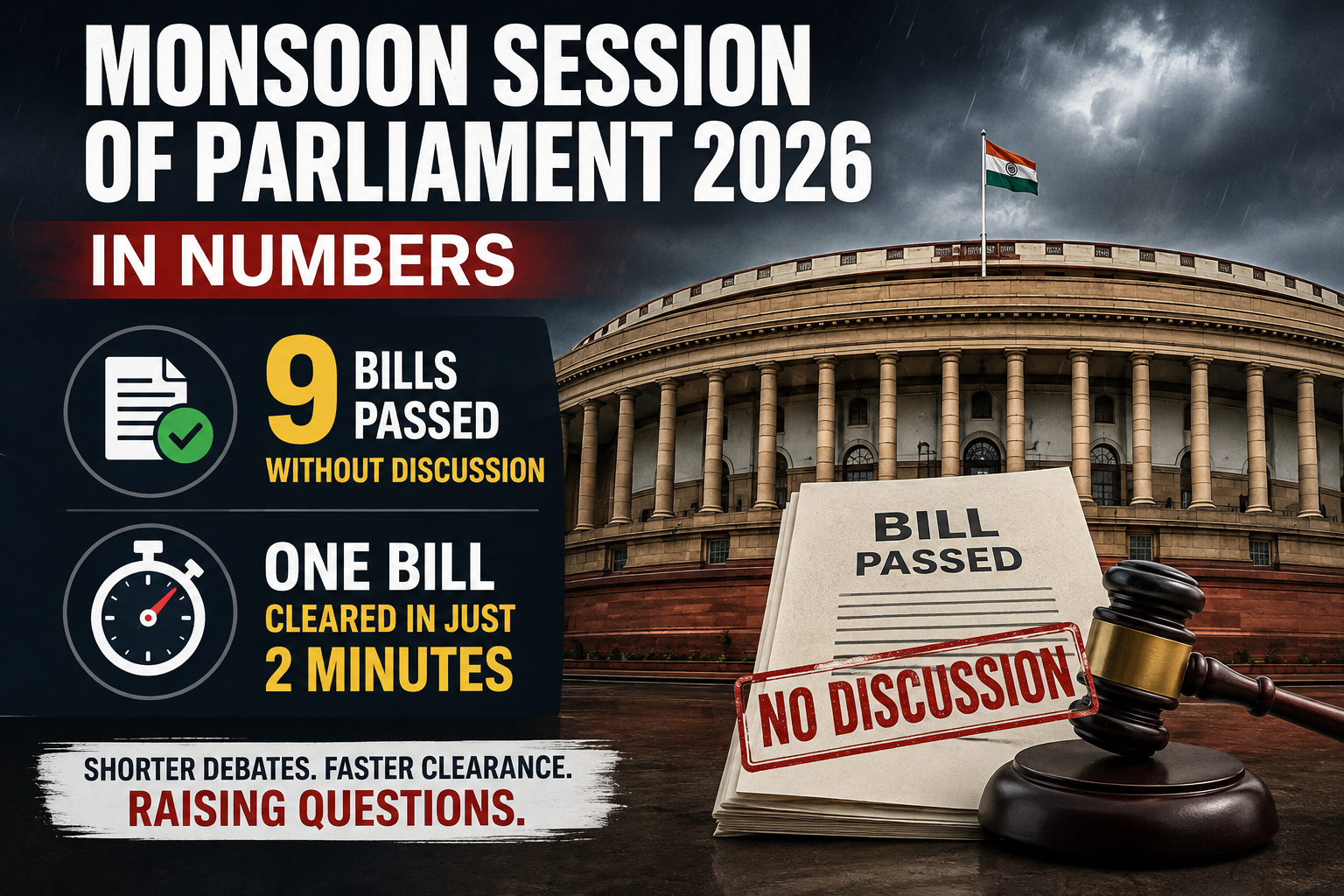
9 of 12 Bills Passed Without a Single MP Speaking
This is the headline number. According to PRS Legislative Research data, of the 12 bills passed by the Lok Sabha, nine were passed without any MP other than the minister piloting them speaking on them. In effect, three out of every four bills that went through the Lok Sabha this session saw zero floor debate.
Some Bills Cleared in Minutes
The speed at which legislation moved was just as striking as the silence around it. Seven monsoon Bills received five minutes or less of discussion in the Lok Sabha, together accounting for just 28 minutes of debate. Two of them the Registration of Births and Deaths (Amendment) Bill and the Supreme Court (Number of Judges) Amendment Bill were each disposed of in four minutes flat.
Not every Bill got the fast-track treatment, though. The Public Examinations (Prevention of Unfair Means) Amendment Bill was the exception, drawing hours and 34 minutes of discussion across both Houses more time than all the other ten Bills combined, which together accounted for 15 hours and 24 minutes of debate. In total, the 11 monsoon Bills that were passed consumed 32 hours and 58 minutes of parliamentary time.
Zero Bills Sent to a Standing Committee
Scrutiny didn’t just take a hit on the floor of the House it was skipped upstream too. None of the 12 Bills introduced this session was referred to a Standing Committee, a sharp break from 2025, when five of the 13 monsoon Bills introduced were sent to committees three to Joint Committees and two to Select Committees of the Lok Sabha.
Lok Sabha Ran at Just 15% of Its Scheduled Time
The disruption numbers are stark.Data from PRS Legislative Research shows the Lok Sabha functioned for only 15% of its scheduled time, while the Rajya Sabha managed 33%. The government’s own count, offered by Parliamentary Affairs Minister Kiren Rijiju, was slightly more generous he put Lok Sabha productivity at 19% and Rajya Sabha’s at 39%.
Either way, this ranks among the least productive sessions in recent memory, though not the worst on record the 2010 Winter Session under the UPA government recorded even lower numbers, with the Lok Sabha functioning for just 5% of its scheduled time.
Question Hour: Almost No Questions, Almost No Answers
Accountability mechanisms fared no better. Question Hour functioned for just nine minutes 1% of its scheduled time in the Lok Sabha, and for about two hours, or 12%, in the Rajya Sabha. Of the questions actually listed for oral answers, only two out of 380 got a response in the Lok Sabha, while the Rajya Sabha answered 16 of 285.
What a Disrupted Day Costs
Running Parliament isn’t cheap, and idle time carries a real price tag. It’s estimated that running Parliament costs around ₹2.5 lakh per minute translating to nearly ₹9 crore for a six-hour sitting day. With entire sittings swallowed by walkouts and adjournments, a sizeable share of that spend went toward chambers that barely legislated or questioned anyone.
Why the Session Was So Disrupted
The 2026 Monsoon Session saw repeated disruptions over police action against students protesting paper leaks, which began on July 20.The Opposition demanded a statement from Union Home Minister Amit Shah on who had ordered the police action; the government agreed to a discussion, but continued protests led to repeated adjournments of the Lok Sabha instead. With bigger-ticket items like delimitation and FCRA amendments shelved, attention in the House and outside it increasingly turned toward positioning for the 2027 state elections.
The Bigger Pattern
Bills clearing the Lok Sabha in single-digit minutes isn’t new. Past Monsoon Sessions have thrown up similarly uncomfortable numbers from bills passed in three minutes flat to entire batches cleared inside 20 minutes without meaningful debate. What makes 2026 notable is less the existence of the pattern than its scale: nine of twelve bills sailing through in near-silence, zero committee referrals, and a Question Hour that barely functioned at all.
Quick Recap: Monsoon Session 2026 By the Numbers
- 12 Bills introduced, 11 passed
- 9 of 12 Lok Sabha bills passed with no MP debate besides the minister
- 4 minutes — the shortest discussion time for a passed Bill
- 28 minutes total discussion across 7 Bills in the Lok Sabha
- 0 Bills referred to a Standing Committee
- 15% — Lok Sabha’s functioning time versus schedule (PRS); government cites 19%
- 33% — Rajya Sabha’s functioning time versus schedule (PRS); government cites 39%
- 1% — Question Hour functioning time in the Lok Sabha
- 2 of 380 — oral questions answered in the Lok Sabha
Learn more about our site archive2in.com
Contact us on our gmail id contactarchive2in@gmail.com
Read out our latest article on our BLOGS section
Leave a Reply
You must be logged in to post a comment.