
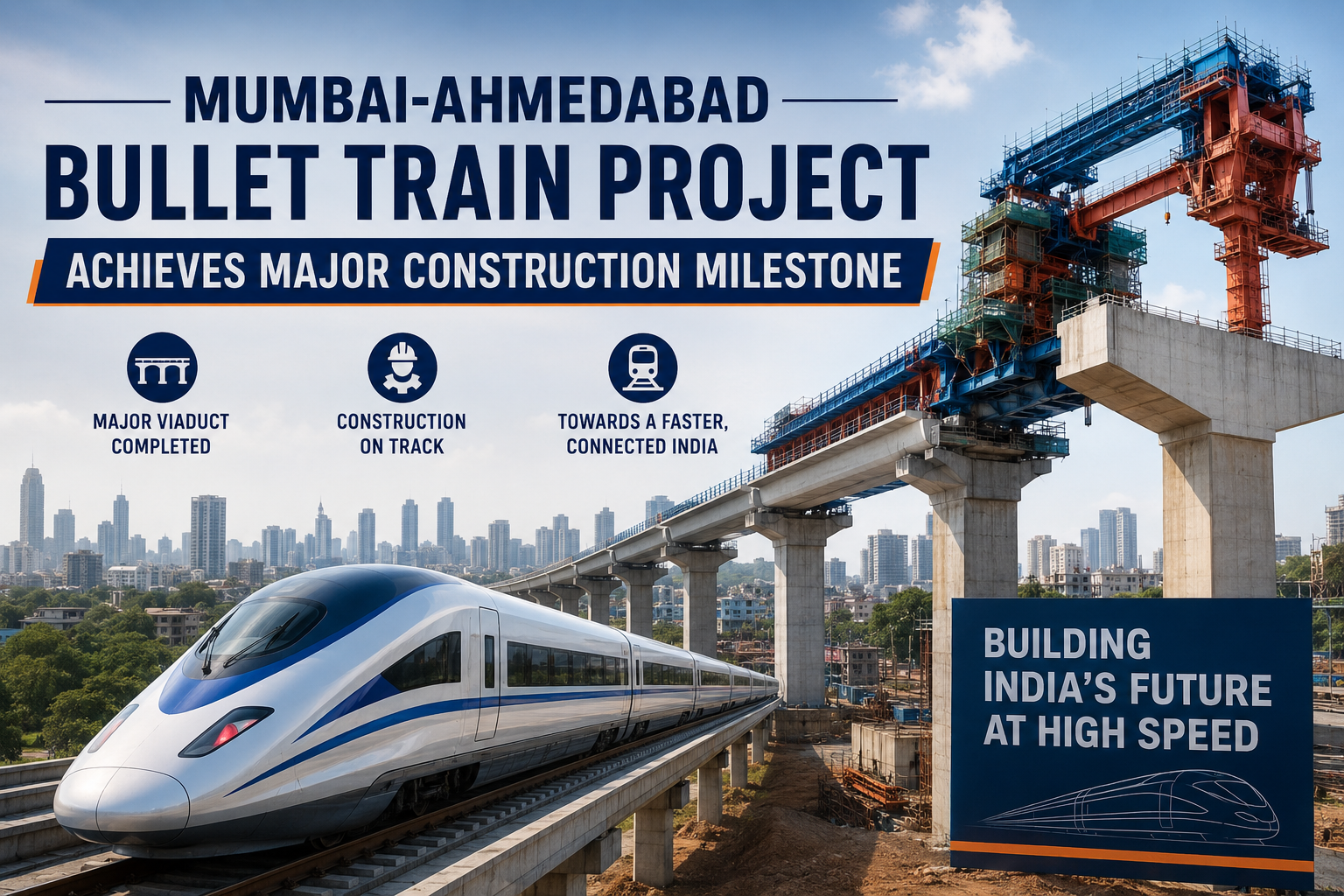
India’s first high-speed rail corridor is racing toward reality, with the Mumbai-Ahmedabad High-Speed Rail (MAHSR) project notching up one engineering milestone after another through 2026. From record-breaking girder launches to tunnel breakthroughs, the 508-km bullet train line connecting Mumbai and Ahmedabad is now firmly in its most active construction phase yet.
A Landmark Girder Launch in Gujarat
Railways Minister Ashwini Vaishnaw announced that one of the heaviest girders used in the project — weighing around 1,360 metric tonnes — was successfully launched at Maninagar in Gujarat. Remarkably, the massive structure was installed in just 3.5 hours, a testament to the precision and speed of the construction teams working on this ambitious corridor.
This single feat reflects the scale of engineering involved in building India’s first bullet train, a 508-km line that will eventually link Mumbai, Maharashtra with Ahmedabad, Gujarat through 12 stations.
Project Progress: By the Numbers
The National High Speed Rail Corporation Limited (NHSRCL), the agency implementing the project, has been publishing steady progress updates throughout 2026:
- 352+ km of viaduct construction completed
- 446 km of pier work finished
- 193 route km of reinforced concrete track bed laid
- 291 km of noise barriers installed over elevated sections
- Nearly 90% of the alignment is being built as an elevated corridor
According to government monitoring reports, the corridor had already crossed the halfway mark earlier in the year, with overall physical progress estimated at 55-60% by mid-2026.
Tunnels, TBMs, and Undersea Engineering
Some of the most complex engineering challenges on the route involve tunnelling. The project has seen multiple breakthroughs in Maharashtra’s Palghar district, where mountain tunnels connecting Virar and Boisar have been completed. One such tunnel breakthrough, achieved in early 2026, stretched roughly 1.5 km, while another completed tunnel measured 454 metres in length and 14.4 metres in width, wide enough to accommodate both up and down tracks.
The corridor also features India’s first undersea rail tunnel, being bored using a massive Tunnel Boring Machine (TBM) employing advanced slurry technology to minimise disturbance in Mumbai’s dense urban areas.
To manage air pressure changes as trains enter and exit tunnels at speeds up to 300 kmph, engineers have also begun installing tunnel hood technology, designed to prevent the loud “tunnel boom” effect and improve passenger comfort.
What This Means for Commuters
Once fully operational, the Mumbai-Ahmedabad bullet train will cut travel time between the two cities to just 1 hour 58 minutes, down from the current 6-9 hours by road or train. Trains will run at speeds of up to 320 kmph across the corridor, stopping at 12 stations including Mumbai (BKC), Thane, Virar, Boisar, Vapi, Bilimora, Surat, Bharuch, Vadodara, Anand, Ahmedabad, and Sabarmati.
Timeline: When Will the Bullet Train Start Running?
The project is being rolled out in phases:
- August 2027 — The first operational stretch, a 100-km run between Surat and Vapi (with the Surat-Bilimora section specifically targeted first)
- 2028 — Operations expected to extend up to Thane
- 2029 — Full corridor between Mumbai and Ahmedabad expected to be operational
India’s first indigenous bullet train, codenamed B28, is being jointly developed by BEML Limited and the Integral Coach Factory, with a prototype targeted for completion by March 2027. It will have a design speed of 280 kmph before the corridor eventually transitions to Japan’s next-generation Shinkansen technology.
Why the Mumbai-Ahmedabad Bullet Train Matters
Beyond faster travel, the MAHSR project is expected to:
- Strengthen industrial and business connectivity across western India
- Boost tourism between Mumbai and Gujarat
- Generate large-scale employment during construction and operations
- Advance domestic manufacturing capabilities in high-speed rail technology
- Serve as the pilot for seven additional high-speed rail corridors announced under the Union Budget 2026-27, spanning nearly 4,000 km nationwide
The Road Ahead
With land acquisition complete, statutory clearances secured, and over 1,600 utility lines shifted, the project’s biggest hurdles are now behind it. What remains is the final push of engineering execution laying track, completing tunnels, and preparing stations before India’s first bullet train finally leaves the station.
As construction accelerates across Maharashtra and Gujarat, the Mumbai-Ahmedabad High-Speed Rail corridor stands as one of the most closely watched infrastructure projects in the country, a symbol of India’s ambitions to enter the global high-speed rail club.
Learn more about our site archive2in.com
Contact us on contactarchive2in@gmail.com
Read out latest Blog on our site
Leave a Reply
You must be logged in to post a comment.