
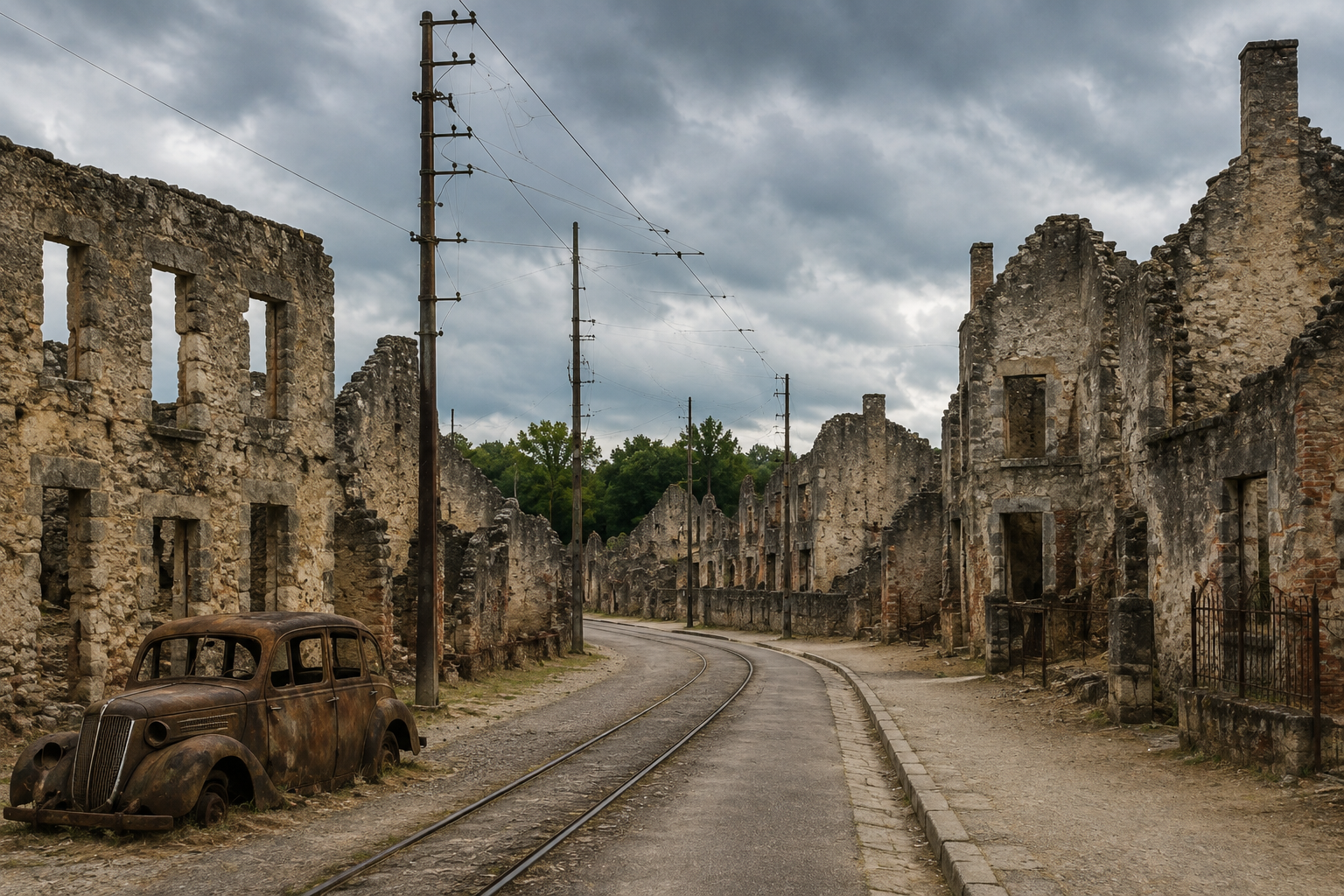
On June 10, 1944, a quiet village in central France became the scene of one of the most horrific massacres committed by Nazi forces in Western Europe.
The village was Oradour-sur-Glane, near Limoges. In a matter of hours, hundreds of civilians were killed and the settlement was deliberately destroyed. Today, its ruins remain preserved as a memorial, offering visitors a haunting glimpse into the consequences of wartime terror.
Historical sources commonly record 642 people killed at Oradour-sur-Glane, including men, women and children. The United States Holocaust Memorial Museum records that only seven villagers survived the massacre itself—six men and one woman.
What happened on June 10, 1944?
The massacre took place only days after the Allied landings in Normandy. Nazi forces were increasingly responding to resistance activity with brutal reprisals against civilian populations.
On the afternoon of June 10, soldiers from the 2nd SS Panzer Division “Das Reich” entered Oradour-sur-Glane.
The soldiers rounded up residents and brought them toward the village centre. The population was then divided by gender.
The men were taken to several barns and other buildings, while women and children were forced into the village church. According to the United States Holocaust Memorial Museum, 197 men were confined in barns, while 240 women and 205 children were locked inside the church.
The men were subsequently shot.
The church was also attacked, with grenades and fire used against the people trapped inside. Those who attempted to escape were fired upon.
By the time the SS unit left, the village had been devastated.
Why were so many civilians killed?
The exact circumstances and motives surrounding the massacre have been debated by historians, but the killing took place in the context of Nazi Germany’s increasingly brutal campaign against resistance movements and civilians in occupied France.
The massacre has often been associated with the killing of SS officer Helmuth Kämpfe, who had been captured by the French Resistance. However, historians have also examined other possible explanations and the broader pattern of Nazi anti-partisan warfare.
What is clear is that the civilians of Oradour were subjected to collective punishment on a devastating scale.
The Holocaust Encyclopedia notes that the German forces later attempted to create an explanation suggesting that the villagers had been involved in fighting. The account was disputed and did not match the reality of what had occurred.
The seven who survived
The survival stories make the tragedy even more striking.
According to the U.S. Holocaust Memorial Museum, seven villagers survived the massacre itself: six men and one woman. All were injured to varying degrees.
One of the best-known survivors was Marguerite Rouffanche, who escaped from the burning church through a window. She was wounded but managed to hide until she could be rescued.
Several men survived by hiding beneath the bodies of those who had already been killed.
There were also people who escaped before the massacre began or avoided being rounded up. The Holocaust Memorial Museum distinguishes these people from the seven who survived the actual massacre.
A village deliberately left in ruins
After the massacre, Oradour-sur-Glane was not rebuilt in its original location.
Instead, the French government decided to preserve the ruins as a permanent memorial.
The remains of houses, shops, workshops, streets and vehicles were left largely as they had been after the destruction.
The Centre de la mémoire d’Oradour-sur-Glane describes the ruins as witnesses to the violence of June 10, 1944. The site was classified as a historic monument shortly after the war.
A new Oradour-sur-Glane was eventually constructed nearby, while the old village became a memorial site.
That decision transformed the destroyed settlement into something more than an abandoned town. It became a place intended to preserve historical memory.
Why is Oradour-sur-Glane called a “ghost village”?
Walking through the preserved ruins today can feel like stepping into a moment frozen in 1944.
Burned buildings, damaged structures and abandoned streets remain visible. The absence of normal village life makes the site particularly powerful.
There are no ordinary modern buildings replacing the original homes. Instead, visitors encounter the physical remains of a community that disappeared almost overnight.
The Centre de la mémoire says the ruins receive hundreds of thousands of visitors and are preserved as a reminder of the massacre and its wider historical context.
The importance of remembering
Oradour-sur-Glane is not simply a story about a village destroyed during World War II.
It is also a reminder of what can happen when civilians become targets of military retaliation and ideological violence.
The preserved ruins provide historians, students and visitors with a tangible connection to the past. The Centre de la mémoire was created to place the massacre within the broader history of Nazism and the Second World War while promoting remembrance and peace.
The story also demonstrates why historical accuracy matters. Sources sometimes differ over whether the death toll should be recorded as 642 or 643, reflecting differences in historical accounting. The U.S. Holocaust Memorial Museum and the French Red Cross use 642, while some official French memorial material cites 643.
Whatever figure is used, the scale of the tragedy remains undeniable.
A memorial that refuses to disappear
More than eight decades later, Oradour-sur-Glane remains one of France’s most powerful World War II memorials.
The village was destroyed in a single afternoon, but its ruins were deliberately preserved so that the memory of those who died would not disappear.
The silent streets, burned buildings and surviving structures tell a story that does not need exaggeration.
Oradour-sur-Glane stands today as a reminder that the victims were not simply numbers in a history book. They were families, workers, children and neighbours whose lives ended in one of the darkest episodes of Nazi occupation in France.
Disclaimer
This article is intended for historical and educational purposes only. Details of the Oradour-sur-Glane massacre, including casualty figures and the circumstances surrounding the attack, may vary slightly between historical sources. The article relies primarily on established institutional and historical sources. It does not endorse or glorify Nazi ideology, violence or war crimes.
learn more about our site on contactarchive2in.com
Contact us on our email id contactarchive2in@gmail.com
Leave a Reply
You must be logged in to post a comment.