
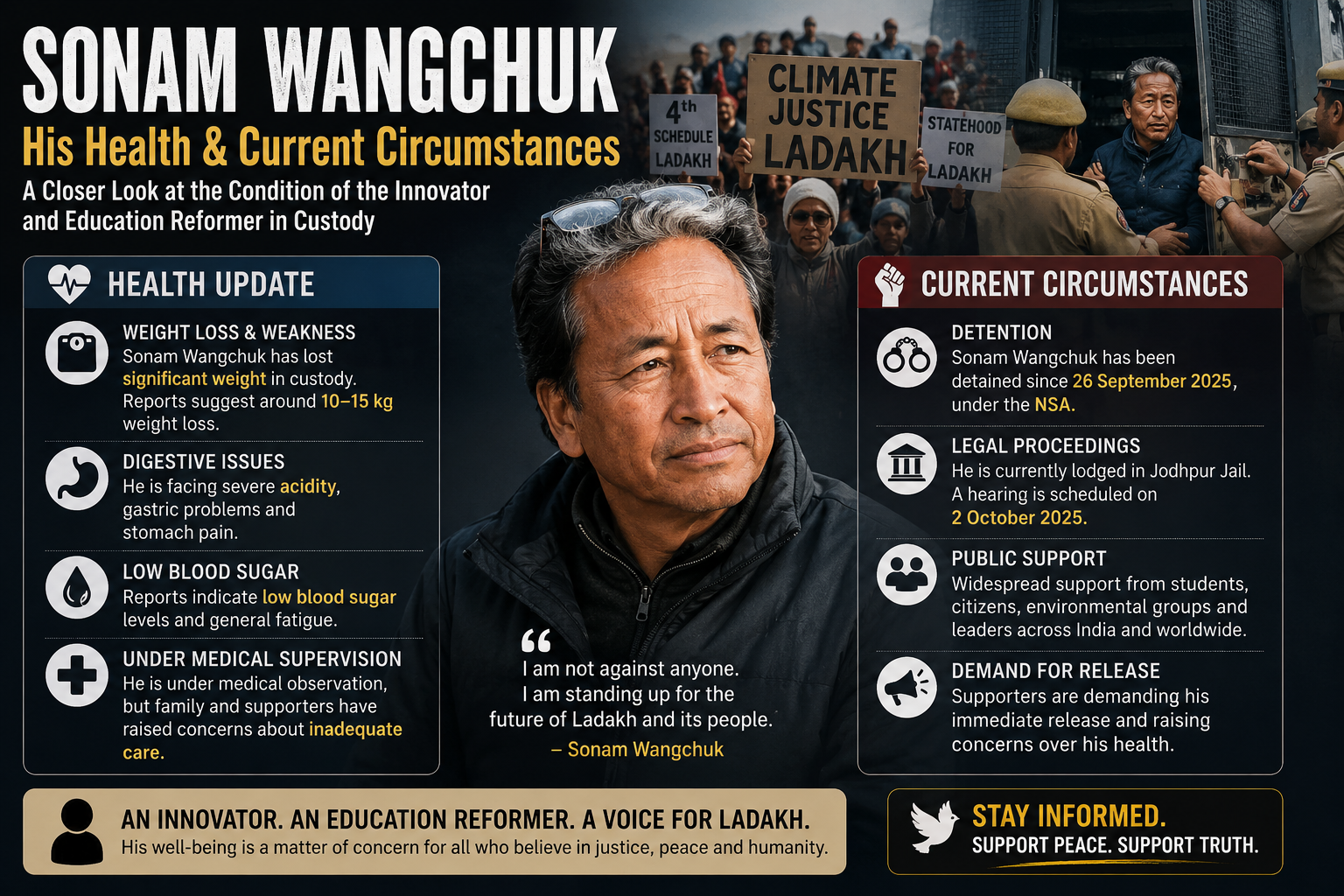
Climate and education activist Sonam Wangchuk’s health has taken a serious turn as his indefinite hunger strike at Jantar Mantar enters its 19th day. His medical team has confirmed he has lost over 9 kg and has now entered a “critical stage” of prolonged fasting, with doctors warning that organ damage could follow if the strike continues. Here’s a complete, up-to-date breakdown of the situation.
Day 19: What the Latest Medical Bulletin Says
Wangchuk’s weight loss crossed nine kg on the 19th day of his indefinite hunger strike on Thursday, with doctors warning that he has entered a critical stage of prolonged fasting and it could begin affecting his organs.
According to the latest medical bulletin issued by his attending physician, Dr Satish Lamba, Wangchuk’s vitals were recorded as follows:
- Weight loss: Over 9 kg since the strike began
- Blood sugar: 80 mg/dL
- Pulse rate: 72 per minute
- Blood pressure: 105/61 mmHg (lying down), 101/65 mmHg (sitting)
- Oxygen saturation: Stable at 97%
- ECG: Normal
- Hydration: Fair, and he remains mentally alert
Despite these relatively stable numbers, Dr Lamba flagged a worrying underlying trend. He explained that once the body’s glucose reserves are used up, it starts consuming fat, and after that, muscle tissue itself begins to break down. Wangchuk’s ketone levels had risen to 3-plus before improved hydration brought them down to 2-plus, and his uric acid levels are elevated — a sign, doctors say, that his muscles are actively being consumed for energy.
The most alarming line from the medical team so far: doctors have warned that the next stage of this process could be genuinely alarming, with the possibility of organ impact, and that Wangchuk is being kept under round-the-clock (24×7) medical vigilance in the hope that it does not reach that point.
Why Is Sonam Wangchuk on Hunger Strike?
Unlike his earlier hunger strikes over Ladakh’s statehood demand, this protest has a different trigger. Wangchuk began this indefinite fast on June 28, 2026, joining an ongoing demonstration organised by the Cockroach Janta Party (CJP) a youth-driven, originally satirical online political movement at Jantar Mantar in Delhi.
The core demand of the protest is the resignation of Union Education Minister Dharmendra Pradhan, following widespread anger over irregularities in India’s examination system, including the high-profile NEET paper leak controversy.
Despite the deteriorating health reports, Wangchuk has ruled out ending his fast. In a video message released late on Wednesday night, he said that breaking the strike without any response from the government would send the wrong message, and instead urged supporters to strengthen the CJP’s planned march to Parliament on July 20.
Delhi High Court Steps In
As concern over Wangchuk’s health grew, an activist-lawyer, Rakesh Kumar Saini, filed a Public Interest Litigation (PIL) in the Delhi High Court seeking directions for the Central and Delhi governments to hospitalise Wangchuk and, if necessary, force-feed him with a liquid diet of essential nutrients to save his life. The petition argued that if he were to pass away, it would be “a matter of great shame for the country and the world.”
Hearing the matter, a Division Bench of the Delhi High Court comprising Chief Justice Devendra Kumar Upadhyaya and Justice Tejas Karia did not order force-feeding but instead directed the Centre to ensure daily clinical monitoring of Wangchuk’s condition, observing that “the life of any citizen is precious and all efforts ought to be made by government authorities to save the same.” The court noted that the Centre had already informed it that government doctors and experts were monitoring Wangchuk, and directed that this continue on a daily basis, with necessary treatment provided as required.
The Medical Risk of Force-Feeding
Interestingly, doctors caution that force-feeding isn’t a simple fix either. If Wangchuk were suddenly fed after 19 days of fasting, his body would be at risk of a dangerous condition called refeeding syndrome where reintroducing food causes a rapid shift of electrolytes like phosphorus, potassium and magnesium into the body’s cells. This shift can trigger serious heart, neurological and respiratory complications. Medical experts note that the safer route to reintroduce nutrition would be through an intravenous drip, allowing sugars and minerals to enter the body gradually rather than all at once.
A History of Hunger Strikes
This isn’t the first time Sonam Wangchuk has used an extended hunger strike as a form of protest. In 2024, he undertook a 21-day “climate fast” in Leh demanding statehood for Ladakh and its inclusion under the Sixth Schedule of the Constitution, ending it after drawing massive public turnout. He has also led fasts and marches over the same demand at Delhi’s borders, during which he and dozens of supporters were detained by police a move that was subsequently challenged in court. His current strike marks a shift in focus from Ladakh’s political status to education-sector accountability, but it follows a familiar pattern of using prolonged fasting to draw national attention to a cause.
What Happens Next
With the Delhi High Court now mandating daily health monitoring and the CJP’s planned Parliament march scheduled for July 20, the coming days are being seen as critical on two fronts both for Wangchuk’s health and for the political pressure building on the government to respond to the protest’s demands. His medical team has been clear that while his condition is currently being managed, prolonged fasting beyond this stage carries a real risk of organ complications if it isn’t addressed soon.
Learn more about our site archive2in.com
CONTACT US ON contactarchive2in@gmail.com
READ OUT OUR LATEST ARTICLE SONAM WANGCHUK...
Leave a Reply
You must be logged in to post a comment.