
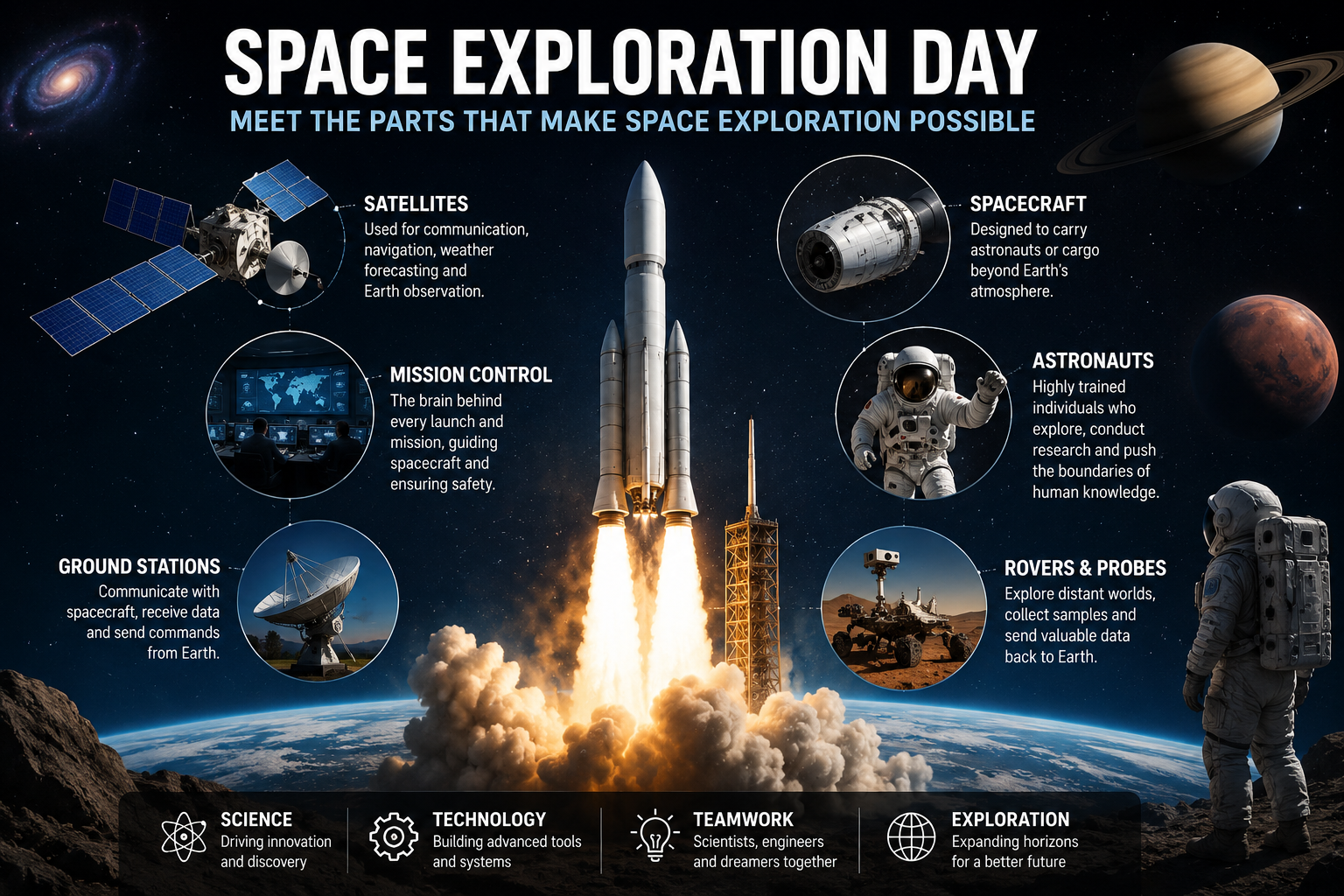
What Is Space Exploration Day
Every year on July 20, the world marks Space Exploration Day, a celebration that commemorates the historic Apollo 11 Moon landing. On this date in 1969, astronaut Neil Armstrong became the first human to set foot on another celestial body, a moment that changed how humanity viewed its place in the universe. The observance was formally proclaimed by President Ronald Reagan in 1984 and has since become an annual reminder to celebrate humanity’s achievements beyond Earth and to inspire future generations to pursue careers in science, technology, engineering, and space exploration.
While the day looks back at a single extraordinary achievement, it also gives us a great excuse to look at everything that has to work together, quite literally, to get humans and machines off this planet. Space exploration isn’t the result of one invention. It’s a system built from thousands of interconnected parts, each one essential to the mission’s success. Here’s a closer look at the key components that make it all possible.
Rockets: The Engines That Escape Earth’s Gravity
Nothing leaves the ground without a rocket, and every rocket depends on a handful of critical parts working in harmony.
Propulsion System
The propulsion system is the heart of any rocket. It includes engines, fuel tanks, and the combustion chambers where fuel and oxidizer mix and ignite to generate thrust. This thrust is what overcomes Earth’s gravity and pushes a spacecraft skyward.
Stages
Most rockets are built in stages, separate sections that burn through their fuel and then detach once they’re no longer needed. This staging process reduces weight as the rocket climbs, allowing it to accelerate more efficiently and carry heavier payloads into orbit.
Fairing
At the very top of many rockets sits the fairing, a protective shell that shields the payload, whether that’s a satellite, a crew capsule, or scientific instruments, from the intense heat and aerodynamic pressure experienced during launch. Once the rocket clears the thickest part of the atmosphere, the fairing separates and falls away.
Guidance and Control Systems
Rockets rely on sophisticated guidance computers, sensors, and gimbaled engines to stay on course. These systems constantly adjust the rocket’s trajectory in real time, correcting for wind, atmospheric drag, and any small deviations from the planned flight path.
Spacecraft: The Vehicles That Carry Crew and Cargo
Once a rocket delivers its payload beyond Earth’s atmosphere, the spacecraft itself takes over the job of keeping crew members alive or equipment functioning.
Life Support Systems
For crewed missions, life support systems are non negotiable. These systems regulate oxygen levels, remove carbon dioxide, control temperature and humidity, and manage water recycling, allowing astronauts to survive and work in the vacuum of space for days, months, or even years at a time.
Heat Shields
Returning to Earth is just as dangerous as leaving it. As a spacecraft reenters the atmosphere, friction generates temperatures that can exceed thousands of degrees. Heat shields, often made from ablative materials designed to burn away gradually, protect the crew capsule and its occupants from being incinerated during descent.
Solar Panels and Power Systems
Spacecraft need a reliable source of energy to run onboard instruments, communication equipment, and life support systems. Solar panels convert sunlight into electricity, while batteries store energy for use during periods when the spacecraft is in shadow.
Communication Arrays
Staying in contact with mission control is critical. Antennas and communication arrays transmit data, telemetry, and video back to Earth, while also receiving commands and updates from ground teams hundreds or thousands of kilometers away.
Spacesuits: Personal Spacecraft for Astronauts
When astronauts step outside their spacecraft, their spacesuit becomes their only barrier between life and the harsh vacuum of space.
Pressure Garment
The pressure garment maintains a stable internal pressure around the astronaut’s body, preventing the fluids in their blood from boiling in the near vacuum of space, a phenomenon that would otherwise occur within seconds of exposure.
Life Support Backpack
Known as the Primary Life Support System, this backpack supplies breathable oxygen, removes exhaled carbon dioxide, and regulates temperature, essentially functioning as a miniature version of a spacecraft’s life support system.
Visor and Helmet
The helmet and its visor protect an astronaut’s head and face from micrometeorites, radiation, and extreme temperature swings, while also providing a clear field of vision for spacewalks and lunar surface space exploration.
Gloves and Boots
Specially designed gloves allow astronauts to maintain dexterity for delicate tasks despite the bulk of a pressurized suit, while insulated boots protect against the extreme cold of the lunar or planetary surface.
Satellites: Eyes and Ears in Orbit
Not every piece of space exploration hardware carries a human crew. Satellites play a massive role in scientific discovery, navigation, and communication.
Payload Instruments
The payload is the reason a satellite exists in the first place. It might include cameras, telescopes, spectrometers, or sensors designed to gather specific data, whether that’s mapping distant planets, monitoring Earth’s climate, or detecting cosmic radiation.
Attitude Control System
Satellites need to maintain a specific orientation to keep solar panels facing the sun and instruments pointed at their targets. The attitude control system uses small thrusters, reaction wheels, or magnetic torquers to make these precise adjustments.
Onboard Computer
Every satellite carries an onboard computer that processes data, manages power distribution, and executes commands sent from ground control, all while operating reliably in the radiation heavy environment of space.
Ground Control: The Team Behind Every Mission
Space exploration doesn’t end once a rocket leaves the launch pad. An enormous network of people and technology on Earth keeps every mission running.
Mission Control Centers
Space exploration Mission control centers house the flight directors, engineers, and specialists who monitor every system aboard a spacecraft in real time, ready to respond to anomalies and guide astronauts through critical maneuvers.
Tracking Stations
A global network of tracking stations and deep space antennas maintains constant communication with spacecraft, no matter where they are in the solar system, ensuring data keeps flowing in both directions.
Why These Parts Matter Together
No single component makes space exploration possible on its own. A rocket without a reliable guidance system can’t reach orbit. A spacecraft without life support can’t sustain a crew. A satellite without an attitude control system can’t collect useful data. It’s the seamless integration of thousands of these parts, designed, tested, and engineered by teams around the world, that turns the dream of exploring space into a reality.
Celebrating Space Exploration Day
This space Exploration Day, take a moment to appreciate the incredible engineering behind every mission that has ever left Earth. Visit a planetarium, watch a documentary about the Apollo missions, or simply look up at the night sky and imagine the journey it takes to get there. Every space exploration rocket launch, every spacewalk, and every image beamed back from a distant planet is the result of countless parts working together toward a single goal: pushing the boundaries of what humanity can achieve.
Learn more about our site archive2in.com
Contact us on our contactarchive2in@gmail.com
Read out our latest article on our Blogs section
Leave a Reply
You must be logged in to post a comment.