
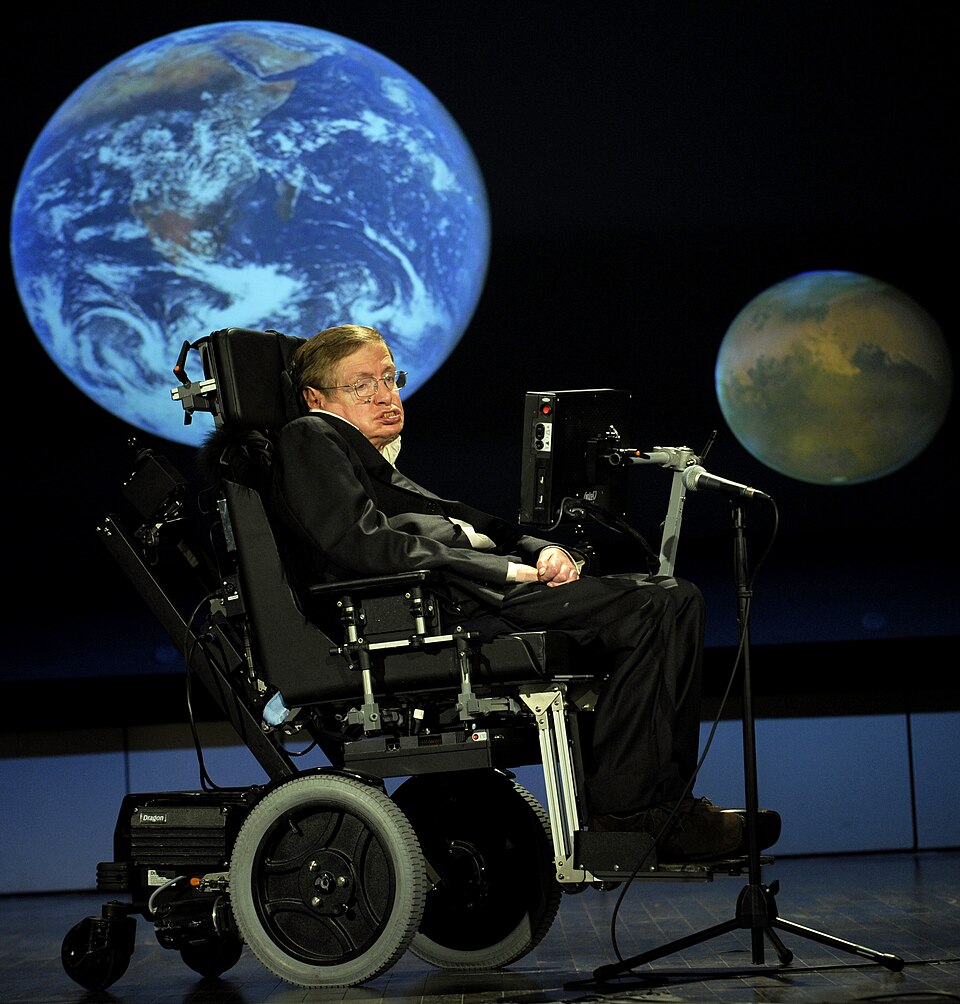
More than 50 years after Stephen Hawking first proposed one of his boldest ideas about black holes, scientists have finally confirmed it with stunning precision. Using data from a record-clear gravitational wave detection, physicists have validated Hawking’s famous “area theorem,” a cornerstone of black hole physics that had remained unproven for decades.
What Did Stephen Hawking Predict in 1971?
Back in 1971, Hawking proposed a deceptively simple but profound idea: when two black holes merge, the surface area of the resulting black hole’s event horizon can never be smaller than the combined surface areas of the two original black holes. In other words, a black hole’s event horizon can grow but it can never shrink.
This idea, known as the black hole area theorem, echoes the second law of thermodynamics, which states that entropy, or disorder, in the universe always increases or stays the same, never decreases. Since black holes are believed to carry entropy proportional to their event horizon’s surface area, Hawking’s theorem essentially applied a fundamental law of physics to the strangest objects in the cosmos.
The Discovery That Proved Him Right
The confirmation came from an extraordinary gravitational wave signal named GW250114, detected by the LIGO-Virgo-KAGRA collaboration in January 2025. The signal was produced by the collision of two massive black holes, each roughly 30 to 35 times the mass of our sun, located about 1.3 billion light-years from Earth.
What made this detection special wasn’t just the event itself LIGO had already picked up black hole mergers before, including the very first detection back in 2015. What set GW250114 apart was its extraordinary clarity. Thanks to major upgrades to LIGO’s detectors, scientists recorded the signal with a signal-to-noise ratio far sharper than any previous observation, allowing them to measure the size and spin of the black holes with unprecedented accuracy.
When researchers calculated the surface area of the newly formed black hole, the numbers lined up exactly with what Hawking had predicted: the resulting event horizon was larger than the combined areas of the two black holes that merged to form it.
Why This Discovery Matters
For physicists, this isn’t just a satisfying footnote in scientific history it’s a meaningful step toward answering some of the biggest open questions in physics. Hawking’s area theorem connects general relativity, Einstein’s theory of gravity, with the seemingly unrelated field of thermodynamics. Proving that black holes obey this entropy-like rule strengthens the deep, and still not fully understood, relationship between gravity and quantum mechanics.
Researchers involved in the discovery, including physicists from MIT, Caltech, and Columbia University, described the result as evidence of a kind of cosmic order underlying even the most violent events in the universe. As one of the study’s co-authors explained, the theorem may sound like a simple statement, but it carries deep implications for how black holes and the universe itself actually work.
Not the First Hint, But the Clearest Proof
Interestingly, this wasn’t the very first time scientists had tested Hawking’s theorem. An earlier analysis of the original 2015 gravitational wave detection, GW150914, had offered tentative support for the same idea. But GW250114 provided the sharpest, most precise confirmation yet, effectively closing the loop on a prediction Hawking made half a century before his death in 2018.
The Bigger Picture
Gravitational wave astronomy a field that barely existed before LIGO’s first detection in 2015 continues to open new windows into the universe’s most extreme phenomena. Each new merger detected gives scientists another opportunity to test the fundamental laws of physics under conditions that simply can’t be recreated on Earth.
Hawking never lived to see his theorem observationally confirmed. But thanks to a decade of technological refinement and international collaboration, one of his most elegant ideas has finally been proven true a fitting tribute to a scientist who spent his life trying to understand the universe’s deepest mysteries.
Key Takeaways
- In 1971, Stephen Hawking proposed that a black hole’s event horizon can only grow, never shrink, after a merger.
- This idea, called the area theorem, mirrors the second law of thermodynamics.
- The theorem was confirmed using gravitational wave signal GW250114, detected in January 2025 with unprecedented clarity.
- The discovery strengthens the connection between general relativity and thermodynamics, a key piece of the puzzle in unifying gravity with quantum mechanics.
- It stands as one of the most significant posthumous confirmations of Hawking’s scientific legacy.
Learn more about our site archive2in.com
Contact us on contactarchive2in@gmail.com
source: times of india
Read out our latest article on Influenza A
Leave a Reply
You must be logged in to post a comment.