
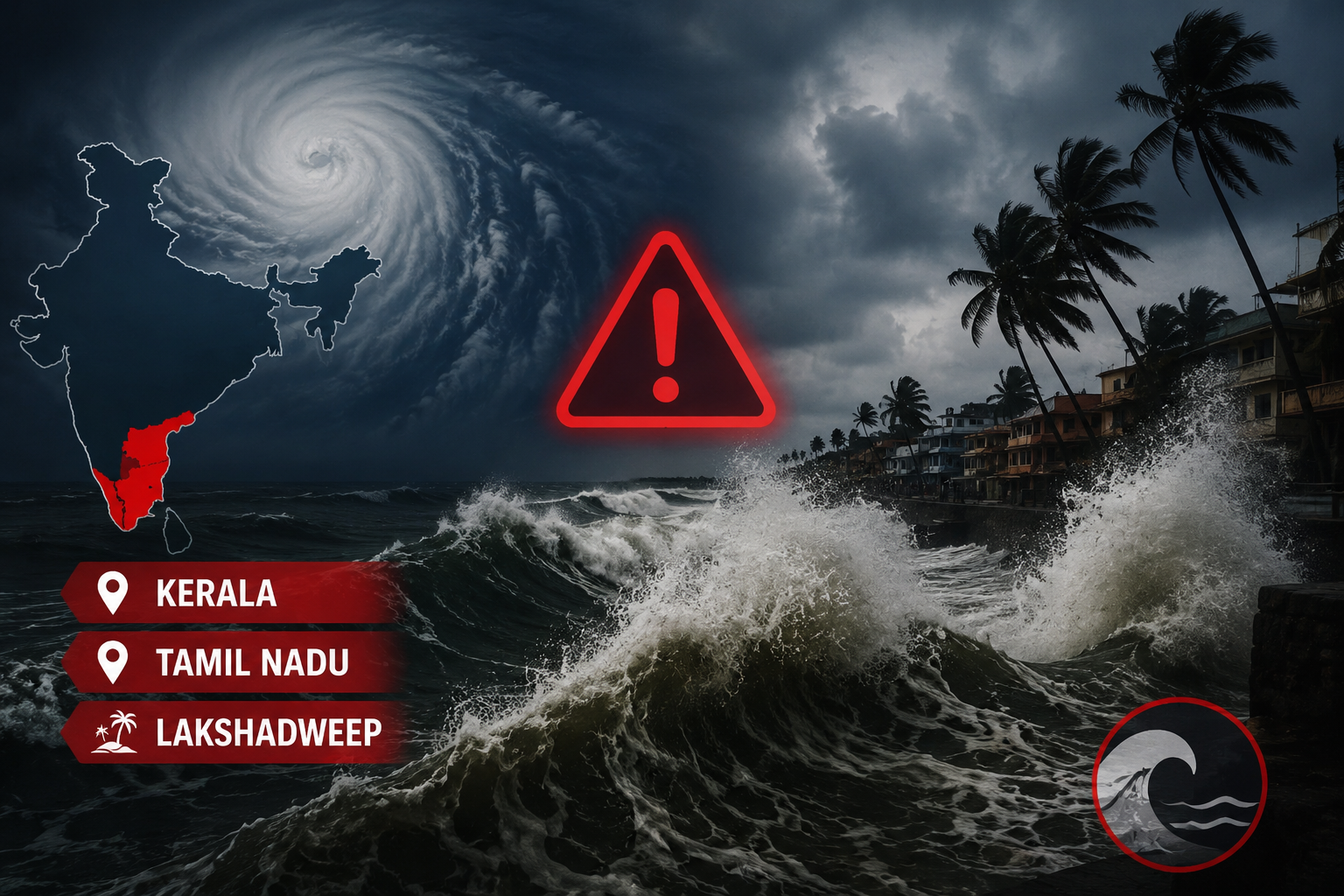
What’s Happening Right Now
Coastal communities across Kerala, southern Tamil Nadu, and the Lakshadweep Islands are on high alert after the Indian National Centre for Ocean Information Services (INCOIS) issued a swell surge warning. Fishermen have been told to keep their boats out of the water, beaches have been closed to tourists, and thousands of fishing vessels have been anchored well away from the shoreline as a safety precaution.
Locally, this phenomenon is known as Kallakkadal, a Malayalam term that roughly translates to “sea that comes like a thief.” It’s a fitting name unlike a cyclone or a monsoon storm, a swell surge gives almost no visible warning on land before it hits.
What Is a Swell Surge (Kallakkadal)?
A swell surge is fundamentally different from the wind-driven waves most people are familiar with. Ordinary waves are choppy and generated by local winds blowing over the sea surface nearby. A swell surge, on the other hand, is born from powerful storm systems far out in the ocean sometimes thousands of kilometers away and travels across open water as long, smooth, high-energy wave trains.
By the time these swells reach the Indian coastline, the sky overhead can be completely clear and the local wind calm. That’s exactly what makes the phenomenon so dangerous: there’s no storm cloud, no gusty wind, and no obvious sign that a wave surge is imminent. The threat arrives from a storm system that residents never even see.
When these long-period swells coincide with high tide, they can push seawater well beyond the normal tideline, flooding low-lying coastal areas, eroding beaches, and putting anchored boats at risk of damage or collision.
Why Kerala, Tamil Nadu, and Lakshadweep Are Especially Vulnerable
The coastlines of Kerala, southern Tamil Nadu (districts like Kanyakumari, Thoothukudi, Tirunelveli, and Ramanathapuram), and the low-lying islands of Lakshadweep sit in a geographic position that makes them regular targets for swells generated deep in the southern Indian Ocean. Many stretches of this coast are densely populated, low-elevation, and home to large fishing communities a combination that raises the stakes whenever a swell surge warning is issued.
Because these regions rely heavily on small-scale and traditional fishing, even short warning windows can disrupt livelihoods significantly, which is why authorities move quickly to advise vessels ashore.
How INCOIS Tracks and Predicts These Events
INCOIS, which operates under India’s Ministry of Earth Sciences, continuously monitors ocean conditions using satellite data, wave buoys, and oceanographic models. When it detects high-period swells building far out at sea, it can often forecast their arrival on Indian shores days in advance even though the swells themselves originate thousands of kilometers away and are invisible to anyone standing on the beach.
Once a swell surge is confirmed to be approaching, INCOIS issues graded alerts (yellow, orange, or red) to the relevant coastal states, recommending precautions that typically include:
- Suspending all recreational and tourism activity on beaches and in nearshore waters
- Keeping fishing vessels, including small country boats and mechanized craft, out of the sea
- Anchoring boats at a safe distance from one another to prevent collisions
- Advising residents of low-lying coastal areas to stay alert for sudden seawater surges
What Coastal Residents and Tourists Should Do
If you live in or are visiting an affected coastal area, the safest approach during an active swell surge alert is simple: stay away from the beach and nearshore zone entirely, even if the weather looks perfectly calm. The absence of wind or rain is not a reliable sign that the sea is safe.
Fishermen should keep vessels anchored and avoid venturing out until authorities officially lift the warning. Coastal residents in flood-prone, low-lying pockets should be ready to move temporarily if local disaster management authorities recommend evacuation.
The Bigger Picture
Swell surge events like this one are a reminder that coastal hazards don’t always come with dramatic storm clouds or howling winds. A weather system generated in a completely different ocean basin, thousands of kilometers away, can still reach India’s shores with enough force to flood streets and destroy fishing equipment all under a clear sky.
As monitoring technology improves, agencies like INCOIS are getting better at giving communities crucial lead time. But the responsibility ultimately falls on residents, fishermen, and local authorities to heed these warnings seriously, precisely because a Kallakkadal, true to its name, arrives like a thief without the visible cues people instinctively look for before venturing near the sea.
Learn more about our site archive2in.com
Contact us on our email id contactarchive2in@gmail.com
Read out our latest article on our BLOG section
Leave a Reply
You must be logged in to post a comment.