
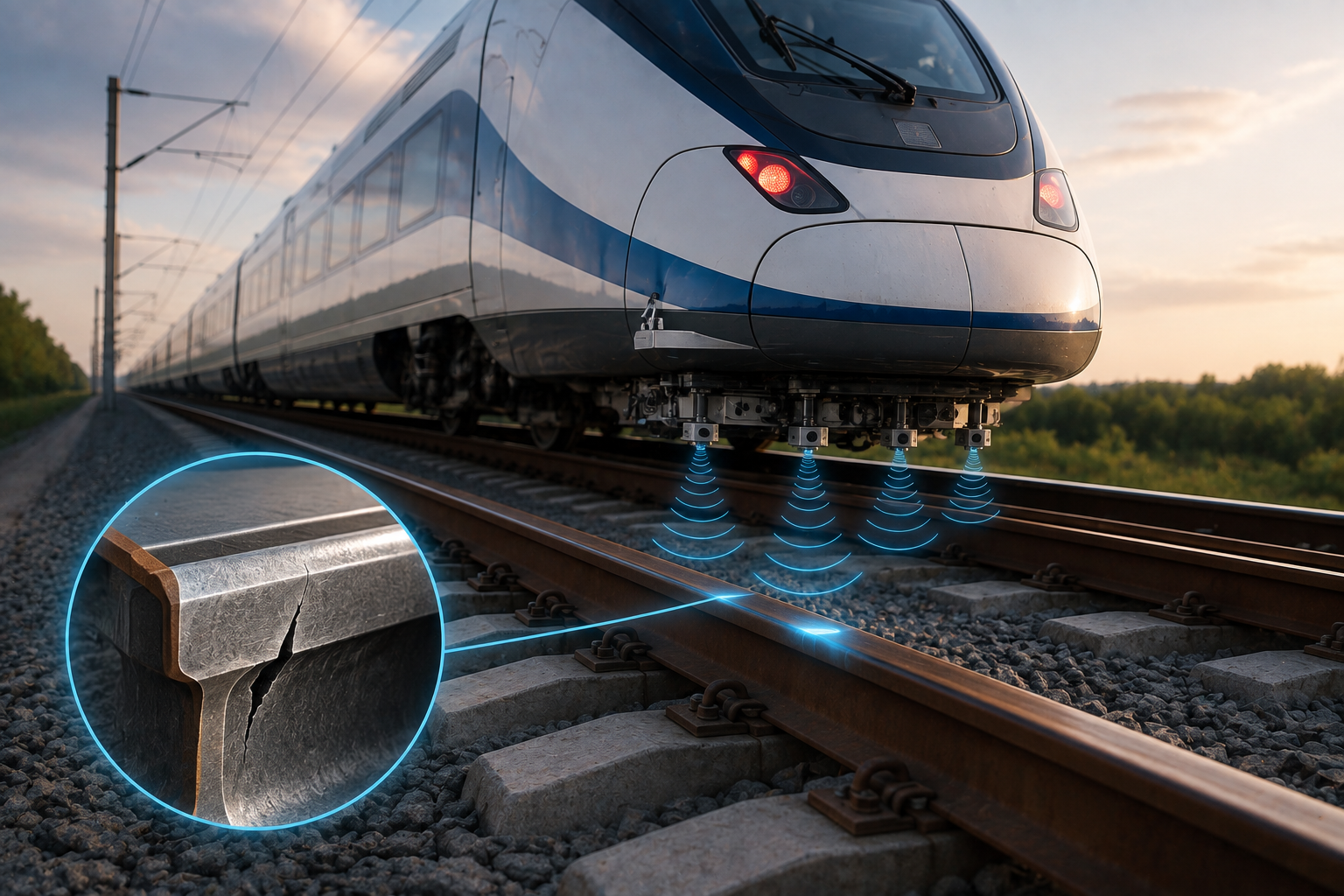
Railway tracks may look like simple pieces of steel, but tiny cracks hidden beneath their surfaces can become serious safety hazards. Detecting those flaws before they grow is one of the biggest challenges in railway maintenance.
In 2004, researchers at the University of Warwick developed a promising non-contact ultrasonic technique that could potentially detect cracks in rails while a train was travelling at high speed. The idea was striking: instead of requiring a dedicated inspection train to move slowly along the track, ordinary passenger or freight trains could potentially carry the technology and help monitor rails during normal journeys.
The technology offered a glimpse of a future in which trains themselves could become part of a continuous railway-safety network.
Why hidden rail cracks are dangerous
Rail damage isn’t always visible from the outside.
A rail can develop internal defects or cracks that gradually expand under the repeated loads produced by passing trains. If a defect becomes large enough, the rail can eventually fracture.
The problem is particularly concerning because railway networks are constantly operating. Taking tracks out of service for inspection can disrupt passenger and freight operations, while inspecting every kilometre frequently is expensive and difficult.
A 2004 review published in NDT & E International noted the important role of rail flaw detection in railway safety and described the development of different technologies designed to identify defects before they result in broken rails.
What did scientists develop in 2004?
Researchers from the University of Warwick’s Department of Physics developed a non-contact ultrasonic method for detecting and measuring rail cracks.
The system was particularly aimed at detecting gauge corner cracking, a type of rail damage that can develop around the corner of the rail head.
According to the University of Warwick’s announcement, the researchers used a specialised form of ultrasound involving low-frequency, wide-band Rayleigh waves. The approach was designed to work at speeds much higher than conventional contacting ultrasonic inspection methods.
The research was significant because traditional ultrasonic testing systems generally required direct contact with the rail and operated at much lower speeds.
Why was speed so important?
Existing ultrasonic inspection systems had limitations when railway lines needed to remain operational.
According to the 2004 research announcement, conventional ultrasonic defect detection could operate at roughly 20–30 miles per hour, while specialised inspection trains could create disruptions because they could not simply travel alongside normal rail traffic at full operating speeds.
The Warwick approach attempted to solve that problem by using a non-contact technique.
Instead of physically touching the rail, the system could potentially be mounted on a regular train.
That meant a passenger or freight train travelling along its normal route could potentially gather information about the condition of the track beneath it.
How does ultrasonic detection work?
Ultrasonic inspection relies on sound waves that travel through or interact with materials.
When the waves encounter a change in the rail — such as a crack or internal defect — the signal can change. Analysing those changes can provide information about whether a flaw is present and potentially where it is located.
The 2004 system used Rayleigh waves, which travel along the surface of a solid material. The researchers designed the technique to detect the effects of cracks without requiring a sensor to physically contact the rail.
In simple terms, the technology attempted to “listen” to the rail using ultrasound and identify abnormalities in the resulting signal.
Could every train become a rail inspector?
That was one of the most exciting possibilities raised by the research.
If the technology could be attached to normal passenger and freight trains, a large number of trains could potentially collect rail-condition information as they travelled.
Instead of relying solely on occasional dedicated inspection runs, railway operators could potentially gather information much more frequently.
The University of Warwick described the concept as having the potential to turn trains into part of a 24-hour rail crack-detection network.
That concept is particularly powerful for large railway systems, where tracks stretch across thousands of kilometres.
But the technology wasn’t a magic solution
It is important not to interpret the 2004 research as meaning that every train immediately gained the ability to detect every type of rail defect.
Rail inspection is complicated, and different technologies have different strengths and limitations.
A Canadian Transportation Safety Board investigation released in December 2004, for example, found that ultrasonic rail testing and hi-rail inspections had failed to identify an internal defect that later contributed to a rail fracture. The report noted that the defect may have been too small to detect during the previous ultrasonic test.
That illustrates an important point: even sophisticated inspection systems are not infallible.
Railway safety therefore depends on multiple layers of inspection, maintenance, engineering controls and operational procedures.
Why the 2004 idea still matters
The Warwick research demonstrated an important principle: railway inspection does not necessarily have to mean stopping trains or sending specialised vehicles down every track.
The possibility of combining high-speed travel with non-contact sensing opened a path towards more frequent and less disruptive monitoring.
The US Federal Railroad Administration also published a 2004 technical report on online high-speed rail-defect detection, covering technologies including ultrasonic guided waves, non-contact ultrasonic testing, laser ultrasonics and air-coupled sensors.
Modern railway inspection has continued to develop, with increasingly sophisticated sensors, automated analysis and computer-based detection systems.
From inspection trains to smarter railways
The most fascinating part of the 2004 breakthrough isn’t simply the ability to detect a crack.
It’s the idea of turning ordinary railway operations into an opportunity for continuous monitoring.
A train travelling its normal route could potentially collect valuable information about the infrastructure beneath it without requiring the railway to stop regular services.
More than two decades later, that idea remains relevant as rail operators look for ways to make inspection more frequent, automated and predictive.
The lesson from the 2004 research is simple: sometimes the smartest safety technology isn’t about stopping the railway to inspect it — it’s about finding a way to inspect the railway while it keeps moving.
Disclaimer
This article is intended for general informational and educational purposes. The technology discussed was a research development reported in 2004 and should not be interpreted as proof that all modern trains automatically detect every hidden rail defect. Rail-inspection capabilities vary by railway, equipment and defect type. Railway operators use multiple inspection and maintenance methods, and ultrasonic systems also have limitations.
learn more about our site on contactarchive2in.com
Contact us on our email id contactarchive2in@gmail.com
Leave a Reply
You must be logged in to post a comment.