
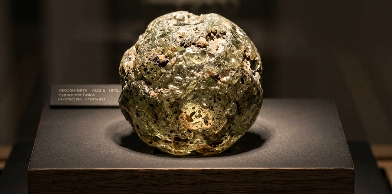
On August 6, 1945, an atomic bomb exploded above Hiroshima, unleashing temperatures and pressures capable of transforming the city’s buildings, metals, glass, soil and water in an instant. The human cost was catastrophic. Yet, more than eight decades later, scientists examining tiny remnants of that event have uncovered another extraordinary consequence: a previously unknown multicomponent alloy preserved inside microscopic glass particles.
The discovery, reported in Science Advances in 2026, offers a remarkable glimpse into the extreme physical and chemical conditions that existed for only fractions of a second during the Hiroshima explosion.
Tiny Glass Spheres Carry an Extraordinary Secret
The material was found in glassy particles known as hiroshimaites, which were recovered from beach sands around Hiroshima Bay. Earlier research had established that these unusual particles formed from materials thrown into the fireball during the 1945 bombing. As the vaporized and molten material expanded, mixed and rapidly cooled, it condensed into tiny spherical and aerodynamically shaped grains.
Researchers studying these particles with modern microscopes noticed microscopic metallic grains trapped inside the glass. Out of 34 examined particles, one contained a particularly unusual metallic phase. Detailed chemical and crystallographic analysis revealed that it was not simply another ordinary piece of bomb debris.
Instead, it represented a previously unknown multicomponent alloy.
The alloy contains iron, chromium, nickel, manganese, molybdenum, silicon and aluminum. More remarkable than its chemical recipe, however, is the way those atoms are arranged.
A Crystal Structure Scientists Had Not Seen Before
According to the researchers, the microscopic alloy crystallizes in the P2₁3 space group and possesses an ordered AlAu₄-type structure, which is related to the structure of beta-manganese. The study describes this as a previously unknown crystal structure within this family of multicomponent materials.
This does not mean that Hiroshima produced a completely new chemical element. Rather, the extraordinary finding is a new combination and atomic arrangement of familiar elements.
That distinction is important. In materials science, the way atoms are organized can dramatically influence a material’s properties. Multicomponent alloys are of particular interest because combining several elements can produce unusual combinations of strength, heat resistance, corrosion resistance and other characteristics. Researchers therefore believe that studying such naturally created structures could eventually provide inspiration for designing new materials.
How Could an Atomic Explosion Create It?
The leading explanation is surprisingly simple in principle, even if the actual physics is extraordinarily complex: vaporization followed by extremely rapid condensation and cooling.
The Hiroshima fireball created an environment unlike ordinary industrial furnaces or laboratories. Materials from the urban landscape were transformed into vapor and molten droplets. As the fireball expanded, the temperature and pressure changed extremely rapidly.
Metallic vapors containing different elements could therefore mix before cooling almost instantaneously. Instead of slowly forming familiar structures under normal conditions, the atoms became locked into an unusual arrangement as the material solidified.
The researchers describe the process as condensation from a mixed metallic vapor followed by ultrafast quenching. In effect, the explosion briefly became an extreme materials-processing laboratory.
Hiroshima’s Glass Is More Than Debris
The discovery builds on earlier research showing that Hiroshima’s glassy fallout contains an extraordinary chemical record of the explosion.
Studies of beach-sand particles have identified combinations of aluminum, silicon, calcium and iron, along with microscopic mineral and metallic phases. Their shapes and compositions indicate formation at temperatures exceeding roughly 1,800°C in some portions of the process.
The newest discovery goes further. It demonstrates that these tiny particles can preserve not merely evidence that materials melted, but information about how atoms reorganized while the fireball was expanding and cooling.
A particle only a few micrometers across can therefore function as a microscopic archive of an event that occurred 81 years ago and lasted only moments.
A Discovery With a Scientific Precedent
This is not the first time researchers have found an unexpected material associated with a nuclear explosion.
At the 1945 Trinity test in New Mexico, the first nuclear weapon detonation produced a glassy material known as trinitite. In 2021, scientists reported an unusual icosahedral quasicrystal inside a piece of red trinitite. That material incorporated elements associated with the bomb and its surroundings and became the oldest known human-made quasicrystal with a precisely documented origin.
The Hiroshima discovery is different—the newly identified alloy is not a quasicrystal—but the two findings demonstrate the same broader principle: extreme, short-lived events can create structures that ordinary geological or industrial processes rarely produce.
Why the Discovery Matters
The significance of the Hiroshima alloy extends beyond its connection to history.
Scientists are increasingly interested in materials that form under extreme nonequilibrium conditions because they can reveal structures that conventional manufacturing may overlook. The researchers suggest that blast-derived materials could serve as natural laboratories for studying rapid alloy formation and could inspire future investigations into advanced materials.
There is also a nuclear-forensics dimension. Glassy particles formed by nuclear explosions can preserve clues about the materials involved, the conditions inside the fireball and the processes that occurred during cooling. Such evidence could potentially help scientists reconstruct characteristics of historical nuclear events.
Yet the most striking aspect of the discovery may be its paradox.
An event remembered primarily for unprecedented destruction has left behind microscopic structures that are now helping scientists understand matter under conditions impossible to reproduce easily.
More than eight decades after Hiroshima, those tiny glass spheres continue to tell a story—not of technological triumph, but of how profoundly an extreme event can transform the physical world.
Disclaimer
This article is intended for educational and informational purposes only. It summarizes findings reported in scientific research and reputable reporting available in 2026. The discovery of the alloy should not be interpreted as evidence that the material has useful commercial or technological applications at present. The Hiroshima bombing caused immense loss of life and suffering, and discussion of its scientific aftermath should not diminish its profound humanitarian and historical significance. Scientific interpretations may also evolve as additional samples and analyses become available.
Learn more about our site on contactarchive2in.com
Contact us on our email id contactarchive2in@gmail.com
Leave a Reply
You must be logged in to post a comment.