
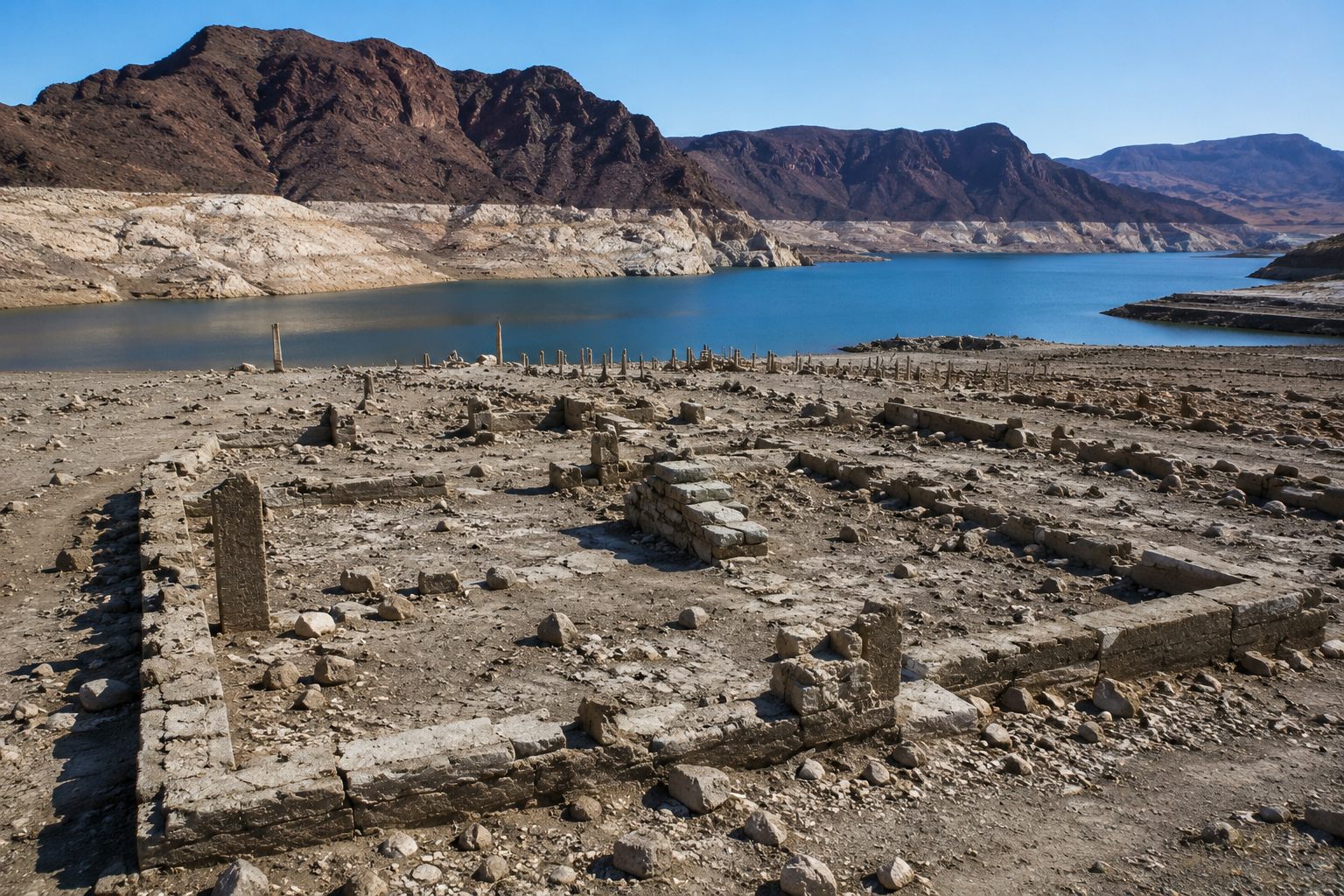
For decades, the remains of a small American town lay hidden beneath the waters of Lake Mead. Streets, foundations and traces of homes that once belonged to a thriving desert community disappeared after the construction of Hoover Dam transformed the landscape.
Now, as Lake Mead reaches historically low levels, parts of that forgotten settlement are once again visible.
The town is St. Thomas, Nevada, a former Mormon settlement that was gradually submerged when Lake Mead filled in the 1930s. The National Park Service says that, at the lake’s high-water mark, St. Thomas was about 60 feet below the surface. Today, visitors can walk through parts of its exposed ruins.
A town built in the desert
St. Thomas was established by Mormon settlers in the 1860s and eventually became a small but active community.
Its location near the Muddy River made farming possible in an otherwise harsh desert environment. Over time, the settlement developed homes, farms, stores, a school, a post office and other businesses.
At its peak, St. Thomas had a population of around 500 people, according to the National Park Service. It also became an important stopping point for travellers moving through the region.
For the people who lived there, St. Thomas was not simply a collection of buildings. It was a community where families worked, children went to school and residents built their lives in the Nevada desert.
But the town’s future changed dramatically when the United States began building what was then called Boulder Dam, now known as Hoover Dam.
Hoover Dam changed everything
The construction of Hoover Dam in the 1930s was one of the largest engineering projects in American history.
The dam was designed to control the Colorado River, provide water storage, support irrigation and generate electricity. Its construction also created a huge reservoir—Lake Mead.
As the reservoir began filling in 1935, water gradually spread into areas that had previously been dry, including the St. Thomas settlement. Residents were informed that they would need to leave and were compensated for their property.
Homes were dismantled, crops were abandoned and families moved away.
The last resident to leave was Hugh Lord, who reportedly rowed away from his home on June 11, 1938, as the rising water reached his property.
Soon afterward, St. Thomas disappeared beneath Lake Mead.
The town was not forgotten
Although the water covered the settlement, St. Thomas was never completely erased.
Changes in Lake Mead’s water level have caused the remains to appear and disappear several times. Former residents and their families even held reunions at the site in 1945, 1963 and 2012, according to the National Park Service.
When water levels fall sufficiently, old roads and building foundations become visible again.
Visitors can now walk along portions of what were once the streets of the community, offering a remarkable connection to Nevada’s past.
Why is St. Thomas visible again?
The latest reappearance is linked to the dramatic decline in Lake Mead’s water level.
The reservoir has been affected by a combination of prolonged drought, reduced water inflows, extreme heat and high demand for Colorado River water.
In August 2026, Lake Mead reached a record-low elevation of approximately 1,040.4 feet above sea level, surpassing the previous record set in 2022.
That decline has exposed parts of the landscape that have been underwater for decades.
St. Thomas is one of the most striking examples because the remains are recognizable enough to reveal the outline of the former community.
A fascinating discovery with a serious warning
The resurfacing of St. Thomas may look like an extraordinary archaeological discovery, but it is also a visible reminder of the water crisis facing the American Southwest.
Lake Mead is a critical component of the Colorado River system, which supplies water to tens of millions of people across the southwestern United States and Mexico.
Its declining water level affects much more than tourism.
Lower reservoir levels can create challenges for water supplies, agriculture, ecosystems and hydroelectric power generation. Recent reports have described the reservoir’s decline as part of a much broader Colorado River crisis.
In that sense, St. Thomas is both a window into the past and a warning about the future.
What can visitors see today?
Those visiting Lake Mead National Recreation Area can reach the St. Thomas area and explore the exposed remains.
The National Park Service says visitors can follow a roughly three-mile trail loop through the former town site. Remnants include foundations, roads and other traces of the community.
However, visitors are asked not to disturb or remove historical objects. The ruins are protected as an important cultural and historic resource.
A ghost town emerging from a modern water crisis
St. Thomas tells an unusual American story.
A community once disappeared because the country needed a massive reservoir for water and power. Nearly a century later, the same reservoir’s declining water level is allowing that community to emerge again.
The exposed ruins provide a rare glimpse of a town that was deliberately abandoned rather than destroyed by war or natural disaster.
But the sight also carries a deeper message. The water revealing St. Thomas is the same water resource on which millions of people depend.
As Lake Mead continues to face pressure from drought, climate change and growing demand, the return of St. Thomas is more than a fascinating historical phenomenon. It is a visible reminder of how dramatically the American West—and its relationship with water—has changed.
Disclaimer
This article is intended for general informational and educational purposes. Lake Mead’s water levels can change continuously, and conditions at the St. Thomas site may vary. Historical details and water-level figures are based on information available from the National Park Service and reputable news reports at the time of publication. Visitors should follow all Lake Mead National Recreation Area rules and avoid disturbing archaeological remains or artifacts.
Learn more about our site on contactarchive2in.com
Contact us on email id contactarchive2in@gmail.com
Leave a Reply
You must be logged in to post a comment.