
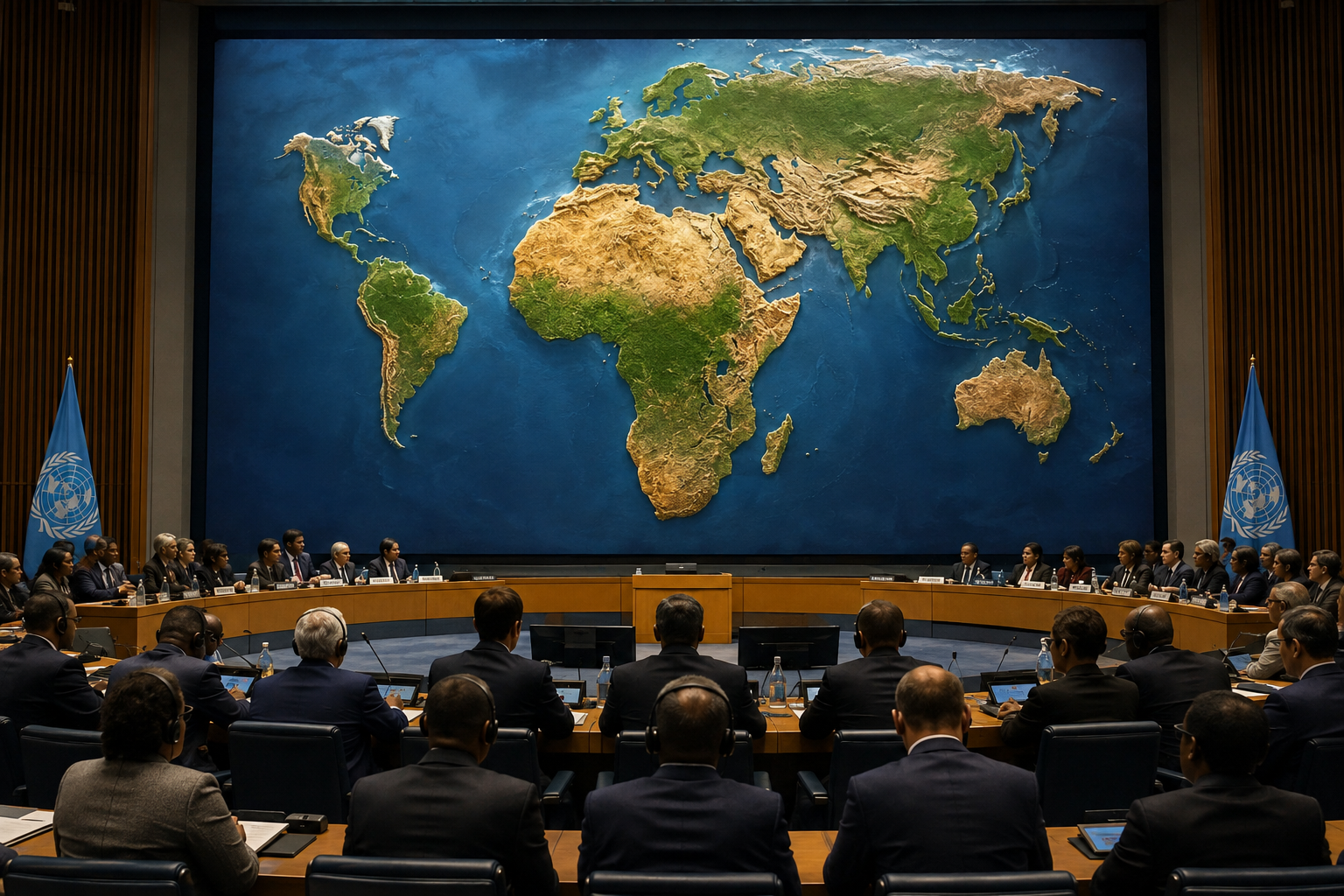
A Historic Vote at the United Nations
In a landmark decision that is reshaping how the world literally looks on paper, the United Nations General Assembly voted on Friday, September 4, 2026, to adopt a new official world map. The resolution, driven by a coalition of African nations, replaces the centuries-old Mercator projection with the more geographically accurate Equal Earth projection a map that makes Africa appear significantly larger while shrinking North America and Europe to their true relative size.
The resolution passed with overwhelming support: 164 countries voted in favor, while the United States cast the sole vote against it, and six other nations abstained.
Why Was the Mercator Map Replaced?
For more than 450 years, the world has relied on the Mercator projection, created in 1569 by Flemish cartographer Gerardus Mercator. While the map was originally designed to help sailors navigate the seas, it came with a major flaw: it dramatically distorts the size of landmasses near the poles while shrinking those near the equator.
This means that on a traditional Mercator map:
- North America, Europe, and Greenland appear far larger than they actually are.
- Africa, South America, and Southeast Asia appear much smaller than reality.
To put it in perspective, Greenland has often looked nearly the same size as Africa on Mercator maps but in truth, Africa is about 14 times larger than Greenland.
What Is the Equal Earth Projection?
The Equal Earth projection, developed by a team of cartographers in 2018, corrects this long-standing distortion. It preserves the true relative surface area of every continent while keeping their shapes close to how they appear on an actual globe.
Under this new map:
- Africa, Latin America, South Asia, and Oceania appear noticeably larger and more accurate.
- North America and Europe shrink to reflect their real proportional size.
According to the resolution text, the goal is to achieve “a more accurate representation” of the world’s continents and to move member states away from a projection that was never meant to represent land area fairly in the first place.
Who Led the Push for Change?
The resolution was spearheaded by African nations, with Togo’s Foreign Minister Robert Dussey playing a leading role. He argued that maps are far from neutral tools, stating that they “guide education, nourish the imagination, and influence collective perceptions.” A distorted map, he warned, risks perpetuating inaccurate representations that get passed down through generations.
The campaign also gained major institutional backing earlier this year when the African Union, representing 55 member states, officially endorsed the push to replace the Mercator map, calling it a step toward “reclaiming Africa’s rightful place on the global stage.”
France emerged as a key co-sponsor of the resolution. Following the vote, French Foreign Minister Jean-Noël Barrot announced that France would formally abandon the Mercator projection, noting that it gives the United States, Russia, and China a “disproportionate visual prominence” compared to Africa, Latin America, or Southeast Asia. He added that while changing a map doesn’t change the world itself, correcting a distorted representation is an important step toward presenting a more accurate picture of it.
Why Did the US Vote Against It?
The United States was the only country to vote against the resolution. Washington’s position reflects a broader skepticism toward the initiative, with US officials suggesting the United Nations should instead “focus on genuine problems” rather than symbolic gestures like changing cartographic standards.
This stance places the US at odds with nearly every other UN member state on the issue, highlighting a notable diplomatic split over how much weight symbolic and educational reforms like correcting long-standing geographic misconceptions should carry on the world stage.
Why This Matters Beyond Cartography
Maps are more than navigational tools they shape perception. Generations of students, policymakers, and everyday people have grown up viewing a world where wealthy northern nations appear physically dominant, while regions like Africa and South America look smaller and, by extension, less significant.
Supporters of the Equal Earth projection argue that this shift is not just about accuracy — it’s about correcting a subtle but powerful narrative that has influenced global politics, education, and even investment decisions for centuries.
Tech platforms have already been moving in this direction. Google Maps, for instance, switched to a 3D globe view on desktop back in 2018, though the Mercator projection remains the default on its mobile app.
What Happens Next?
While the UN resolution is not legally binding, it urges member states, schools, and institutions to adopt the Equal Earth projection in place of the Mercator map. With France already committing to the switch and growing momentum from campaigns like “Correct The Map,” more countries and organizations including bodies like the World Bank, which has already begun phasing out Mercator on its web maps are expected to follow suit in the coming months.
Whether this leads to a permanent shift in how the world visualizes itself remains to be seen, but for now, the vote marks one of the most significant symbolic changes in global cartography in decades.
Key Takeaways
- The UN General Assembly adopted the Equal Earth projection, replacing the 456-year-old Mercator map.
- The resolution passed 164–1, with the US as the only country voting against it, and six abstentions.
- The Equal Earth map makes Africa, Latin America, and Southeast Asia larger, while North America and Europe appear smaller reflecting true proportional size.
- Togo led the resolution; the African Union and France were major backers.
- The US opposition was framed around wanting the UN to prioritize more pressing global issues.
Learn more about our site on contactarchive2in.com
Contact us on our email id contactarchive2in@gmail.com
Read out our latest blogs on our pages.click the link
Leave a Reply
You must be logged in to post a comment.