
Introduction
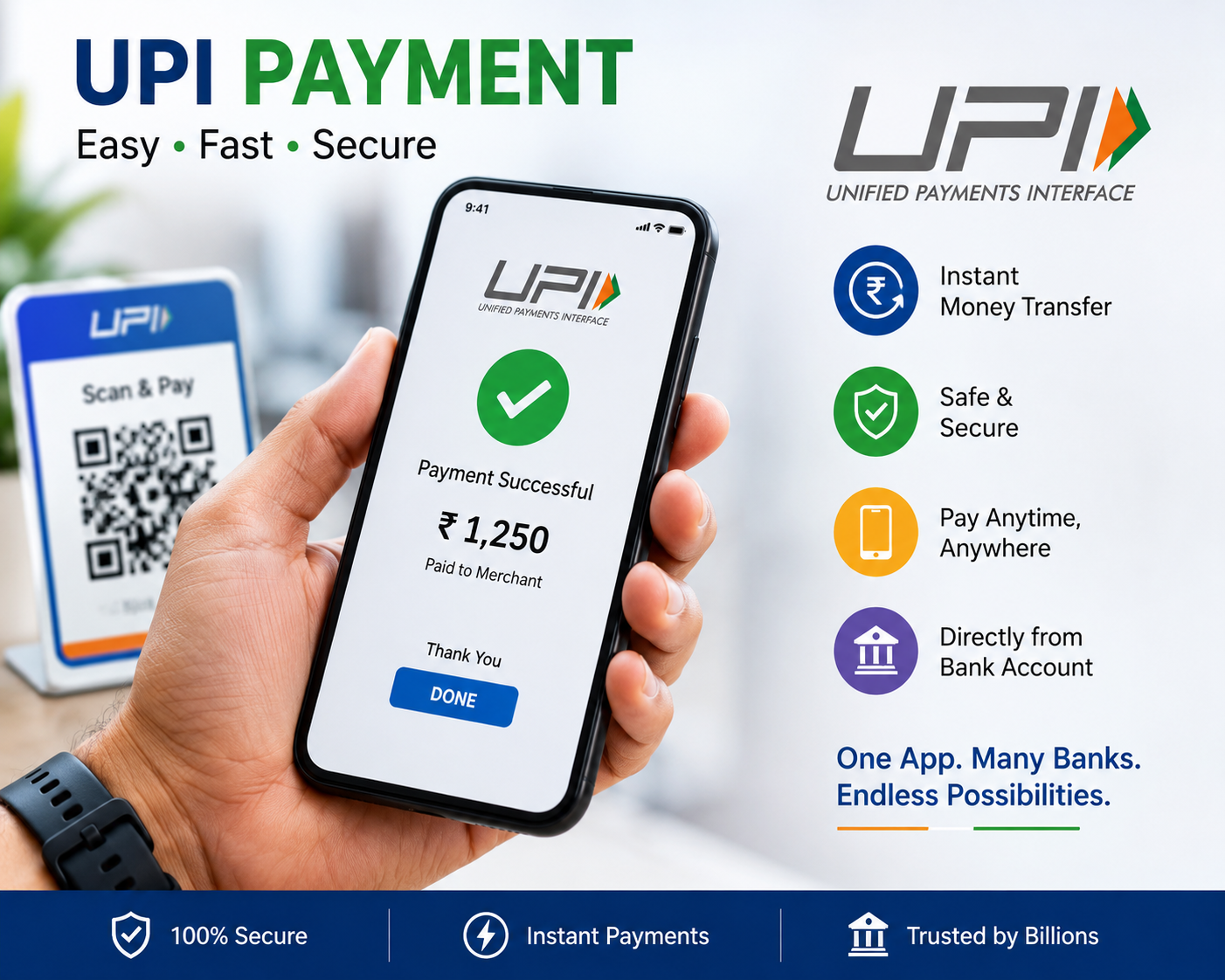
In today’s digital age, carrying cash has become almost a thing of the past. Everyone now sends and receives money straight from their phone, and the biggest driver behind this revolution is UPI (Unified Payments Interface). In this article, we’ll explore what is upi , how it works, and why it has become so important for India here is a digital guides for beginners
What is UPI?
what is UPI ?is a real-time payment system developed by the National Payments Corporation of India (NPCI). It allows multiple bank accounts to be linked to a single mobile application, enabling fund transfers, merchant payments, and peer-to-peer transactions within seconds without needing to enter account numbers or IFSC codes.
How Does UPI Work?
The entire UPI process works like this:
-
- Download a UPI App – Google Pay, PhonePe, Paytm, BHIM, or your bank’s official app.
-
- Link Your Bank Account – register the mobile number linked to your bank account.
-
- Set a UPI PIN – create a secure 4-6 digit PIN used for every transaction.
-
- Create a VPA (Virtual Payment Address) – something like
yourname@upi, which people can use to send you money.
- Create a VPA (Virtual Payment Address) – something like
-
- Make Transactions – scan a QR code or enter a VPA/mobile number to send money, then confirm with your UPI PIN.
Benefits of UPI
-
- Instant Transfers – money moves within seconds, anytime, 24×7.
-
- Zero or Minimal Charges – most personal transactions are free.
-
- No Need for Bank Details – just a mobile number or QR code is enough.
-
- Multiple Bank Accounts, One App – manage all your accounts from a single app.
-
- High Security – two-factor authentication and encryption keep transactions safe.
Where is UPI Used?
-
- Online shopping and bill payments
-
- Payments to local shops and street vendors
-
- Sending money to friends and family
-
- Mobile recharge, DTH, and utility bills
- Fund transfers on investment platforms

The Takeaway
UPI is a rare example of public digital infrastructure actually working at scale — free for consumers, low-cost for merchants, and built on an open standard rather than a single company’s walled garden. Whether that model is exportable elsewhere is one of the more interesting open questions in fintech right now. But inside India, the debate is basically over: UPI didn’t just change how people pay. It became the plumbing the entire economy now runs on.
Who’s Actually Moving the Money
Despite dozens of apps sitting on top of UPI, the market is heavily concentrated. PhonePe and Google Pay together handle somewhere in the neighborhood of 85% of all transaction volume, with PhonePe consistently in the lead at roughly 48%. Paytm trails at around 6–8%, and everyone else — CRED, BHIM, Amazon Pay, and newer entrants like Navi and super.money — splits the remainder. NPCI has floated a 30% market-share cap per app to keep the ecosystem from becoming a duopoly, though implementation has been repeatedly delayed.
Where It’s Headed
A few threads worth watching:
- Going global. UPI already works in a handful of countries — Sri Lanka, Singapore, UAE, Mauritius, Bhutan, Nepal — and NPCI has talked about expanding further into the Gulf and East Asia, positioning UPI-style rails as an export, not just a domestic tool.
- Offline and low-connectivity access. UPI Lite now supports offline transactions up to a set limit, aimed at users in areas with patchy connectivity.
- Credit on UPI. RuPay credit cards linked to UPI have expanded meaningfully, which starts to blur the line between a payments network and a lending one.
- Subscriptions and recurring payments. what is UPI Autopay? and how it will become a digital payment guides for beginners is quietly becoming the backbone for recurring debits — OTT subscriptions, SIPs, insurance premiums — the kind of thing that used to require standing instructions or manual renewals.
UPI vs Traditional Banking Methods
Compared to traditional methods like NEFT, RTGS, and IMPS, UPI is much faster, simpler, and more user-friendly. While NEFT transactions sometimes took hours, UPI transactions are instant without the need to fill out any complex forms.
Conclusion
UPI has given a new direction to digital payments in India. Whether it’s a small shopkeeper or a large business, you will also taking a help of Artificial intelligence UPI has proven to be a game-changer for everyone. If you haven’t started using UPI yet, give it a try it will make your daily life a lot easier and these are these are the above payments guides for beginners
Leave a Reply
You must be logged in to post a comment.