
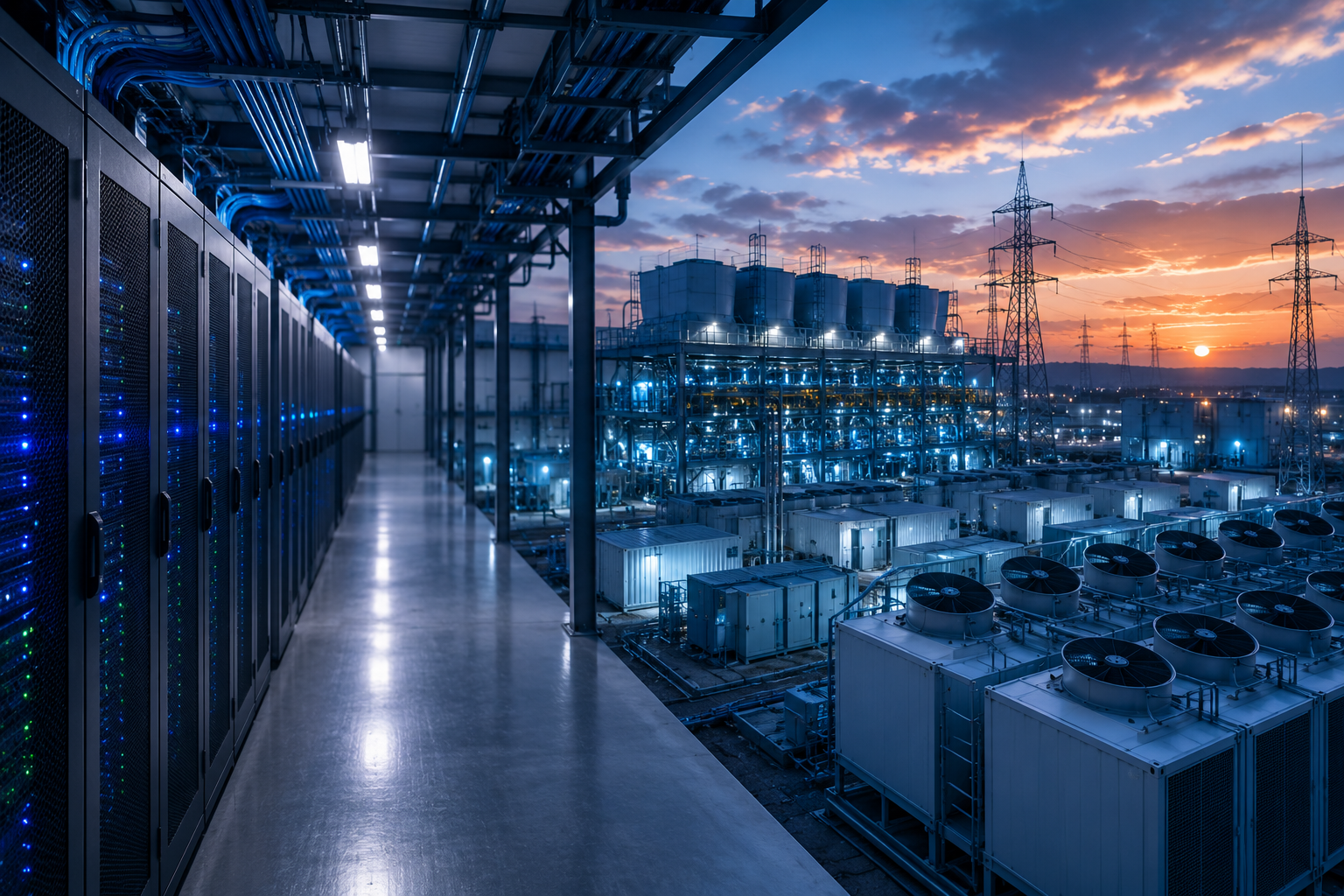
Artificial intelligence may look like a software revolution, but behind every chatbot, AI assistant and image generator is something much more physical: enormous data tech centres packed with specialised chips, servers, cooling systems and power infrastructure.
That is why some of the world’s biggest technology companies are spending extraordinary amounts of money to expand their AI infrastructure.
Alphabet, Amazon, Microsoft and Meta are all investing heavily in computing capacity. Alphabet alone expects $180 billion to $190 billion in capital expenditure in 2026, with the overwhelming majority going toward technical infrastructure. The company has also said its 2027 capital spending is expected to increase significantly further.
So why are technology companies willing to spend billions on buildings and machines instead of simply developing better software?
AI needs enormous computing power
Traditional software can often run on relatively modest computing infrastructure. Modern AI is different.
Training large AI models requires thousands of specialised processors working together. Once a model is released, millions of users can simultaneously ask it questions, generate images, analyse documents or perform other tasks.
Every one of those requests requires computing resources.
This means companies need enormous amounts of GPU and AI accelerator capacity to train and operate their systems.
Microsoft, for example, announced a new data-centre campus in Pecos, Texas, that will add approximately 2 gigawatts of capacity to its global data-centre infrastructure. The company described the multibillion-dollar project as a response to sustained demand for AI and cloud services.
The AI race is also a cloud race
There is another major reason for the spending: AI is becoming a huge business opportunity for cloud providers.
Companies such as Microsoft Azure, Amazon Web Services and Google Cloud can rent computing power to businesses that don’t want to build their own AI infrastructure.
As companies adopt AI for customer service, software development, research, marketing and data analysis, demand for cloud computing can increase.
Amazon CEO Andy Jassy has described AI as a major technological shift and argued that companies need to invest aggressively when such large opportunities emerge.
For Big Tech, therefore, building data centres isn’t simply about running their own AI chatbots. It is also about selling AI computing capacity to thousands of other companies.
Why can’t companies simply use existing data centers?
AI workloads place unusual demands on infrastructure.
Modern AI systems require powerful processors that generate considerable heat. Data centres therefore need sophisticated cooling systems, high-capacity electrical connections and specialised networking equipment.
The physical infrastructure must also be designed to accommodate enormous concentrations of computing power.
Microsoft says its latest infrastructure strategy is evolving because AI workloads are scaling rapidly and require different approaches to performance, cost and energy efficiency.
This explains why simply adding a few more servers to an existing facility isn’t always enough.
Electricity has become a critical issue
One of the biggest challenges facing the AI industry is not just computing hardware—it is electricity.
Large AI data centres can require power on a scale comparable to that of sizeable industrial facilities.
As more data centres are built, technology companies are increasingly competing for electricity connections and suitable locations.
Recent research has warned that the concentration of AI data centres could create significant regional pressure on electricity systems, particularly in areas where infrastructure cannot expand quickly enough.
This has turned electricity availability into a strategic consideration for the technology industry.
A company may have enough money to buy thousands of AI chips, but without sufficient power, those chips cannot be used effectively.
AI infrastructure is becoming a global competition
The spending race is not limited to the United States.
Technology companies are also expanding AI infrastructure in countries where demand for cloud services and AI products is growing.
In June 2026, Meta announced an agreement with Reliance Industries to lease an AI-enabled data centre in Jamnagar, Gujarat, describing it as the company’s first AI-enabled data centre in India. Meta said the facility would help scale its AI infrastructure and support its products in one of its largest global communities.
Amazon has also announced an additional $13 billion investment in India to expand AI and cloud infrastructure, taking its planned investment in the country to $48 billion between 2026 and 2030.
For countries such as India, this could mean more data-centre construction, cloud capacity and demand for skilled technology and infrastructure workers.
Why are companies spending so much?
There are several reasons behind the enormous investments:
1. AI demand is growing
More consumers and businesses are using generative AI, AI agents and other machine-learning applications.
2. Computing capacity can become a competitive advantage
A company with access to more advanced computing infrastructure can potentially train and deploy AI systems faster.
3. Cloud customers are demanding AI services
Businesses increasingly want AI capabilities without building their own expensive infrastructure.
4. AI hardware has a short competitive cycle
Companies cannot assume today’s processors will remain the most efficient for years. They need to continuously upgrade their computing infrastructure.
5. Infrastructure takes years to build
A large data centre cannot be constructed overnight. Companies therefore need to anticipate future demand rather than wait until capacity becomes scarce.
But there are risks
Spending billions on AI infrastructure does not guarantee that the investment will generate equivalent returns.
AI companies face enormous costs for chips, electricity, construction, networking, cooling and maintenance.
There are also questions about whether AI demand will grow quickly enough to justify the infrastructure being built today.
Financial markets have therefore begun paying close attention to the enormous capital expenditures of Big Tech.
Recent reporting has highlighted the scale of future data-centre commitments and the increasing use of financing and long-term leases to secure AI capacity.
What does the AI data-centre boom mean for ordinary people?
The effects could extend far beyond technology companies.
More data centres could create construction and engineering jobs, increase demand for electricity and renewable-energy projects, and accelerate investment in power grids.
At the same time, communities may face concerns about electricity consumption, land use, water requirements and environmental impact.
The AI revolution is therefore becoming an infrastructure story as much as a software story.
The bigger picture
The extraordinary spending on AI data centres reflects a simple reality: AI requires physical infrastructure.
Every AI-generated answer, image, video or business application ultimately depends on servers somewhere in the world.
Big Tech companies are betting that demand for AI will continue growing rapidly enough to justify today’s enormous investments.
Whether that bet pays off remains to be seen.
But one thing is already clear: the AI race is no longer happening only inside laboratories and software companies. It is being built in data centres, power plants, semiconductor factories and massive infrastructure projects around the world.
Disclaimer
This article is intended for general informational and educational purposes. Investment figures and company plans can change, and capital expenditure does not guarantee future profits or returns. Readers should consult official company disclosures and reliable financial sources before making investment decisions based on this inform
Learn more about our site on contactarchive2in.com
Contact us on our email id contactarchive2in@gmail.com
Leave a Reply
You must be logged in to post a comment.